

World Scientists and Thinkers in the Reign of King Rama IV
The Pioneer
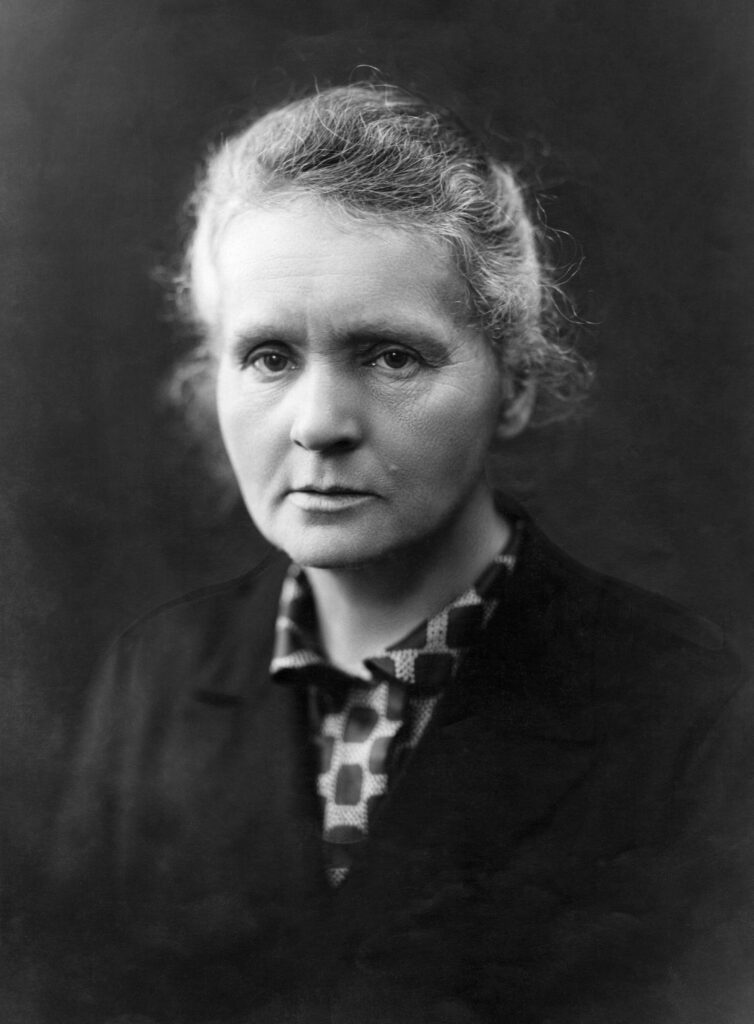
Marie Curie
A woman who received the Nobel Prize twice, she was a chemist who discovered the elements polonium and radium. She conducted extensive research on radium and was able to apply radium radiation to the treatment of cancer in its early stages. This was regarded as an important application of chemical science that was highly esteemed for its contribution to the preservation of human life. She and her husband also discovered the phenomenon of radioactivity, and she became the first female professor at the University of Paris.
Table of content
Family background
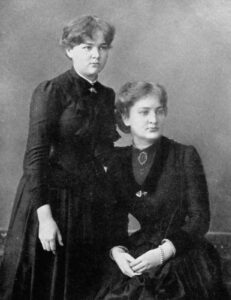
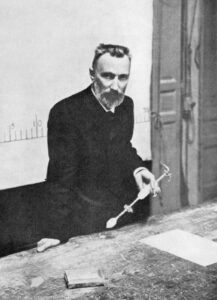
Marie Curie was born on November 7, 1867, in Warsaw, Poland. Before her marriage to Pierre Curie, her name was Maria Sklodowska. Her father, Wladyslaw Sklodowski, was a science and mathematics teacher at a secondary school in Warsaw. He often took her to the school’s science laboratory, which fostered her interest in science from an early age, despite the prevailing social values of the time that emphasized women preparing to become homemakers. After completing her basic education, Marie and her elder sister, Bronya (Bronislawa), worked as teachers at a kindergarten and gave private lessons to children in their neighborhood. Because Poland was under Russian rule, the two sisters faced financial hardship and difficult living conditions. Nevertheless, they did not abandon their ambition to pursue further studies in France. They agreed to take turns working and supporting one another’s education: once Bronya completed her studies and found employment, she would support Marie in continuing her education in science. In 1891, Marie traveled to France to study science at the University of Paris. This opportunity led her to meet Pierre Curie, a lecturer and laboratory supervisor at the University of Paris. Sharing similar life experiences and a mutual passion for science, Pierre and Marie decided to marry in 1895.
Major discoveries
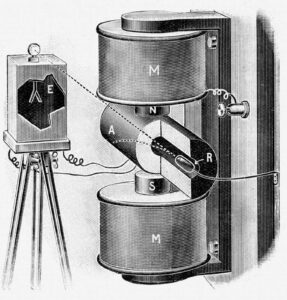
At that time, many scientists were conducting experiments and discovering various kinds of radiation. For example, in 1879 William Crookes discovered cathode rays. In 1895 Wilhelm Konrad Roentgen discovered X-rays, and Antoine Henri Becquerel, a close friend of Pierre Curie, discovered radioactivity from uranium ore. From the discoveries of these scientists, Marie conceived the idea of experimenting to find radioactivity in other minerals. She therefore tested for uranium radiation by grinding elements into a fine powder and sprinkling them onto photographic plates in a dark room to prevent exposure to light. The plates were then developed; if black spots appeared on the film, it indicated that the element was capable of emitting radiation. In addition, radiation could also be detected using an electroscope. Marie collaborated with her husband, Pierre Curie, to search for radioactive emissions from elements other than uranium.
Marie tested almost every known element for uranium radiation, including both elements that contained uranium compounds and those that did not. From these tests, she found that elements containing uranium compounds were capable of emitting uranium radiation, but only with very weak intensity, and the uranium itself could not be isolated. Nevertheless, Marie did not give up. She continued to search for and separate many other elements. She spent many years testing minerals, and eventually discovered that pitchblende, a hard black mineral that is an oxide of uranium ore, emitted radiation several times stronger than uranium itself. This strong radiation from pitchblende was due to the presence of other elements mixed within it. As a result, Marie discovered two new elements: “polonium,” which emits radiation but cannot be seen with the naked eye, and “radium,” which is silver in color, emits radiation, and can be seen glowing in the dark. Marie used her discovery of radium as the subject of her doctoral dissertation. After the examination committee carefully reviewed her report and questioned her in detail, the committee approved her work, and she was awarded a doctoral degree.
As a result of Marie’s discovery of radium, Pierre and Marie continued their research with the serious aim of isolating radium from pitchblende. Marie ordered one ton of pitchblende from Austria for use in their experiments. The two attempted to separate radium using various methods, such as grinding the material finely and dissolving it in water with chemicals, separating it by electrical methods, and using certain types of electroscopes. Eventually, in 1902, they succeeded in isolating pure radium, which they called “radium chloride.” This pure radium was capable of emitting radiation up to 900 times stronger than uranium. In addition, pure radium possessed several important properties, including the ability to produce light and heat. Furthermore, when the radiation emitted by radium struck other materials, those materials could be transformed into radioactive substances and emit radiation in the same manner as radium. Later, while Pierre was conducting experiments on radium, radiation accidentally came into contact with his skin, causing a burning sensation and redness in the affected area. Although Pierre was alarmed, his curiosity led him to further investigate the effects of radium on the skin. From his experiments, he concluded that radium could be used to treat skin diseases and cancer. The couple published these findings to inform the public and to promote their practical application.
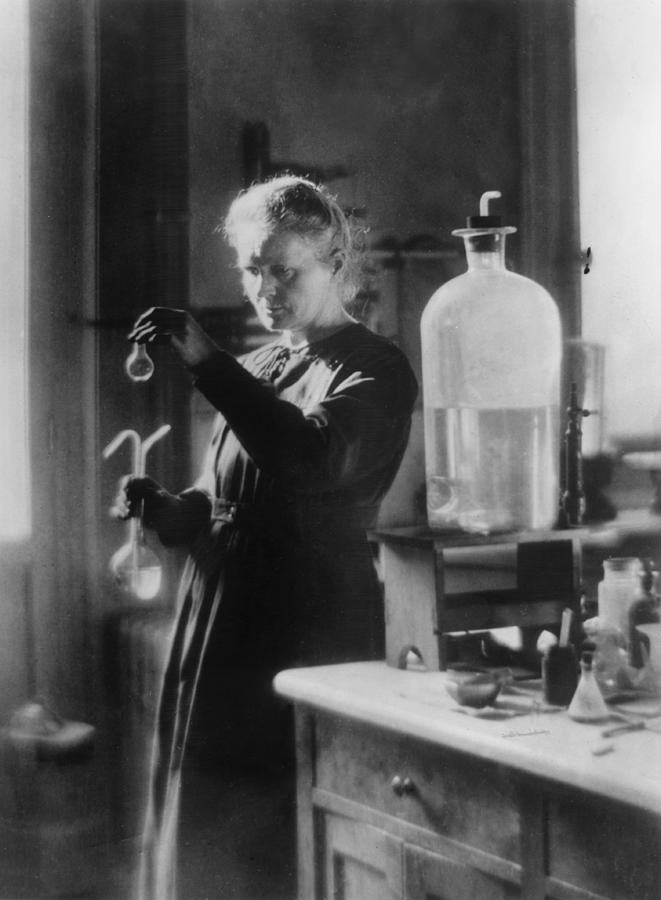
A woman who received the Nobel Prize twice
From these achievements, the Curie husband-and-wife team was honored with awards from scientific societies, including the Davy Medal from the Royal Society of London in 1903. In the same year, they received the Nobel Prize in Physics, jointly with Henri Becquerel, the discoverer of radiation from uranium. This Nobel Prize made Marie Curie the first woman to receive a Nobel Prize. Later, in 1911, after Pierre’s death, Marie Curie was awarded the Nobel Prize in Chemistry for her further and intensive research into the applications of radium.
Benefits to society
Subsequently, the University of Paris approved a sum of funding for Marie to establish the Radium Institute, equipped with modern facilities for conducting research and separating radium for further medical applications. Marie designed the institute herself, and its construction was completed in 1914. She proceeded with her research in earnest; however, despite having modern laboratories and equipment, her work was interrupted by the outbreak of World War I. As a result, assistants and workers at the Radium Institute, most of whom were men, were conscripted into military service. Under these circumstances, Marie volunteered to assist wounded soldiers and applied her scientific knowledge to this effort. She established mobile X-ray units to travel and provide treatment to injured soldiers at various military units. Marie treated more than 100,000 wounded soldiers using X-ray technology.
คุณประโยชน์เพื่อสังคม
ต่อมามหาวิทยาลัยปารีสได้อนุมัติเงินก้อนหนึ่งให้กับมารี ในการจัดสร้างสถาบันเรเดียม พร้อมกับอุปกรณ์อันทันสมัยเพื่อทำการทดลองค้นคว้าและแยกธาตุเรเดียม สำหรับประโยชน์ทางการแพทย์ต่อไป มารีได้ออกแบบสถาบันแห่งนี้ด้วยตัวของเธอเอง สถาบันแห่งนี้สร้างเสร็จในปี ค.ศ.1914 มารีเดินหน้าทดลองค้นคว้าอย่างจริงจัง แต่ถึงแม้ว่าจะมีห้องทดลองและอุปกรณ์ที่ทันสมัยแล้ว แต่ก็มีเหตุที่ทำให้การทดลองต้องหยุดชะงัก เพราะได้เกิดสงครามโลกครั้งที่ 1 ขึ้น ทำให้ผู้ช่วยและคนงานที่ทำงานในสถาบันเรเดียม ซึ่งส่วนใหญ่เป็นผู้ชายต้องถูกเกณฑ์ไปเป็นทหาร เมื่อเป็นเช่นนั้น มารีจึงสมัครเข้าร่วมกับอาสาสมัครเพื่อช่วยเหลือทหารที่บาดเจ็บ อีกทั้งยังนำความรู้ไปใช้ในงานครั้งนี้ด้วย เธอจัดตั้งแผนกเอกซเรย์เคลื่อนที่ขึ้น เพื่อตระเวนรักษาทหารที่บาดเจ็บตามหน่วยต่าง ๆ มารีได้รักษาทหารที่บาดเจ็บด้วยรังสีเอกซ์มากกว่า 100,000 คน
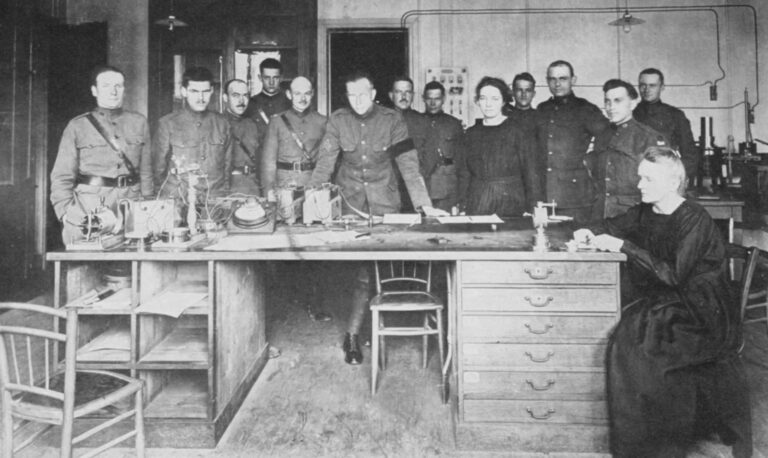
After World War I came to an end, Marie returned to her work once again. Unfortunately, her long years of research and experimentation with radium caused her to suffer from the effects of radium’s radioactivity. Her bone marrow was gradually destroyed, and eventually her body could no longer withstand the continued damage caused by radium radiation. She passed away on July 4, 1934. Nevertheless, the results of Marie’s experimental work have continued to be of great benefit up to the present day.

Finally, for those who are interested or would like to read books related to Marie Curie, whether on specialized knowledge or general knowledge, they can read the book recommendation article on Marie Curie at https://kmutt.me/book-curie