

King Mongkut Studies Project
Royal Genius in Learning
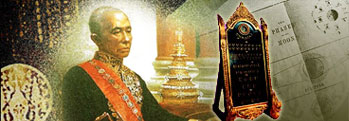
When looking back at the history of almost all countries in Asia, it can be seen that they were once colonies of Western imperial powers, with the sole exception of Thailand, which was able to preserve its independence, although it did lose some territories. This phenomenon is something that all Thai people understand and take pride in sharing with others. Such pride in national independence would not have existed if Thailand, or Siam in the Rattanakosin period, had not had King Mongkut. He was a monarch of exceptional ability, endowed with outstanding intellectual capacity and a remarkable aptitude for learning from the time he was in the monkhood, accumulating experience that he later applied to royal judgment, decision-making, and the conduct of astute foreign policy. Through this, he was able to lead the country safely through the crisis of Western colonial expansion, while also laying the foundations for national development and international recognition. One aspect of his intellectual brilliance was his learning in the field of religion.
King Mongkut was ordained as a Buddhist monk in accordance with ancient royal tradition at the Temple of the Emerald Buddha in the year 1824 and remained in the monkhood for 27 years. He received the monastic name Vajiranyano, meaning one whose wisdom shines like a diamond. He later resided to study insight meditation at Wat Samorai, later known as Wat Ratchathiwat, and subsequently studied scriptural learning at Wat Mahathat. He mastered the Magadha language, being able to translate, speak, and write it fluently. He was the first royal prince to sit for the examination in Buddhist doctrinal studies, attaining the level of five sections, and was later granted the rank equivalent to nine sections due to his mastery of the Tipitaka, commentaries, and sub-commentaries. Through this knowledge, he recognized that certain practices long observed by the monkhood deviated from the discipline laid down by the Buddha, and he therefore undertook reforms to restore proper and complete observance. He personally instructed and preached so that people might understand the essence of the Dhamma, teaching both doctrinal studies and monastic discipline to monks. In addition, he composed sacred verses and chants that are still in use today, including the Pali morning and evening chanting, hymns in praise of the Triple Gem, the eightfold Namo verses, the Ovado Patimokkha, invocations of the power of the Triple Gem, reverence to the Triple Gem, teachings on liberation from suffering, the dedication of merit, the invitation to hear the Dhamma, proclamations of Uposatha days, and compositions for the full moon and the new moon.
Learning in Religious Studies
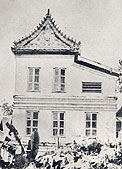
King Mongkut ordained as a Buddhist monk in accordance with ancient royal tradition at Wat Phra Si Rattana Satsadaram in 1824. He remained in the monkhood for 27 years and bore the monastic name Vajiranyano, meaning one whose wisdom shines like a diamond. He later resided to study vipassana meditation at Wat Samorai, later known as Wat Ratchathiwat, and subsequently studied scriptural learning at Wat Mahathat. He mastered the Magadha language, being able to translate, speak, and write it fluently. He was the first prince to sit for the examination in Buddhist doctrinal studies and passed five levels, and was later granted the ceremonial fan of rank equivalent to the highest level due to his deep expertise in the Tipitaka, commentaries, and subcommentaries. Through this knowledge, he recognized that certain practices observed by monks were inconsistent with the disciplinary code established by the Buddha, and he therefore reformed and restored monastic discipline to proper completeness. He personally instructed and delivered sermons to convey the essence of the Dhamma, teaching both doctrinal studies and disciplinary practice to monks. In addition, he composed Buddhist verses and chants that continue to be used today, including Pali texts for morning and evening chanting, praises of the Triple Gem, the eight Namo verses, the Ovata Patimokkha, invocations of the power of the Triple Gem, homage to the Triple Gem, teachings on the path to liberation from suffering, dedication of merit, invitation to hear the Dhamma, proclamations of observance days, and royal compositions for the full moon and new moon days.
Learning about the hardships and well-being of the people
While in monkhood, King Mongkut undertook dhutanga journeys to pay homage to great stupas in various provincial towns.
This enabled the people to have close access to the King, and since he was a monk, he preached and taught the Dhamma so that the people could understand and reach the principles of morality. The people felt confident to respectfully report their hardships and well-being to him, and after his accession to the throne, he undertook royal journeys to inspect the provinces.
He observed the physical geography, the abundance of forests, and visited people living in remote areas, which allowed him to truly understand the living conditions, needs, and hardships of the people. Examples included the cleanliness of rivers and canals, indebtedness, the selling of daughters, indulgence in vices, restrictions preventing the people from approaching the monarch closely, the submission of petitions in which the people had to be flogged beforehand, and the collection of market fees.
He used what he observed as information to improve conditions and provide royal assistance so that the people could live with greater well-being and the country could be developed. Examples include the abolition of market taxes, personally receiving petitions, granting royal permission for the people to approach him closely, and allowing them to wear shirts when appearing before the monarch.
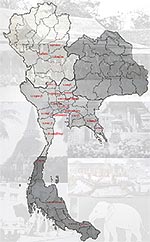
He used what he had observed as information for reform and for granting assistance so that the people could live in happiness and the nation could be developed, such as the abolition of market taxes, personally receiving petitions, granting royal permission for the people to approach him closely, and allowing them to wear shirts when appearing before the monarch.
He traveled throughout all regions of the country, for example to the North as far as Sukhothai, to the South as far as Pattani, to the East as far as Trat, and to the West as far as Kanchanaburi. His journeys to provincial areas thus became the model for the royal tours of King Rama V and for the visits to remote local communities undertaken by the present King.
Learning together with Western clergy
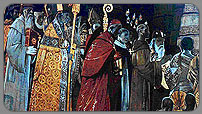
Christian clergy and missionaries entered Thailand to spread Christianity beginning in the Ayutthaya period. Many clergy and missionaries played important roles in assisting national development, as many of them were not only knowledgeable in religion but also possessed expertise in other fields such as linguistics, medicine, science, and astronomy, for example Dr. Dan Beach Bradley, known among Thais at that time as Mo Bradley, and Bishop Pallegoix.
When Westerners began to play a greater role in Thailand and increasingly sought to conclude treaties, King Mongkut recognized the necessity for Siamese people to learn foreign languages for communication. As Wat Samorai was located near Wat Khmer, or Wat Conception, His Majesty became familiar with Bishop Pallegoix and exchanged knowledge with him. The King taught Pali, Thai, customs, ways of life, and culture to the bishop, while the bishop taught Latin and Western customs to His Majesty. When Bishop Pallegoix wrote the Thai dictionary, the King likely contributed assistance to its compilation.
In sending diplomatic missions to establish friendly relations with Emperor Napoleon III and Pope Pius IX at the Vatican, His Majesty likewise received assistance from Bishop Pallegoix. After moving to reside at Wat Bowonniwet, the King studied English with Dr. Jesse Caswell, known among Thais as Mo Haskan, studying four days a week for one hour each day. In each session, in addition to learning English, they exchanged knowledge, texts, and opinions, and the King asked questions whenever doubts arose. As a result, His Majesty acquired extensive knowledge in fields such as geography, physics, chemistry, mathematics, astronomy, history, and Western systems of governance.
He ordered books, textbooks, instruments, and equipment from abroad for study, research, and experimentation, which led to his expertise in astronomy, enabling him to accurately predict a total solar eclipse as much as two years in advance.
Learning from neighboring countries
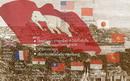
King Mongkut was fully aware of the threats posed by Western imperial powers, as he continuously followed news and developments in neighboring countries.
from newspapers and from foreign books that he ordered and that were presented to him, as well as through exchanges of knowledge with foreigners. He therefore realized that although countries in Asia, including Siam, had no desire to engage in relations or trade with Western nations, in an era of colonial expansion by powers with strong military force and armaments, resistance, refusal, or isolation would not produce beneficial results of any kind.
For example, Japan, which had long maintained a policy of national seclusion, was compelled to agree to the Kanagawa Treaty and open the country to the United States. Burma resisted and fought wars with Britain and ultimately lost its independence. Vietnam was colonized by France, while China, India, and Sarawak were also brought under British control. King Mongkut therefore used these facts as part of his consideration in deciding what kind of foreign policy should be pursued and how independence and sovereignty could be preserved from the threats of those great powers. As Siam was a small country, a policy of yielding to circumstances, making necessary concessions, and balancing power thus emerged. At the same time, the great powers began to exert influence over Siam’s tributary territories, namely Cambodia, Laos, and the Malay Peninsula, compelling the King to modernize the country so that Western powers would not use backwardness as a pretext for colonization.
His willingness to amend treaties in accordance with the demands of British envoys, to accept extraterritorial rights, and to open the country while conducting foreign relations with awareness and caution, enabled Siam to preserve its independence, freedom, and sovereignty to this day. These decisions are regarded as correct and highly worthy of praise and admiration.
The Promotion of Learning
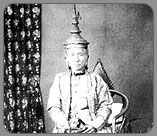
It is widely acknowledged that King Mongkut was a monarch devoted to learning throughout his life, as he recognized the value of education, particularly the study of languages, including English, Magadhi, and French, since language served as an essential medium for learning.
He was the only monarch in Asia who could read, write, and speak English, enabling him to follow news from the outside world and apply this knowledge in his decision-making, as well as to study various fields of learning in order to elevate the country to be accepted among civilized nations. He therefore recognized the importance of the English language.
Accordingly, while he was in the monkhood, he promoted opportunities for monks, princes, and nobles to study English with Dr. Jesse Caswell, known among the Thai people as Doctor Hasgun.
Upon his accession to the throne, he employed Mrs. Bradley and Mrs. Mattoon, the wives of missionaries, to teach English, literature, and Western academic subjects to his royal daughters and the women of the Inner Court, thus opening a new world of learning for women. Later, he employed Mrs. Anna Leonowens and Dr. J. H. Chandler, known as Doctor Chandle, as English teachers for the royal sons and daughters at the school within the Grand Palace. English instruction at that time involved no translation into Thai; learning was conducted through natural comprehension, enabling correspondence and the keeping of written records.
In addition, in order to provide opportunities for common people to learn English and modern knowledge, King Mongkut supported missionaries in establishing schools in Bangkok and in the provinces. Especially after the printing of textbooks such as Jindamanee, Prathom Ko. Ka, Prathommala, manuals on craftsmanship, and medical texts, learning expanded more widely among ordinary people, thereby broadening educational opportunities for the general population. He also sent certain princes to observe developments abroad and dispatched officials to study various fields in foreign countries.