

King Taksin the Great
Chapter 12: Royal Duties in Religion and Education
12.1 Royal Duties in Religion
12.1.1 After Thailand Experienced the Great Destruction in 1767, How Severely Was Buddhism Affected?
When Ayutthaya faced the great destruction in 1767, Buddhism in the Thai kingdom suffered severe disruption unlike anything previously experienced. Temples, Buddha images, stupas, religious monuments, and sacred objects, as well as the Tripitaka and various scriptures, were destroyed or lost in great numbers at the hands of the invaders. Many high-ranking monks were killed or captured as prisoners by the enemy, while those who survived were forced to wander, scattering and hiding in various places, a situation that was truly pitiful and tragic.
Somdet Phra Wanrat of Wat Phra Chetuphon, in the reign of King Rama I, described the great destruction of Ayutthaya at that time in “Sangkitiyawong: Chronicle of the Recitation of the Dharma and Discipline.” Composed contemporaneously, it contains multiple passages detailing the devastation of Buddhism, making it highly valuable as a historical document. The author personally witnessed the events and was of considerable age, providing credible testimony. Some translated excerpts (originally composed in Magadhi) are provided here as evidence:
“The capital was besieged for two years. The people of the city ran out of supplies and the city weakened. In the Buddhist year 2310, the years of the Dog and Rooster consecutively, in the third month, the ninth day, Tuesday, in the evening hours, it was the end of the war.”
“The capital was destroyed in every way. Whatever was lost, perished, disrupted, or destroyed—all by the hands of the enemy (the Burmese). They seized all the people, including the royal family, taking all the possessions in great quantities. They burned the city, the three main palaces, and the temples and monasteries. They destroyed the city walls and ruined the belongings of Ayutthaya, including the Buddhist scriptures and disciplinary texts such as the Tripitaka. Then they returned to their city, taking with them abundant treasures and weapons, especially for their nobles.”
Afterward, the author detailed the various severe sufferings endured by the Thai populace at that time, and then returned to describe the sorrowful devastation of Buddhism itself. Some of the important passages are as follows.
“The people suffered two kinds of misery: the sorrow of losing relatives and the sorrow of losing possessions. They were devoid of compassion for one another. The danger arose from hunger, and when the pressure became severe, they could not provide support for the Buddha images, the Dharma, or the monks, and struggled to sustain themselves in extreme distress.”
“The monks, when they could not receive alms from donors, suffered greatly and could not maintain the monastic robes. They sent disciples to seek food to fill their stomachs, sometimes successfully, sometimes not, growing weary of ordination due to the hardship of maintaining the monastic life, and many left to earn their living according to their own means.”
“Some who still maintained the monastic robes labored desperately to sustain themselves, sometimes eating, sometimes not. Their bodies became emaciated, covered with twisted skin and sinews. They were not united in spirit, lost all attachment, and could not safeguard the Buddha images or the Dharma, instead residing in suitable places as they could manage.”
“The heretical groups caused damage to the Buddha images.”
“The Dharma and Discipline, the Tripitaka, when left unprotected, were destroyed in various ways: heretics seized the wrappings and ropes; termites gnawed and ruined them; some were lost, fallen to the ground, soaked, or decayed.” In summary, the fall of Ayutthaya caused enormous devastation to Buddhism, making restoration nearly impossible (Sethuen Supasophon, 1984: 63).
Suchat Phueaksakon, Police Major General (http://www.dabos.or.th/pr13.html [28/11/44]) commented: “The ongoing chaos that persisted for many years before the fall of Ayutthaya had a severe negative impact on the monastic organization of the kingdom. Besides the high-ranking monks perishing or being captured as prisoners by the Burmese, the administration of the monastic order, which relied on royal authority for support, collapsed alongside the disintegration of the Ayutthaya kingdom. The economic decline at that time forced many deviations and irregularities in the conduct of monks in various ways.”
12.1.2 What were King Taksin’s royal duties in the field of Buddhism?
During the reign of King Taksin of Thonburi, the country was in a state of devastation and collapse, with widespread ruin everywhere. It was an era of national restoration, a period in which the sovereign had to tirelessly devote himself to military campaigns and the pursuit of enemies, with scarcely any time for respite. It can be said that King Taksin bore responsibilities of this nature unlike any previous monarch.
Nevertheless, it is highly commendable that regarding the Buddhist religion, he devoted his heart to its maintenance and preservation as much as circumstances allowed. The French missionary Pallegoix remarked on his interest in Buddhism, stating, “…King Taksin of Thonburi demonstrated himself to be more than a supreme patron of Buddhism, a role that the monarchy had traditionally upheld from the beginning of the reign. After the conflicts with Ayutthaya’s remnants, there is evidence that he became even more devoted to religious matters…The Royal Chronicles state regarding the manner of his devotion to religion that…”
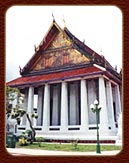
The Ubosot of Wat Bang Yi Ruea Tai
(Image from the book Interesting Facts about Thonburi)
He went to practice meditation at the ordination hall of Wat Bang Yi Ruea Tai (Wat Intharam or Wat Bang Yi Ruea Nok, Knowledge of Thonburi, 2000: 58) starting from 1776…” (Nithi Eawsriwong, Thai Politics in the Reign of King Taksin, Silpa Wattanatham Special Issue, cited by Police Major General Suchart Phueksakorn: http://www.dobos.or.th/pr13.html, 28/11/44)
Whenever he had free time, whenever circumstances allowed, he immediately devoted himself to restoring and promoting Buddhism.
This can be seen in every instance when he went on military campaigns, whether against assemblies in various cities or neighboring countries; whenever there was an opportunity, he ensured that the maintenance and support of Buddhism were integrated continuously. This practice continued throughout his entire reign.
The royal duties in restoring and maintaining Buddhism by King Taksin of Thonburi can be briefly summarized as follows:
1. Organization of the Sangha districts
When Ayutthaya fell for the second time in 1767, the Sangha districts in Thailand suffered severe destruction. Therefore, once the establishment of the new capital had begun to take shape, King Taksin immediately ordered the reorganization of the Sangha districts in 1768. This was based on his consideration that the monks at that time were still seriously lacking in discipline, as the country had been in disarray and without senior monastic leaders or virtuous and knowledgeable clergy to oversee and instruct the proper adherence to the Vinaya.
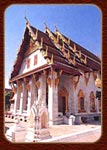
Phra Ubosot, Wat Bang Wa Yai
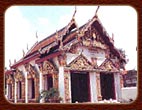
The Vihara of the Supreme Patriarch (Si)
(Image from the book Interesting Facts about Thonburi)
He therefore ordered the search for virtuous monks from all available places and invited them to assemble at Wat Bang Wa Yai (now Wat Rakhangkhositaram, Thonburi side) and elected the most virtuous and senior monk as the Supreme Patriarch to oversee the Sangha in the districts. Subsequently, he appointed the senior monks to various ranks as in former times and assigned them to reside in different monasteries in Thonburi, instructing the monks and novices in both Khandhaka and Vipassana practices to earn the respect and faith of the people and to restore Buddhism to its proper state.
It was recorded that during that time, the clergy collectively selected Phra Ajahn Dee of Wat Pradu from Ayutthaya to serve as the first Supreme Patriarch of the Thonburi period. In this way, monastic governance in Thonburi moved out of the previous chaotic state and began to operate in an orderly manner from then on.
2. Restoration and Renovation of Important Temples
At the same time as the reorganization of the Sangha districts in 1768, during the establishment of the new capital, King Taksin commissioned both military and civil officials to assist in building ordination halls, vihara, sermon halls, and monk’s quarters across more than 200 temples, spending considerable royal resources. In subsequent years, he continued to establish and renovate many temples repeatedly.
Temples established during his reign included Wat Bang Yi Ruea Nuea (Wat Ratchakaruh), while renovated temples included Wat Bang Wa Yai (Wat Rakhangkhositaram), Wat Jaeng (Wat Arun Ratchawararam), Wat Bang Yi Ruea Tai (Wat Intharam), and Wat Hong Asawas Wihara (Wat Hong Rattanaram), among others.
The most significant temple he focused on restoring during his reign was Wat Intharam, then called “Wat Bang Yi Ruea Nok” or “Wat Bang Yi Ruea Tai,” an ancient temple dating back to Ayutthaya, located along the Bangkok Yai canal near Talad Phlu, Thonburi side. He elevated it to a royal temple of the highest rank in Samatha and Vipassana practice.
When Somdet Krom Phra Thepamat, the Queen Mother, passed away, he ordered her cremation at this temple in 1775, and the following year, he organized merit-making ceremonies for her relics at the same temple. He also conducted a major renovation of the temple, constructing 120 new monk’s quarters, restoring Buddha images, stupas, ordination halls, and viharas throughout the temple complex. He then invited monks practicing Vipassana to reside in the newly built quarters.
On this occasion, King Taksin himself practiced Vipassana meditation at Wat Bang Yi Ruea Nok for five days to dedicate merit to the Queen Mother. The bed he used during this retreat has been preserved in a small vihara beside the old ordination hall to this day as a memorial.
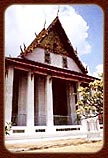
The ubosot of Wat Hong Rattanaram
(Image from the book Interesting Facts about Thonburi)
In addition, when he was executed, his royal remains were also interred at this temple, at the site where the ubosot (ordination hall) now stands. Later, after his cremation at this temple, his relics and royal remains were enshrined here as well.
Thus, Wat Intaram (commonly referred to by locals simply as “Wat Tai”) truly serves as a commemorative temple of King Taksin the Great.
Another temple is Wat Hong Rattanaram (officially called at that time “Wat Hong Awas Wiharn”), which he ordered to be extensively renovated concurrently with the first restoration of Wat Intaram in 1776. He also elevated it to a first-class royal temple, designating it as a temple for education and the study of the Buddhist scriptures.
Since this temple was located near the royal palace and in the heart of the city at that time, it became a temple where royal princes and other important persons of the period often came to ordain and practice monastic life. Another significant temple during the Thonburi period was Wat Arun Ratchawararam, which at that time was called “Wat Chaeng.” King Taksin the Great took great care in restoring it as much as possible. However, during the Thonburi period, this temple was within the royal palace grounds, so no monks resided there. Later, toward the end of his reign, when he obtained the Emerald Buddha from Vientiane, he ordered it to be enshrined in this temple. Wat Chaeng thus became the “Temple of the Emerald Buddha,” similar to Wat Phra Si Rattana Satsadaram today.
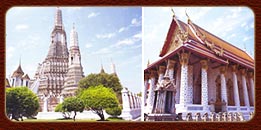
The prang and ordination hall of Wat Arun Ratchawararam (image from Thai Journal).
3. Promotion of Study of the Tripitaka
He contemplated that Buddhism could endure forever only if the monks and novices diligently devoted themselves to studying the Tripitaka. Therefore, he graciously commanded the Sangha to create records surveying which monks had mastered the Tripitaka the most. Specially, he bestowed fine cotton tricings and offered the four requisites to monks and novices according to how much they had studied. This initiative began at the start of his reign.
4. Maintenance and Support of Buddhism in Nakhon Si Thammarat
On the occasion of leading the army to subdue the forces of the Lord of Nakhon at Nakhon Si Thammarat, successfully in 1769 (B.E. 2312), after organizing the city, he graciously invited monks, novices, elders, and hermits from both inside and outside the city to gather. He provided each with a jar of rice and one baht in silver; for those lacking robes, he gave a set of three robes. He also distributed alms to beggars, one salung each, on every holy day at the ordination hall. Moreover, he commissioned officials, both military and civilian, to assist in establishing, restoring, and renovating ordination halls, assembly halls, sermon halls, cloisters, and monk dwellings in many temples, expending a great amount of royal resources. Subsequently, he graciously held festivals with candle processions to celebrate the great stupa at the Phra Borommathat temple for three consecutive days.
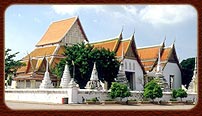
Wat Phanan Choeng
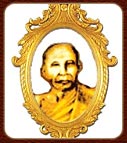
The Supreme Patriarch (Sri) held the position of Supreme Patriarch for two reigns
(Image from http://www.dhammathai.org/thailand/sangkharaja01.php)
When it was time to return to Thonburi, he graciously summoned Phra Ajarn Sri of Phananchoeng Temple in the old capital, who had fled the Burmese and taken refuge in Nakhon Si Thammarat, along with all his monk and novice disciples. He then appointed him as the Supreme Patriarch, stationed at Wat Bang Wa Yai (Wat Rakhang), to succeed Phra Ajarn Dee, who had passed away (according to the account of royal duties regarding law, section 11.2.2, Phra Ajarn Dee was allowed to disrobe because he failed the ordeal by fire).
Somdet Phra Sangharat Si thus became the second Supreme Patriarch of Thonburi. Later he was also elevated as the first Supreme Patriarch of Rattanakosin during the reign of King Rama I.
After his return from Nakhon Si Thammarat on that occasion, he undertook many further actions concerning the religion, until the Royal Chronicles recorded that
“From that time onward, Buddhism gradually prospered and flourished as before, and His Majesty the King increased in royal merit and virtuous power. The people of the realm came to enjoy peace, comfort, and abundance once again, as in the days when the old capital was still in its normal and stable condition.”
5. The Compilation of the Tipitaka
When Ayutthaya fell to the Burmese for the second time in 1767, temples, palaces, and dwellings were burned to the ground, and a vast number of Tipitaka manuscripts and other texts were destroyed and lost. After King Taksin of Thonburi ascended the throne, he devoted himself to searching for surviving Tipitaka manuscripts in the provincial towns that had escaped enemy destruction, and had them copied in order to establish an official royal edition for the capital. For example, when he went to suppress the Nakhon Si Thammarat faction in 1769, he ordered Tipitaka manuscripts from Nakhon Si Thammarat to be loaded onto boats and brought to Thonburi for copying. Likewise, when he marched north to suppress the Phra Fang faction at Uttaradit in 1770, he commanded that the Tipitaka of that town be brought down for comparison with the manuscripts obtained from Nakhon Si Thammarat.
But the production of the royal edition of the Tipitaka, as described above, was not completed according to his intention, for his reign ended before the work could be fully accomplished. Nevertheless, his effort to gather and copy the Tipitaka manuscripts in Thonburi proved greatly beneficial for the recension of the Tipitaka undertaken in the succeeding period. In addition, toward the end of his reign he sent Phra Thepkawi to Cambodia and Phra Phrommuni to Nakhon Si Thammarat to collect manuscripts of the Visuddhimagga, which were then copied and preserved in Thonburi.
6. The Purification of the Northern Sangha (1770)
Paang sawaangkabures rai Rawaeng phit
Phutthabut la phutthakit Ko klaeo
Thusin thucharit it- Cha ratcha
Sadet prap sat bap phaew Fok fuen sasana
(Khlong in Praise of His Majesty by Nai Suan, Royal Page)
When the capital fell for the second time in 1767, a certain faction in the northern provinces set itself up as an independent power. This faction was unusual among all others in that its leader was a monk, and its generals and officers were all monks as well. This group is known as the Phra Fang faction.
These monks committed acts of grave misconduct, violating the monastic discipline in ways that were deeply lamentable. Therefore, when King Taksin of Thonburi subdued this faction in 1770, he immediately ordered an inquiry and purification of the monks in Phra Fang.
After the generals and officers had been defrocked and made laymen, placed in chains, and sent down to be imprisoned in Thonburi, the King summoned all the monks of the northern provinces in that town to gather before the royal seat, together with high and lesser officials, both military and civil. He then delivered the royal pronouncement that
“All the monks dwelling in the northern region are supporters of Ai Ruean of Phra Fang. They have borne arms and guns in battle, killed people, plundered property, drunk liquor, committed acts of lewdness with women, incurred the various offenses of defeat, and severed themselves from the discipline of the Buddhist religion. They are all depraved and cannot be allowed to remain in the monastic order.”
After this, an order was given for all monks who had violated the monastic discipline in various ways to confess their offenses, and they would be permitted to disrobe and enter royal service. If they refused, they would have to prove their purity according to ancient custom, which required them to dive underwater before the royal presence as part of the ritual. Those who succeeded would be appointed as abbots and ecclesiastical officers according to their merit, virtue, and knowledge. Those who failed would be punished; if equal, they would be granted a robe to be ordained anew. The King then ordered the ritual of proving the monks’ purity by diving underwater to be held for the monks of Phra Fang. Those who lost their cases were punished accordingly. The robes of those defrocked were burned and made into soot, which was applied to the Mahathat chedi of Sawangkhaburi.
7. The Promotion of Buddhism in the Northern Provinces
When the purification of the Sangha had been completed, the King ordered one thousand sets of robes to be sewn for the ordination of new monks to be stationed throughout the northern provinces. He then commanded royal envoys to proceed to Thonburi and invite ecclesiastical dignitaries together with ranking monks, fifty in number, to travel north and ordain monks in every town. Afterward, these ecclesiastical dignitaries were appointed to reside permanently in the various cities to instruct and supervise the northern monks in their respective monasteries. For example, Phra Phimolthamm resided at Sawangkhaburi, Phra Thamma Chedi at Thung Yang, Phra Thammaracha and Phra Thepkawi at Sawankhalok, Phra Thamma Udom at Phichai, Phra Phothiwong at Phitsanulok, and Phra Phrommuni at Sukhothai, and so forth.
From that time onward, the religious affairs of the northern provinces returned to their normal condition.
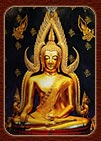
Phra Phuttha Chinnarat, Wat Phra Si Mahathat Woramahawihan
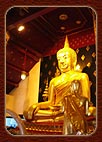
Phra Phuttha Chinnasi, Wat Phra Si Mahathat Woramahawihan
He then proceeded to Sawangkhaburi, where he ordered a three-day celebration of the Great Relic and commanded that it be restored to its original condition. After that, he went to celebrate the Phra Than Sila Asana at Thung Yang for three days, and then continued on to celebrate the Phra Si Rattanamahathat at Wat Phra Prang in Sawankhalok for another three days. From there he traveled down to Phitsanulok and ordered a three-day celebration of the Phra Si Rattanamahathat, Phra Phuttha Chinnarat, and Phra Phuttha Chinnasi. Thus were his royal undertakings for the support and promotion of religion in the northern provinces brought to completion on that occasion.
8. The Creation of the Traiphum Picture Book
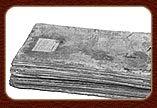
The Format and Condition of the Ancient Thonburi Edition of the Traiphum Picture Book
Preserved at the National Library, Tha Wasukri
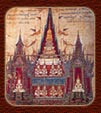
Image from the Royal Traiphum Picture Book, Thonburi Period
In order for the public to correctly understand the concepts of hell and heaven according to the scriptures, and to encourage the performance of good deeds while abstaining from evil in accordance with the teachings of Buddhism, he ordered the creation of a Traiphum Picture Book in 1776. This was a large, ancient-style picture book of remarkable beauty. Details of this work are recorded in the chapter on Fine Arts (Chapter 13).
9. The Return of the Emerald Buddha
On the occasion when he appointed Somdet Chao Phraya Maha Kasatsuek (later King Phutthayotfa) as the supreme commander to lead the army against Vientiane in 1779, the Thai army, on its return, brought back the Emerald Buddha and Phra Bang, which had been enshrined in Vientiane.
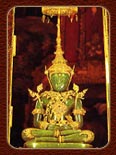
Phra Phuttha Maha Mani Rattana Patimakorn (The Emerald Buddha)
(Image from the book Somdet Phra Chao Taksin Maharaj)
The Emerald Buddha is regarded as a highly sacred and invaluable image, a national palladium and source of blessing for the country. It is believed to have been created by the devas and can only reside in a sovereign nation where Buddhism is firmly established.
When King Taksin of Thonburi learned of the return of this highly sacred and precious Buddha image, he was exceedingly joyful. He ordered the Supreme Patriarch and all members of the royal ecclesiastical order to proceed in procession to receive it as far as Saraburi.
At the same time, he commanded a royal barge procession to go forth and receive the image personally at Bang Thorani, near Pak Kret. The grand fleet numbered 154 vessels, and when combined with the originally accompanying barges, the total reached 246 boats, which were then paraded back to Thonburi.
He ordered the construction of halls to enshrine these two highly important Buddha images, placing them beside the ordination hall of Wat Chao (Wat Arun) within the royal precinct, and provided extensive offerings for their veneration. He then commanded a grand royal celebration for the Emerald Buddha, with various performances along both banks of the Chao Phraya River, in magnificent and elaborate style, lasting seven days and seven nights. Numerous theaters and performance stages were set up, believed to be the first grand festive celebration of such scale in Thailand after the fall of Ayutthaya twelve years earlier. King Taksin also planned to build a grand royal palace to house the Emerald Buddha within the royal compound whenever time permitted from his military duties, but the work remained unfinished by the end of his reign.
10. Royal Instructions Given to the Sangha
On the occasion of the first major restoration of temples and monasteries in 1768, when the work was completed, King Taksin of Thonburi delivered royal instructions to the Sangha, urging them to firmly observe the precepts and monastic discipline, and not to let Buddhism suffer any detriment. His steadfast determination in religious matters is clearly reflected in the royal instructions of that time:
“May all of you set your minds to serve diligently, and remain steadfast in the complete observance of the fourfold purity of conduct, the Vinaya, and monastic rules. Do not allow your religion to be defiled. Even if you are lacking in the four requisites, I will provide for you.”
“If all of you are perfect in virtue within the religion, even if you desire meat or blood, I may be able to provide them for acts of charity.”
His instructions were not limited to Thai monks alone. King Taksin also addressed Chinese and Vietnamese monks, instructing them to adhere to Dhamma and Vinaya to earn the respect and faith of the people. Evidence appears in daily military dispatches during the campaigns against Phutthaisong and Cambodia in 1771. One entry records:
“On Monday, the 10th waxing of the first month, in the morning, His Majesty proceeded to perform merit at the Vietnamese temple, paying respects to the Buddha image. After the Vietnamese monks completed chanting, His Majesty, moved by devotion, gave alms to the monks, novices, and possibly nuns. He also delivered instructions to the monks in the Vietnamese language, to remain in discipline, avoid illicit sexual relations, and diligently promote Buddhism. Should they lack any necessities, they may request assistance from Phraya Rajasetthi…”
The Phraya Rajasetthi mentioned here was the newly appointed governor of Phutthaisong, installed after the city was reconquered by Siam in 1771. He had previously served as Phraya Phiphit, a high-ranking official in the treasury, and was an important Chinese official during the reign of King Taksin. On some occasions, the King gave royal instructions to the Vietnamese monks in a manner akin to issuing firm orders:
“On Saturday, the 15th waxing of the first month, in the morning, His Majesty rode the royal horse to perform merit at the Vietnamese temple. The sanghakaris invited a large number of Thai, Chinese, and Vietnamese monks to assemble at the temple, where they chanted in their respective languages. Afterward, alms were offered: 1 baht per Thai monk, robes and cloth for each, 1 baht per Vietnamese monk, 1 baht per Chinese monk, and 1 baht per novice. His Majesty then addressed the Vietnamese monks in Vietnamese and the Chinese monks in Chinese, explaining that they must observe the monastic rules, abstain from sexual relations, and that novices and laypersons not observing the discipline would face beheading. After the instructions, beggars and mendicants among the Chinese and Vietnamese received alms of 1 baht each by royal hand.”
These records clearly indicate that King Taksin had a strong command of both Chinese and Vietnamese.
Furthermore, it is noted that he associated with Islamic teachers (tukru). According to royal chronicles, King Taksin’s knowledge of Chinese, Vietnamese, and Persian/Indian languages enabled him to speak all three fluently, which is historically accurate (Sethuon Suphasophon, 1984: 69).
11. Engagement in Dhamma Discussions and Royal Inquiries with the Sangha
King Taksin showed great devotion to Buddhism. He not only provided royal patronage according to traditional customs, but also diligently pursued study and practice, both in scriptural knowledge (pariyatti) and meditation (patipatti).
Whenever he had leisure from royal duties, he would summon the Supreme Patriarch or senior monks of virtue and knowledge to the royal palace to engage in dhamma discussions (sakataca). At times, he would pose royal inquiries (puccha) and receive answers and explanations on various doctrinal and practical matters.
The tradition of the monarch presenting royal inquiries on Dhamma to the ecclesiastical council is regarded as a means of promoting the study and flourishing of the Dhamma-Vinaya. Those who wish to answer the royal questions must research and examine various scriptures to provide their responses. This practice dates back to the Ayutthaya period and continued into the Rattanakosin era.
Evidence of this appears in several parts of the Royal Chronicles, particularly in the Phan Chan Nu Mat (Cherm) edition, which is considered an important historical source for events during the Thonburi period.
For example, in 1777, King Taksin posed a royal inquiry to the Supreme Patriarch concerning the results of performing acts of charity.
He asked the Supreme Patriarch, “If money exists in the world at this moment and people are instructed to give charity with gold and silver, what merit will they attain in the heavenly realm?” After receiving the Supreme Patriarch’s answer, he then ordered Phra Thepkawi to go to Cambodia and Phra Phrommuni to Nakhon Si Thammarat to bring back copies of the Visuddhimagga, which were then carefully compiled and preserved.
On another occasion in the same year, he posed a royal inquiry to the ecclesiastical council concerning the physical characteristics of the Buddha, for the purpose of creating a Buddha image in accordance with ancient royal tradition. On that occasion, he even commanded the Supreme Patriarch to open the texts and instruct the craftsmen directly.
“He then asked the council about the Buddha’s physical characteristics, observing the contours and proportions of the image. How should this be described in Pali?” The council replied, “In Pali, the Buddha’s characteristics are described as follows: the image is like a banyan tree; the proportions are neither too high nor too low, neither too long nor too short. There are seven principal features: one right and one left arm, one right and one left foot, one right and one left shoulder, and the chest, making seven in total. The King then graciously commanded that the Buddha image be cast according to these characteristics, instructing the Supreme Patriarch to display the Pali texts for the craftsmen to follow.”
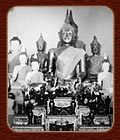
Buddha Image in Royal Attire, Enshrined at Wat Intharam
(Image courtesy of the National Library)
The Buddha image in royal attire of King Taksin mentioned here is currently enshrined as the principal image in the old ordination hall of Wat Intharam. It is a seated Buddha with a width of 4 feet 8½ inches, and it is said that a relic was enshrined in the base beneath the sacred cloth.
12. Practice of Vipassana Meditation
Among his religious activities, one of the most exceptional, unprecedented in any previous monarch, was King Taksin’s deep devotion to the practice of Vipassana meditation.
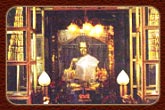
Model of King Taksin the Great Practicing Vipassana Meditation at Wat Intharam
(Image from the book Interesting Facts about Thonburi)
During periods of leisure from other royal duties, and when not engaged in military affairs that might trouble his mind, he would sit in meditation and practice Dhamma regularly.
It is understood that the place where he habitually practiced Vipassana meditation was likely at the royal riverside pavilion in front of Wat Arun (then still called “Wat Chaeng”) or in the small ordination hall in front of the main prang, the original ordination hall of the temple built during the Ayutthaya period alongside the original prang. This is supported by accounts in two volumes of an ancient Thai manuscript on white mulberry paper called The Book of Ancestral Miracles, which states:
“Furthermore, in the Thonburi reign, the specific Chulasakarat year is not recorded in the chronicles. On one occasion, King Taksin sat in meditation at the royal riverside pavilion, with Somdet Phra Wanarat Thong presiding as the chief. King Taksin sat in practice during that brief period… etc.”
Somdet Phra Wanarat (Thongyu) resided at Wat Bang Wa Yai (Wat Rakhang) and was also the teacher of King Phra Buddha Loetla Nabhalai. Later, after the end of King Taksin’s reign, he was compelled to leave the monkhood and enter royal service as Phraya Pojanapimol during the reign of King Rama I.
One important piece of evidence, serving as a lasting testament to the King’s practice of Dhamma that remains to this day, is the meditation seat he used for Vipassana practice, which is still preserved in the small ordination hall in front of the prang. The seat is made from a single large wooden plank, larger than any other known board of its kind.
It was in this original small ordination hall of Wat Chaeng that King Taksin sat during his temporary ordination near the end of his reign. According to a prominent historian, he was executed while still in monkhood in this hall on April 6, 1782, just before noon (Sethuon Suphasophon, 1984: 70).
Besides the riverside pavilion in front of Wat Arun, he sometimes diligently practiced Vipassana at Wat Intharam (Wat Bang Yi Ruea Nok or Wat Bang Yi Ruea Tai) for extended periods of up to five days and five nights. This occurred during the royal merit-making ceremony in 1776 in honor of the relics of Somdet Krom Phra Thepamat, his royal mother, when he also ordered extensive restoration of the temple. The Phan Chan Nu Mat (Cherm) edition of the Royal Chronicles records:
“On Monday, the 15th waxing of the first month, the relics of Somdet Phra Phanpi Luang were placed on a royal boat procession along the canal into the crematorium at Wat Bang Yi Ruea. Ten thousand monks were invited, and great alms were offered. His Majesty, observing the precepts and practicing Dhamma, remained at the riverside pavilion of Wat Bang Yi Ruea Nok for five days. He had 120 monk’s quarters constructed, restored the Buddha images, chedis, viharns, and the ordination hall, excavated the ground and planted lotuses, and cleared the area wider than before. He also invited monks from the Vipassana sect to reside in the new quarters, where attendants served them. The King then delivered royal instructions to the monks, explaining his practice so that the merit and teachings of the Dhamma could continue.”
From the aforementioned evidence, it is clear that King Taksin did not merely spend five nights in meditation to dedicate merit to his royal mother. After completing his Vipassana practice at that time, he also delivered royal instructions to the monks at the temple, explaining the techniques of Vipassana meditation based on his own successful experience.
Another important piece of evidence demonstrating his practical wisdom in Dhamma is a short royal composition he authored, explaining the “Characteristics of Advanced Dhamma Practice,” or simply called Lakkhana Bun (“Moments of Merit”). He composed this on Sunday, the 2nd waxing of the 3rd month, in the year 1776 (B.E. 2319), less than two months after completing his Vipassana practice at Wat Bang Yi Ruea Nok. The content of this royal composition is as follows:
On Lakkhana Bun
The peculiar moment (lakkhana) which becomes merit, for any person who sees, experiences, or understands the past, future, and present, who feels aversion, shame, reluctance, fear, or the sense of wrongdoing, leads the mind of that person toward merit and observance of the precepts. Even if the precepts are observed, if greed, anger, delusion, or lust remain unresolved, the precepts are not fully perfected. When greed, anger, delusion, and lust are removed, yet one fails to maintain mindfulness and proper conduct, the lakkhana cannot perfect the precepts. A mind oriented toward merit arises when aversion, shame, reluctance, fear, and the sense of wrongdoing are present, without attachment to greed, anger, delusion, or lust. The lakkhana of upholding the precepts has three categories: one that leads to merit, one that leads to demerit, and one that is neutral. Among these, one observes the precepts like cattle eating grass, without transgression, with utmost diligence. Another fails to turn the mind toward merit, even if minor or major faults occur, eventually leading to the hell realms upon death. The lakkhana of merit has three aspects: merit arising from past, present, and future; merit arising in the present; and merit arising for the future. A person who maintains the precepts without generosity may be impoverished in the present but gains merit for the future. One who properly observes the precepts benefits both in this world and in the next. The cultivation of precepts involves two principles: observance and restraint, with five to six points of mindfulness. One should carefully consider the precepts in one’s heart, maintaining purity of conduct and decorating the mind with wholesome qualities.
If one has duties to perform, one should follow the example of the Nagaraja’s graceful movements. One should recognize every aspect of the moments of maintaining precepts, and whenever one recalls them, one must do so at once. Do not forget any rule concerning the preservation of the precepts, and strive so that none of them is neglected or lost. If a person truly maintains the vinaya, and diligently observes it to accumulate merit with greater spiritual power, then they should study the forty meditation practices, with the Anapanasati (mindfulness of breathing) meditation as the principal method. Refer to the ceremonies preserved in the royal library for guidance. The proper practice of meditation is incomparable, beyond ordinary measure. A devoted practitioner, properly observing discipline, will generate a stable mind. When the subtle winds of assasa and passasa move calmly within, one becomes attentive and tranquil. Those unaware may disrupt these movements, but one should preserve and follow them carefully. By doing so, the practitioner attains proficiency in meditation. The subtle wind of vayo-sukhum moves steadily inward and outward, but it does not disturb the body’s head, neck, or limbs. The finest and most stable movement of the wind, known as nic-svadi, is observed by the meditator. Anyone with merit who follows the movements of assasa and passasa will progress to the first level of jhana (Ukkha-patitthana) and ultimately reach the fifth jhana. If one has difficulty, they should consult the commentaries and ritual manuals preserved in the royal library, summarizing the practices with understanding. If one agrees with the instruction, they should study it; if not, one may leave it. The benefits will serve as a spiritual offering. Dated Sunday, third month, waxing second day, Chulasakarat 1138, Year of the Monkey, Attha era. (Sethuon Supasopon, 1984: 64–73)
12.1.3. How King Taksin established the Royal Decree on Monastic Precepts
The Royal Decree on Monastic Precepts was a law regulating the rules and disciplinary practices of Buddhist monks. King Taksin promulgated this decree in the year of the Snake, Chulasakarat 1135 (B.E. 2316), early in his reign, six years after establishing Thonburi as the capital. At that time, the kingdom was still unstable, having just been reunified after suppressing various uprisings, the last being the rebellion of Chao Phraya Phang (present-day Uttaradit) in B.E. 2313.
Issuing this decree shows that while the King was fully occupied with governance and military campaigns, he simultaneously took responsibility for religious affairs.
The decree was necessary because the Sangha (monastic community) was still disorganized. Many monks were lax in their discipline, causing the public’s faith to decline significantly. If left unchecked, this could have affected not only religion but also the stability of the kingdom.
Therefore, King Taksin the Great decreed the promulgation of this Sangha Code to ensure that the monks would properly observe the Buddhist Vinaya. This was enforced not only through religious discipline but also with the authority of the state, in order to restore the faith of the people and to secure the stability and endurance of Buddhism within Thai society.
It is understood that this Sangha Code may well be the first law concerning monks in Thailand.
Previously, it had been believed that King Rama I (Phra Buddha Yodfa Chulalok the Great) was the first monarch to promulgate laws regarding monks, as seen in the “Three Seals Code,” which included ten separate regulations concerning the Sangha (see the compendium of laws in reign of Rama I, Chula Sakarat 1166, Vol. 3, Thammasat University edition, 1938; or the “Three Seals Code,” published by the Fine Arts Department, 1978; and King Buddha Yodfa Chulalok and Cultural Revival, authored by Krom Muen Phitthayalapaphrutthiyakon, published 1957).
However, the promulgation of this Sangha Code under King Taksin clearly confirms that he was the first Thai monarch to enact laws concerning the Sangha, predating the first “Sangha Regulations” issued by King Rama I by a full nine years.
This demonstrates his sincere concern for the stability and continuity of Buddhism (Sethuon Supasopon, 1981: 110).
Moreover, it is believed that this Sangha Code was also authored by King Taksin himself.
Krom Phraya Damrong Rajanubhab, known as the “Father of Thai History,” observed that the style of the text appears to be the king’s own composition; if not entirely written by him, it certainly contains sections supplemented by his royal authorship.
When first published in 1915 (B.E. 2458), Krom Phraya Damrong Rajanubhab wrote explanatory notes on this Sangha Code, noting an important point:
“The Sangha Code printed here, readers will likely believe, from the style of composition, that it is the royal writing of King Taksin. However, some readers may form an incorrect opinion, because the phrasing is somewhat rough and not elegantly refined, unlike the style of later decrees, or even older laws of the former Ayutthaya period, as seen in other royal decrees. This difference is a key feature of King Taksin: in his actions, he prioritized practical results rather than formal conventions.”
In summary, the style of this Sangha Code in King Taksin’s own composition is somewhat rigid and lacking the smooth elegance typical of general royal decrees of the time.
This can be regarded as a distinctive characteristic of King Taksin, who valued practical action above the written words or literary style.
The Sangha Code of King Taksin, Chulasakarat 1135, also demonstrates his profound wisdom and capability in religious affairs. It stands as an important royal act, showing his deep care and concern for the Sangha—something that most of us are still not fully aware of.
The original manuscript of this code was obtained from Wat Kaen Lek in Phetchaburi Province. It was first published in 1915 (B.E. 2458) and then printed a second time in 1967 (B.E. 2510), the latter edition being produced in very limited numbers for distribution at a funeral, and was not widely circulated.
This publication marks an effort to honor and commemorate King Taksin, ensuring that his contributions remain known and respected for generations to come.
The Royal Decree of King Taksin regarding the Vinaya rules (Sila-sikkha) was issued for monks who observe the full discipline. His Majesty, in consultation with the Sangha Council and learned scholars, explained the rationale behind the 227 precepts, which are considered branches and extensions of the Ten Precepts as follows:
1. Panatipata – Prohibition against killing any living being
2. Adinnadana – Prohibition against theft
3. Abrahmacariya – Prohibition against sexual misconduct
4. Musavada – Prohibition against lying
5. Surameraya – Prohibition against intoxicants
6. Vikala-bhojana – Prohibition against eating at improper times
7. Naccakitava – Prohibition against watching dances or performances
8. Malakandha – Prohibition against wearing garlands or perfumes
9. Uccasayanamha – Prohibition against sleeping on luxurious beds
10. Caturupa-rapa – Prohibition against accumulating wealth
If one has the wisdom to uphold these precepts, the 227 Sila remain intact. However, if any of the Ten Precepts are neglected by a monk due to inherent faults, the 227 Sila are considered nullified. The 227 precepts are divided into categories as follows: Pacittiya (Jatupatisajja) 4 Sanghatthese 13 Aniyata 3 Nissaggiya 30 Pacittiya 92 Patidesaniya 4 Sekhiya-vatthu 75 Adhikarana-samatha 7 Regarding the Four Parajika precepts:
1. The Four Parajika precepts are as follows:
2. Prohibition against sexual intercourse with a woman by any of the three gateways (Your Majesty).
3. Prohibition against stealing gold, silver, or goods valued at one baht or more (Your Majesty).
4. Prohibition against killing a human being, whether in the womb or outside (Your Majesty).
5. Prohibition against falsely claiming knowledge of the path and its fruits (Your Majesty).
Thus ends the explanation of the Four Parajika precepts.
1. Do not exert semen movement, under hell penalty (Your Majesty).
2. Do not have lustful mind properly toward a woman, under hell penalty (Your Majesty).
3. Do not be coarse or violate the three gates, under hell penalty (Your Majesty).
4. Do not believe that sexual acts bring great merit, under hell penalty (Your Majesty).
5. Do not entice husband or wife of another, under hell penalty (Your Majesty).
6. Monks must demonstrate their own monastery of length 18 sok and width 22 sok, under hell penalty (Your Majesty).
7. Monks must demonstrate the large vihara they built, under hell penalty (Your Majesty).
8. Do not punish an innocent person as if they committed Parajika, under hell penalty (Your Majesty).
9. Do not observe others’ sexual acts and use it to falsely accuse monks, under hell penalty (Your Majesty).
10. Do not disturb a monk three times in front of the Sangha; if the monk does not listen, under hell penalty (Your Majesty).
11. Do not join a group that tries to mislead other monks; if they do not listen after three warnings, under hell penalty (Your Majesty).
12. Do not commit faults and ignore monks’ admonitions; if they do not listen after three warnings, under hell penalty (Your Majesty).
13. Do not engage in non-relative services as a diviner, masseur, or healer, against monks’ prohibition, under hell penalty (Your Majesty).
1. Do not commit sexual acts where witnesses are absent; if done in presence of a woman, the monk incurs the respective offense, under Your Majesty’s penalty.
2. Do not engage in flirtatious acts; if alone with a woman, the monk incurs the respective offense, under Your Majesty’s penalty.
1. Do not keep robes beyond the Kathina boundary without proper consecration after 10 days, under Sanghapat penalty (Your Majesty).
2. Do not leave robes outside the Kathina boundary overnight, under Sanghapat penalty (Your Majesty).
3. Do not take robes from outside the Kathina boundary without sufficient robes to combine and renew properly for more than one month, under Sanghapat penalty (Your Majesty).
4. Nuns who are not relatives must not wash their robes, under Sanghapat penalty (Your Majesty).
5. Do not receive robes from nuns who are not relatives, under Sanghapat penalty (Your Majesty).
6. Do not keep complete robes if requesting robes from non-relatives, under Sanghapat penalty (Your Majesty).
7. Do not allow robes to be lost; if only undergarments and upper robes remain, do not request more, under Sanghapat penalty (Your Majesty).
8. Do not have a single person select robes to offer; if they do, it causes discomfort, under Sanghapat penalty (Your Majesty).
9. Do not have multiple people select robes to offer; if they do, it causes discomfort, under Sanghapat penalty (Your Majesty).
10. Do not remind donors excessively; three reminders are sufficient, standing six times; beyond that, under Sanghapat penalty (Your Majesty).
1. Do not weave sashes with mixed threads, under Sanghapat penalty (Your Majesty).
2. Do not weave sashes with purely black hair, under Sanghapat penalty (Your Majesty).
3. Do not weave sashes with two parts black, one part white, one part red; it must be proper, under Sanghapat penalty (Your Majesty).
4. Do not remake old sashes before six years, under Sanghapat penalty (Your Majesty).
5. If a torn sash is remade, overlaying the old sash by one cubit causes loss of merit, under Sanghapat penalty (Your Majesty).
6. Do not carry hair threads farther than 3 yojanas, under Sanghapat penalty (Your Majesty).
7. Do not allow nuns who are not relatives to wash or dye hair threads, under Sanghapat penalty (Your Majesty).
8. Do not desire money, gold, or possessions, under Sanghapat penalty (Your Majesty).
9. Do not exchange money or gold, under Sanghapat penalty (Your Majesty).
10. Do not buy, sell, or spend wealth, under Sanghapat penalty (Your Majesty).
1. Do not consecrate alms bowls beyond 10 days, under Sanghapat penalty (Your Majesty).
2. Do not request new bowls if old bowls are not cracked beyond 10 inches, under Sanghapat penalty (Your Majesty).
3. Do not accept offerings of various liquids (water, oil, honey, sugarcane juice) beyond seven days, under Sanghapat penalty (Your Majesty).
4. Do not request bathing robes from the sixth to the seventh month of the lunar calendar, under Sanghapat penalty (Your Majesty).
5. Do not take back robes already given to monks, under Sanghapat penalty (Your Majesty).
6. Do not request threads to give to the weaver, under Sanghapat penalty (Your Majesty).
7.Do not take robes to give; allow them to be given by the weaver, under Sanghapat penalty (Your Majesty).
8. Do not take robes from seriously ill persons, from people going to war, or from pregnant women, before one month passes, under Sanghapat penalty (Your Majesty).
9. Do not leave robes with villagers for protection from thieves beyond six nights, under Sanghapat penalty (Your Majesty).
10. Do not take the monastery’s property for oneself alone, under Sanghapat penalty (Your Majesty).
1. Do not lie to elders, under Sanghapat penalty (Your Majesty).
2. Do not speak harshly to monks, under Sanghapat penalty (Your Majesty).
3. Do not slander other monks, under Sanghapat penalty (Your Majesty).
4. Do not teach Dhamma together with novices or householders, under Sanghapat penalty (Your Majesty).
5. Do not share the same shelter with novices or men beyond three nights, under Sanghapat penalty (Your Majesty).
6. Do not share the same shelter with women, under Sanghapat penalty (Your Majesty).
7. Do not give sermons to women exceeding five to six words, under Sanghapat penalty (Your Majesty).
8. Do not reveal the path or its results to novices or householders, under Sanghapat penalty (Your Majesty).
9. Do not reveal grave offenses to novices or householders, under Sanghapat penalty (Your Majesty).
10. Do not dig the ground, under Sanghapat penalty (Your Majesty).
1. Do not cut grass or chop wood, under Sanghapat penalty (Your Majesty).
2. Do not act wrongly when the Sangha asks, under Sanghapat penalty (Your Majesty).
3. Do not forgive other monks’ offenses without proper procedure, under Sanghapat penalty (Your Majesty).
4. Do not leave monastery property exposed in public without securing it, under Sanghapat penalty (Your Majesty).
5. Do not place seats in the temple and fail to remove them when the Sangha has finished, under Sanghapat penalty (Your Majesty).
6. Do not sleep crowded with monks in the temple hall, hoping to disturb them, under Sanghapat penalty (Your Majesty).
7. Do not expel a monk without fault from the temple hall, under Sanghapat penalty (Your Majesty).
8. Do not sleep on beds suspended in the temple hall, under Sanghapat penalty (Your Majesty).
9. Do not construct monastery buildings exceeding two or three floors, under Sanghapat penalty (Your Majesty).
10. Do not use water mixed with animal substances, under Sanghapat penalty (Your Majesty).
1. Do not pretend to recite to a nun, under Sanghapat penalty (Your Majesty).
2. Do not teach a nun in the evening if you have pretended, under Sanghapat penalty (Your Majesty).
3. Do not visit a nun’s residence to teach if you have pretended, under Sanghapat penalty (Your Majesty).
4. Do not gossip about the Sangha teaching nuns regarding worldly matters, under Sanghapat penalty (Your Majesty).
5. Do not give robes to a nun who is a relative, under Sanghapat penalty (Your Majesty).
6. Do not sew robes for a nun who is a relative, under Sanghapat penalty (Your Majesty).
7. Do not take a nun on a long journey together, under Sanghapat penalty (Your Majesty).
8. Do not go by boat with a nun, under Sanghapat penalty (Your Majesty).
9. Do not accept alms offered by a nun or follow her invitation to eat, under Sanghapat penalty (Your Majesty).
10. Do not sit alone in a secluded place with a nun, under Sanghapat penalty (Your Majesty).
1. Lay donors may offer food only for one meal; do not exceed, under Sanghapat penalty (Your Majesty).
2. Monks of four or more should not accept invitations claiming “I will eat,” under Sanghapat penalty (Your Majesty).
3. Once a monk has accepted an invitation, he must not go to eat elsewhere, under Sanghapat penalty (Your Majesty).
4. Do not accept alms from donors exceeding three bowls of rice, under Sanghapat penalty (Your Majesty).
5. Do not claim that you will not eat and then return to eat again, under Sanghapat penalty (Your Majesty).
6. Do not, knowing that a monk has not eaten, give it to him to eat again, under Sanghapat penalty (Your Majesty).
7. Do not eat outside the proper meal time, under Sanghapat penalty (Your Majesty).
8. Do not eat food that has been offered but kept for another day, under Sanghapat penalty (Your Majesty).
9. Do not request food mixed with spices or preserves to eat, under Sanghapat penalty (Your Majesty).
10. Do not eat what has not yet been offered, under Sanghapat penalty (Your Majesty).
1. Do not give food to naked ascetics, under Sanghapat penalty (Your Majesty).
2. Do not beg alms with companions and speak to women about it, under Sanghapat penalty (Your Majesty).
3. Do not sit near husband and wife who have not yet reached the proper stage, under Sanghapat penalty (Your Majesty).
4. Do not sit near women in secluded places, under Sanghapat penalty (Your Majesty).
5. Do not sit in the open with a single woman, under Sanghapat penalty (Your Majesty).
6. Do not accept invitations to eat and then go elsewhere or leave the Sangha to visit another family, under Sanghapat penalty (Your Majesty).
7. Do not request medicine from outsiders or donors, sworn for four months, under Sanghapat penalty (Your Majesty).
8. Do not observe military formations, under Sanghapat penalty (Your Majesty).
9. Do not watch an army for more than three nights, under Sanghapat penalty (Your Majesty).
10. Do not watch armies fighting, under Sanghapat penalty (Your Majesty).
1. Do not drink intoxicating liquids, under Sanghapat penalty (Your Majesty).
2. Do not eat with fingers, under Sanghapat penalty (Your Majesty).
3. Do not play in water, under Sanghapat penalty (Your Majesty).
4. Do not wrong others or fail to admonish appropriately, under Sanghapat penalty (Your Majesty).
5. Do not deceive or frighten others, under Sanghapat penalty (Your Majesty).
6. Do not light a fire for warmth when you are not ill, under Sanghapat penalty (Your Majesty).
7. In the middle region, do not bathe for less than fifteen days, under Sanghapat penalty (Your Majesty).
8. Do not possess cloths or robes that are not properly purified, under Sanghapat penalty (Your Majesty).
9. Do not take into possession cloths entrusted to you without proper authentication, under Sanghapat penalty (Your Majesty).
10. Do not hide a companion’s belongings for amusement, under Sanghapat penalty (Your Majesty).
1. Do not kill solitary animals, under Sanghapat penalty (Your Majesty).
2. Do not consume water containing living creatures, under Sanghapat penalty (Your Majesty).
3. If monks witness an offense together, do not neglect to admonish and stop it, under Sanghapat penalty (Your Majesty).
4. Do not conceal a Sanghatises offense or deny a fellow monk’s report, under Sanghapat penalty (Your Majesty).
5. Do not ordain boys under twenty years of age, under Sanghapat penalty (Your Majesty).
6. Do not consort with thieves within the village vicinity, under Sanghapat penalty (Your Majesty).
7. Do not walk with women in the village vicinity alone, under Sanghapat penalty (Your Majesty).
8. Do not misinterpret or oppose the Buddha’s teachings; if one refuses to heed admonition, do not fail to report it, under Sanghapat penalty (Your Majesty).
9. Do not associate with monks who misinterpret the Buddha’s words, under Sanghapat penalty (Your Majesty).
10. Do not associate with novices who misinterpret the Buddha’s words, under Sanghapat penalty (Your Majesty).
1. Do not reject a monk who admonishes you to study the Vinaya, under Sanghapat penalty (Your Majesty).
2. Do not criticize the Patimokkha, under Sanghapat penalty (Your Majesty).
3. Do not mislead others concerning the Patimokkha, under Sanghapat penalty (Your Majesty).
4. Do not strike one another with sticks or hands, under Sanghapat penalty (Your Majesty).
5. Do not threaten or strike a monk, under Sanghapat penalty (Your Majesty).
6. Do not accuse a monk of serious offenses falsely, under Sanghapat penalty (Your Majesty).
7. Do not blame another monk to cause them difficulty, under Sanghapat penalty (Your Majesty).
8. Do not watch or listen to monks quarrelling, under Sanghapat penalty (Your Majesty).
9. Monks who have approved a communal act are forbidden to later object or criticize it, facing Sanghata hell (Your Majesty).
10. One is forbidden to rise and flee while a communal act with the Sangha is not yet completed, facing Sanghata hell (Your Majesty).
11. One is forbidden, after having agreed together in council, to later revile that the distribution of cloth was unjust, facing Sanghata hell (Your Majesty).
12. One is forbidden to offer the gains of the Sangha to others, facing Sanghata hell (Your Majesty).
End of the Sahadhammika Section, all eight completed.
1. It is forbidden for a great king to go where his queen resides without first requesting that her presence be announced, facing Sanghata hell (Your Majesty).
2. One is forbidden to accept entrusted goods from a householder who is not a relative, facing Sanghata hell (Your Majesty).
3. One is forbidden, in the afternoon, to enter a house without first taking leave of one’s companion, facing Sanghata hell (Your Majesty).
4. One is forbidden to make a needle case from bone, horn, or ivory, facing Sanghata hell (Your Majesty).
5. One is forbidden to make a bed higher than one cubit for use, facing Sanghata hell (Your Majesty).
6. One is forbidden to make a bed with a seat padded with cotton, facing Sanghata hell (Your Majesty).
7. One is forbidden to make a sitting cloth three cubits long and two cubits six inches wide, facing Sanghata hell (Your Majesty).
8. One is forbidden to make a waist cloth to cover scabs and sores longer than six cubits and wider than three cubits, facing Sanghata hell (Your Majesty).
9. One is forbidden to wear a rain-bathing cloth longer than nine cubits and wider than three cubits and six inches, facing Sanghata hell (Your Majesty).
10. Cloth longer than three wa, one cubit, and a span, and nine cubits wide, equal to the Buddha’s robe, is forbidden, facing Sanghata hell (Your Majesty).
End of the Ratana Section, the ninety-two Suddhapacittiya complete thus.
1. The four Patidesa are these: one is forbidden to receive food in a house at the next meal from a bhikkhuni who is not a relative, facing Kalasutra hell (Your Majesty).
2. One is forbidden, when a bhikkhuni urges offering, if one does not forbid her approach and does not dismiss her, facing Kalasutra hell (Your Majesty).
3. One is forbidden, without invitation from an ariya person, to enter and receive alms, facing Kalasutra hell (Your Majesty).
4. A monk traveling in a remote place where there are tigers, elephants, and bandits, knowing that a donor is giving alms, must declare it; if he declares outside the boundary before receiving within the boundary, he faces Kalasutra hell (Your Majesty).
End of the Four Patidesa.
1. Sekhiyavat 75 forbids wearing the upper cloth covering the navel, and the lower cloth must not hang more than eight inches above the knee. The corners of the cloth must not flap loosely. Hell sign (Your Majesty)
2. One must not drape the robe so that it extends more than four inches below the knee. Hell sign (Your Majesty)
3. It is prohibited to roll up the hems or sleeves and walk around the neighborhood. Hell sign (Your Majesty)
4. Such cloth is forbidden even when sitting in the neighborhood. Hell sign (Your Majesty)
5. One must not display recklessness with hands and feet while walking in the neighborhood. Hell sign (Your Majesty)
6. One must not display recklessness with hands and feet while sitting in the neighborhood. Hell sign (Your Majesty)
7. When walking in the neighborhood, one must not gaze farther than four cubits. Hell sign (Your Majesty)
8. When sitting in the neighborhood, one must not gaze farther than four cubits. Hell sign (Your Majesty)
9. One must not open the robe to reveal the undergarment while walking in the neighborhood. Hell sign (Your Majesty)
10. One must not open the robe to reveal the undergarment while sitting in the neighborhood. Hell sign (Your Majesty)
End of the first section of the Patimandala
1. One must not laugh loudly while in the neighborhood. Hell sign (Your Majesty)
2. One must not laugh loudly while sitting in the neighborhood. Hell sign (Your Majesty)
3. One must not speak loudly while walking in the neighborhood. Hell sign (Your Majesty)
4. One must not speak loudly while sitting in the neighborhood. Hell sign (Your Majesty)
5. One must not deliberately sway the body while walking in the neighborhood. Hell sign (Your Majesty)
6. One must not sway the body while sitting in the neighborhood. Hell sign (Your Majesty)
7. One must not stretch the arms while walking in the neighborhood. Hell sign (Your Majesty)
8. One must not stretch the arms while sitting in the neighborhood. Hell sign (Your Majesty)
9. One must not tilt the head while walking in the neighborhood. Hell sign (Your Majesty)
10. One must not tilt the head while sitting in the neighborhood. Hell sign (Your Majesty)
End of the second section of the Patimandala
1. One must not walk in the neighborhood with feet on the hips. Hell sign (Your Majesty)
2. One must not sit in the neighborhood with feet on the hips. Hell sign (Your Majesty)
3. One must not cover the head while walking in the neighborhood. Hell sign (Your Majesty)
4. One must not cover the head while sitting in the neighborhood. Hell sign (Your Majesty)
5. One must not stomp the feet while walking in the neighborhood. Hell sign (Your Majesty)
6. One must not bind the knees while sitting in the neighborhood. Hell sign (Your Majesty)
7. One must not disrespectfully refuse to accept alms. Hell sign (Your Majesty)
8. One must not avert the eyes elsewhere when alms are offered. Hell sign (Your Majesty)
9. One must not take more curry than rice from alms. Hell sign (Your Majesty)
10. One must not fill the alms bowl to the brim.
End of the third section of the Patimandala
1. One must not disrespectfully refuse to accept alms. Hell sign (Your Majesty)
2. One must not avert the eyes outside the bowl while eating. Hell sign (Your Majesty)
3. One must not dig or poke the rice into pits for eating. Hell sign (Your Majesty)
4. One must not eat more curry than rice. Hell sign (Your Majesty)
5. One must not heap rice into a mound in the middle of the bowl while eating. Hell sign (Your Majesty)
6. One must not hide pieces of fish or curry within the rice while eating. Hell sign (Your Majesty)
7. One must not ask for rice, fish, or curry from relatives who are not proper kin. Hell sign (Your Majesty)
8. A monk must not look at the mouth of another while eating to excuse himself. Hell sign (Your Majesty)
9. One must not eat large mouthfuls of rice. Hell sign (Your Majesty)
10. One must not make elongated bites of rice while eating. Hell sign (Your Majesty)
End of the fourth section of the Patimandala
1. One must not keep the mouth open while eating a mouthful of rice. Hell sign (Your Majesty)
2. One must not put fingers into the mouth while eating. Hell sign (Your Majesty)
3. One must not speak while a mouthful of rice is in the mouth. Hell sign (Your Majesty)
4. One must not throw a mouthful of rice while eating. Hell sign (Your Majesty)
5. One must not bite a mouthful of rice while eating. Hell sign (Your Majesty)
6. One must not spill a mouthful of rice while eating. Hell sign (Your Majesty)
7. One must not shake the hands while eating. Hell sign (Your Majesty)
8. One must not let grains of rice fall from the mouth while eating. Hell sign (Your Majesty)
9. One must not stick out the tongue to take a mouthful of rice. Hell sign (Your Majesty)
10. One must not eat making smacking sounds. Hell sign (Your Majesty)
End of the fifth section of the Patimandala
1. One must not purse the lips while eating. Hell sign (Your Majesty)
2. One must not lick the fingers. Hell sign (Your Majesty)
3. One must not use fingers to take food from the alms bowl. Hell sign (Your Majesty)
4. One must not stick out the tongue to lick the color of the lips. Hell sign (Your Majesty)
5. One must not touch the eating vessel with food-stained hands. Hell sign (Your Majesty)
6. One must not pour water to wash the alms bowl containing grains of rice into the neighborhood. Hell sign (Your Majesty)
7. A person not sick must not display the teaching while holding an umbrella. Hell sign (Your Majesty)
8. A person not sick must not display the teaching while holding spear or sword. Hell sign (Your Majesty)
9. A person not sick must not display the teaching while holding a bow. Hell sign (Your Majesty)
End of the sixth section of the Patimandala
1. A person not sick must not wear shoes to display the teaching. Hell sign (Your Majesty)
2. A person must not wear any shoes when not sick to display the teaching. Hell sign (Your Majesty)
3. A person must not drive a vehicle when not sick to display the teaching. Hell sign (Your Majesty)
4. A person must not be above the bed when not sick to display the teaching. Hell sign (Your Majesty)
5. A person must not hug the knees when not sick to display the teaching. Hell sign (Your Majesty)
6. A person must not wrap the head when not sick to display the teaching. Hell sign (Your Majesty)
7. A person must not cover the head when not sick to display the teaching. Hell sign (Your Majesty)
8. A person sitting above the seat when not sick must sit on the ground to display the teaching. Hell sign (Your Majesty)
9. A person must not sit on a high place when not sick to display the teaching. Hell sign (Your Majesty)
10. A person must not stand while sitting when not sick to display the teaching. Hell sign (Your Majesty)
End of the seventh section of the Patimandala
1. A person walking in front when not sick must not have the person walking behind display the teaching. Hell sign (Your Majesty)
2. A person walking outside the path when not sick must not have the person walking in the path display the teaching. Hell sign (Your Majesty)
3. One must not stand to relieve oneself. Hell sign (Your Majesty)
4. One must not relieve oneself on green grass. Hell sign (Your Majesty)
5. One must not relieve oneself in consumable water. Hell sign (Your Majesty)
End of Sekhiyavat 75
1. The Sattadhikaranasamatha Vinaya 7 is the dispensation to suspend the punishment when plaintiff and defendant agree among themselves before the Sangha, according to the Vinaya called Samatha Vinaya.
2. One is when an Arahant, perfectly observing morality and restraint, pardons without invoking the Sattidharma.
3. One is when a monk is mad and loses his mind, pardoning without invoking the Amula Vinaya.
4. One is when the Sangha states the offense and the plaintiff and defendant agree among themselves, called Patijnana Vinaya.
5. One is when the Sangha has a serious dispute into two parties, consulting to draw lots to select the two parties, called Yepuyyasika Kamma.
6. One is when the Sangha censures the Ratana Tri, associating with householders holding wrong views; they should be expelled, and if abandoning the evil deed, it should be corrected within the community, called Tassapiyisika Kamma.
7. One is when the Sangha has a serious, widespread offense and desires to remain in the monastic order, then they recite to suspend the evil deed, consulting to conceal the offense until it disappears like grass covering dung, called Tinvattharaga.
The conclusion of the seven Sattadhikaranasamatha constitutes Vinaya rule 227, directing that novice monks, who have not learned the Pali commentaries, should study and understand them thoroughly in their minds, and then be ordained and serve in accordance with these instructions in every respect.
The regulation was issued on the 7th day, 2nd month, 4th night, Chula Sakarat 1135, the year of the Snake, Benja cycle
(Setuon Suphasopon, 1984: 110-115)
It is, however, most lamentable that in the later years of his reign, His Majesty suffered from mental disturbance, due to practicing Vipassana meditation while being overwhelmed with the royal duties of the kingdom, both external and internal. It has been said that King Taksin of Thonburi experienced disaster because of his excessive preoccupation with religious practice (Setuon Suphasopon, 1984: 64).
Police Major General Suchart Phueaksakorn has commented critically on King Taksin’s deep devotion to Buddhism as follows (http://www.dabos.or.th/pr13.html (28/11/44)).
I believe that King Taksin the Great cultivated meditation practice through royal faith, diligence, mindfulness, concentration, and wisdom, until he attained a certain level of insight, which can be considered that of a noble person. As to whether he reached the stage of Stream-enterer or higher, only His Majesty himself would know, by the measure of his own wisdom. In the year 1776 CE, he composed a treatise on advanced meditation practice, briefly called “Lakkhana Bun.” This treatise was also used to instruct the monks. In the same year, he restored Wat Bang Yi Ruea Nok and invited numerous Vipassana monks to reside in the monk’s quarters he had constructed. He also personally delivered royal instructions to the monks, explaining the correct methods of practice to ensure proper understanding and to impart merit for the continuation of religious practice.
King Taksin the Great’s interpretation of Vinaya rules, the issuance of regulations for monastic practice, the composition of texts on Vipassana meditation, and the delivery of royal instructions to the Sangha may seem to exceed the traditional role of a Thai monarch in the Ayutthaya Kingdom concerning the Sangha. However, such actions had precedent during the reign of King Songtham.
However, His Majesty must have carefully and thoroughly considered the matter, realizing that after Ayutthaya fell to the Burmese invaders, it was not only the wealth, jewels, and treasures that the Burmese plundered and took back to their own country, but they also captured human resources, including monks who were highly qualified and well-versed in the Tipitaka. Furthermore, many other learned monks perished due to the dangers of war, and the Tipitaka scriptures were burned along with the temples and monasteries. It can thus be said that almost no pillars remained to uphold Buddhism during the reign of King Taksin the Great. In restoring Buddhism during his reign, His Majesty therefore had to invite the remaining monks from various localities, not far away, and confer monastic ranks appropriately to supervise the religious activities in Thonburi.
These monks did not have close relationships or mutual respect in the manner of teacher and disciple as before the fall of the city, which led to factions, divisions, and frequent disputes and accusations within the Sangha. Moreover, the qualifications and abilities of these monks were insufficient to assist in restoring and developing the core functions of Buddhism. Because King Taksin the Great had studied and practiced the Dhamma deeply and thoroughly, he had to devote part of his own time to restoring Buddhism in the kingdom personally. It appears that His Majesty did not merely act as the chief patron of Buddhism, but also functioned effectively as the head or leader of the Sangha itself.
One method King Taksin the Great used to test the knowledge and abilities of the monks in the Tipitaka was to pose questions for them to answer, called “Puchcha-Visakhana,” in the same manner as King Milinda did with the monk Nagasena. If any monk could not provide a correct and clear answer in accordance with the essential points found in the Tipitaka, or did not follow proper scholarly principles, His Majesty would graciously provide royal guidance and instruction. If, after careful consideration, it was clear that the monk could not be developed further, he would resort to strict measures, including removal from monastic rank and eventual defrocking. It is said that His Majesty once inquired whether a monk could properly pay respect to a householder who had attained Dhamma.
When the royal monk council reported that they could not answer correctly, His Majesty became angry and imposed punishment on the royal monks and their attendants, as if he expected the monks to pay obeisance to him. This incident was later cited to accuse him of being mentally disturbed or insane. However, there is no clear evidence to confirm that His Majesty actually acted in the manner alleged. Historical records, including chronicles, royal annals, and testimonies, often contain errors and contradictions regarding the facts. The question of whether a monk could pay respect to a householder who had attained Dhamma may have been framed by King Taksin as referring to an “Ariya person of the eight stages,” which could explain why monks lacking sufficient understanding of the Dhamma provided incorrect answers.
If the monk in question held the rank of royal monk, it was appropriate for His Majesty to remove him from rank, as retaining him would have served no purpose for the royal policy of restoring Buddhism.
The dissatisfaction caused by removal from rank and defrocking also led to the spreading of rumors, recorded in historical chronicles as stating: “…Phraya Taksin conducted state affairs at that time with delusion and greed, and did not act according to proper custom…” This seems implausible for a monarch who had deeply experienced the taste of the Dhamma. At that time, there was also a report written by a French missionary who was biased against Buddhism and resentful that King Taksin showed no interest in other religions. This hindered the spread of Christianity in Thailand—particularly through persuading the king to accept it as a state religion, as had been attempted during the reign of King Narai—and the missionary’s report distorted the facts, portraying King Taksin as mentally disturbed. This only served to further inflame criticism against him.
Historical evidence, such as the daily military reports during the campaign against Phuthaimat, confirms King Taksin’s steadfast devotion and faith in Buddhism. He expressed in royal statements that the goal of the monarch, or the state, was not for personal gain, as follows:
“…It is the truth that I strive diligently, without concern for body or life at this time. I do not desire any treasures or possessions. I only wish that monks, brahmins, and all living beings may be happy, free from harm, and firmly established in Dhamma practice as a means to Bodhi knowledge alone. If anyone is able to rule the kingdom and ensure the well-being of monks, brahmins, and the people, I shall grant all this wealth to that person, and I will devote myself entirely to cultivating monastic virtue. Otherwise, any desire for life or property shall be given to that person…” (Nithi Eawsriwong. “Thai Politics in the Time of King Taksin of Thonburi,” Silpa Wattanatham, Special Edition)
12.1.4 How generous was King Taksin toward leaders of other religions, and how much did he support their activities?
King Taksin extended royal patronage to other religions in the kingdom, such as Christianity and Islam. He graciously granted land for building temples, provided funds, supplies, and facilities for religious propagation, and allowed religious leaders of various faiths to have audiences to discuss spiritual matters without regard to rank. Thus, during King Taksin’s reign, religion flourished in a notable way (Royal biography and royal activities of King Taksin of Thonburi, at the funeral of Ms. Phan Na Nakhon, 20 September 1981:7).
1. Regarding Muslim clergy, evidence in the Phra Ratchaphongsawadan, Phan Chanthanu-mat edition (Jerm), shows that King Taksin was well-acquainted with Muslims, especially learned clerics called “Toh Kru.” It is recorded that he once entered meditation under their observation for as long as 30 minutes. Sometimes the Toh Kru would bring books on Islamic meditation practice for him to read.
“Moreover, he sat in meditation for the Toh Kru for five ‘baht’ of time, then asked how they observed it. The Toh Kru replied that such meditation, as he has learned in the past, has never been seen performed like His Majesty.”
“On Wednesday, the 14th day of the waning moon of the 7th month, Year of the Rooster, Napasak (1777 CE), in the morning, the Sangharaja and royal monks presented Pali texts. His Majesty sat, and Toh Ris, Toh Thong, and Toh Nok brought books of the guest clerics, who were practicing concentration, to read before him.”
This evidence demonstrates that King Taksin of Thonburi took great interest in meditation practice.
2. Regarding Catholic missionaries
The records of the French missionary orders, in the 39th volume of the compiled chronicles, describe several instances of the relationship between King Taksin of Thonburi and the French missionaries of that time. These accounts show that His Majesty was eager to study the doctrines of various religions and compare them with the practices of Thai monks. He took pleasure in associating with clergy of all religions without asserting his royal status.
One of His Majesty’s intentions was to improve the practices of Thai monks, as recorded in these missionary chronicles:
“On 2 April 1772, a royal command summoned us for an audience. On this occasion, important monks and Chinese priests were also present. That day was a festive day throughout the kingdom, as it was the Thai New Year. The King was in good spirits and sat on a simple mat like the rest of us. At first, he spoke on various matters, then asked whether, as missionaries, we must remain celibate for life. We replied that having dedicated ourselves to God, this must be a lifelong commitment, unchangeable. His Majesty then said, ‘I intend that our monks shall be the same. Henceforth, once ordained, monks shall not disrobe, nor shall they have wives.’
‘The King of Siam considered carefully how to ensure his subjects were virtuous. He upheld Buddhism and accepted Christianity in one particular: that those who serve in religion should not have a wife. In issuing this regulation, he did not fear that the kingdom’s population would decline.’
‘At that time, the missionaries took the opportunity to explain their religion at length. The King listened attentively and acknowledged that there is only one true God, while others are merely subordinate lords. Occasionally, he raised questions, such as, “If God has no body, how can He speak to humans?” We explained this clearly, telling him that even if God has no physical form, the faculties of tongue, ear, and voice would still enable communication with humans.’”
“The fact that the missionary addressed the King in this manner is remarkable; it is believed that no one had ever witnessed or heard anything like it before. The courtiers and officials present were astonished to see a missionary teaching religion to the monarch during an audience, and even more amazed that the King listened attentively and responded to the missionary. King Taksin then turned to the monks who were observing and decreed that henceforth, once ordained, monks shall not disrobe and shall absolutely not have wives. Because the King is the head of Buddhism, he also ordered that monks continue studying Pali, as it is the language they must use—just as we must use Latin—to enable monks to read texts and understand them independently. He further instructed that many of the traditional tales that had been circulated should be removed, for these stories were all untrue…” (Sethuon Suphasopon, 1984:70-71)
12.2 Royal Activities in Education
History of Thai Education
Education in Thailand did not begin only in the Rattanakosin period; it has existed since the Sukhothai era, as can be inferred from the creation of the Thai script known as “Lai Sue Thai.” The style of education and schools during the Sukhothai period suggests that the state and households served as centers of learning and vocational training.
During the Ayutthaya period, general education was centered in temples and homes. Both institutions contributed significantly to the development of literature and the arts in Thailand. It can be observed that various crafts continued to be practiced and passed down through generations.
Education in the Thonburi Period
The Thonburi period was a time when the country was still unsettled, so the restoration of education was limited. Temples remained the primary centers of learning, but only boys had the opportunity to study. They lived at the temple to learn reading, moral discipline, Buddhist teachings, Pali, Sanskrit, and Khmer vocabulary for the purpose of reading Buddhist scriptures. In addition, they studied mathematics, focusing on measurement, weighing, volume, Thai currency, and simple accounting skills, which were necessary for daily life. Practical vocational training for older children focused mostly on construction crafts, useful for restoring and repairing temple buildings and structures. Direct professional training was the responsibility of parents, who passed down the skills related to their own occupations.
Skills and knowledge were passed down to their own children according to family lineage, such as traditional medicine, pottery, metalworking, carving, plasterwork, blacksmithing, silversmithing, and gold-leaf application. As for girls’ education, following ancient customs, they were taught sewing, embroidery, cooking, household management, and training in proper manners for ladies. At that time, society generally did not encourage girls to study, so few could read and write (53 Thai Monarchs, 2000: 244-245).
King Taksin graciously promoted education in various temples and also ordered the establishment of libraries, similar to those in the Ayutthaya period, comparable to later royal archives (Veena Rojanarat, 1997: 99). In addition, he encouraged the collection and consolidation of scattered manuscripts from the time of the kingdom’s fall into royal temples or made copies to serve as study materials (Prapai Paktraksem and Phongphan Ekaowut, 1992: 123).