

His Majesty King Bhumibol Adulyadej the Great
Chapter 5: Royal Activities Throughout the Year
His Majesty King Rama IX the Great ascended the throne for no less than 58 years (from 1946 to the present year, 2004). During this time, His Majesty carried out numerous royal duties and activities, both large and small, all for the sustainable development of the nation and the well-being of the people, including those who sought refuge under his protection. Through his immense benevolence and dedication, countless benefits have been realized. These royal duties can be broadly categorized into two main types:
Regular royal activities performed consistently each year, which some publications refer to as “Royal Activities Throughout the Year.”
Royal duties or responsibilities that led to the establishment of various projects, totaling approximately 2,500 initiatives.
1.Royal Activities Throughout the Year
Compiled from the book Royal Activities, which is prepared annually by the Office of His Majesty’s Principal Private Secretary and published with descriptive text and royal photographs, these royal activities can be summarized into eight main categories as follows:
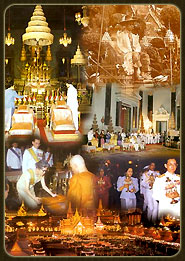
Royal Ceremonies, State Ceremonies, and Religious Ceremonies refer to both regular and special royal and state ceremonies such as birthday celebrations, royal merit-making ceremonies for presenting the Kathin robes, state ceremonies commemorating Constitution Day, as well as religious ceremonies at which His Majesty was invited to preside. These include ceremonies for casting Buddha images, installing finials on temple roofs, laying sacred boundary stones, and royal cremation ceremonies for those who died in the line of duty or distinguished individuals who contributed to the nation.
Royal Attendance at Charity Events refers to His Majesty’s presence as the presiding figure at events organized for charitable purposes, such as attending sports competitions, observing cultural performances, and participating in various social functions.
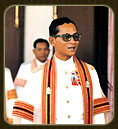
Royal Attendance at Educational Events, such as presiding over degree, diploma, and certificate presentation ceremonies for graduates from various educational institutions, as well as attending art exhibitions.
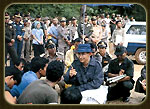
Royal Visits to the People, including visits to various locations and the presentation of unit flags to the Village Scouts, as well as visits to and inaugurations of various places such as universities, hospitals, and schools.
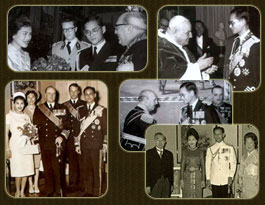
Head of State and Important Persons, such as receiving royal guests and attending receptions for diplomatic corps.
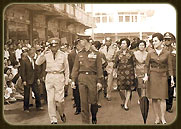
Audiences with government officials, merchants, and the public, including both Thai nationals and foreigners.
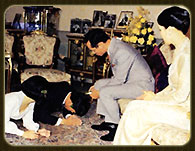
Presiding over royal marriage ceremonies.
His Majesty graciously appoints royal representatives to attend various events.
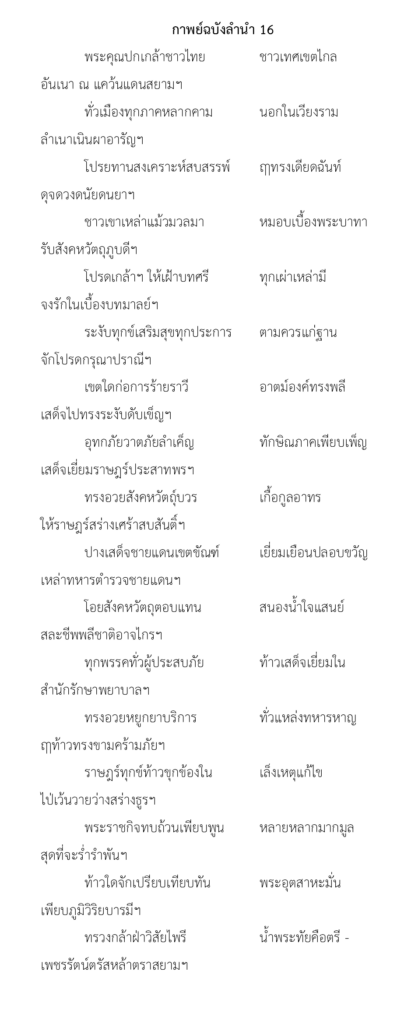
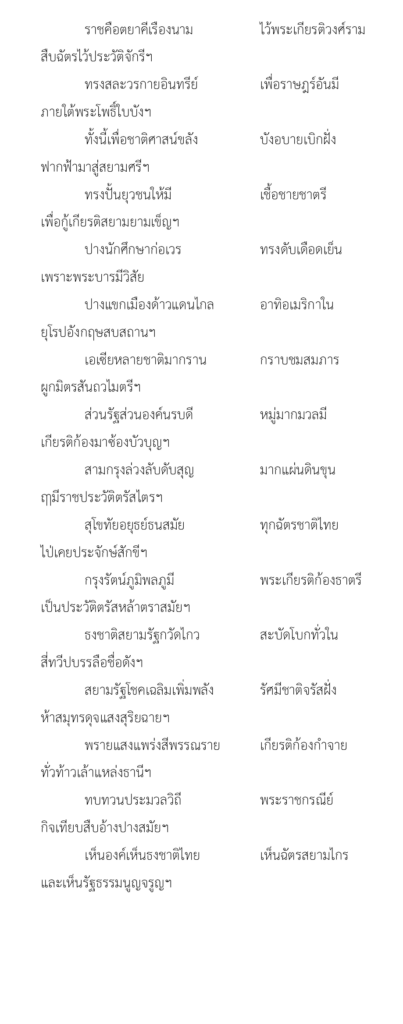
According to statistics compiled by the Office of His Majesty’s Principal Private Secretary, it is evident that King Rama IX carried out a vast number of royal duties each year. For example, from October 1988 to September 1989, there were 1,181 scheduled royal activities, and from October 1994 to September 1995, there were 1,314 scheduled activities. This shows that as the years of his reign increased, the number of official engagements also rose accordingly. It is difficult to find any monarch who has performed royal duties for the benefit of the nation and its people to an extent comparable to His Majesty the present King. Due to the challenge of describing these in detail, we would like to present a royal ode written by Mr. Wong Chaowanagavi in honor of the auspicious occasion of the coronation ceremony on Wednesday, June 9, 1971, to represent this praise.
Royal Duties
2. The performance of royal duties or activities that have led to the establishment of approximately 2,500 projects.
Associate Professor Dr. Pathom Maneerot compiled this in the book Genius Monarch published by the University Council Office (1996: 22-25), explaining one approach to examining the details of projects initiated by royal directives. This involves considering the characteristics of different types of related projects. His Royal Highness Prince Chakrabandh Pensiri, former Privy Councillor, once provided an explanation that these related projects fall into several categories: projects according to royal wishes, royal projects, projects initiated by royal directives, and projects under royal patronage. The details of each type of project are as follows.
Projects According to Royal Wishes are initiatives that His Majesty personally studied and experimented with. He consulted experts in relevant fields, sought methods to test and develop these projects, and continuously improved them over time to manage outputs both within and outside the royal premises. Using his own funds, he carried out these experimental projects until positive results were achieved. Once confident that the projects would truly benefit the people, he graciously allowed the government to support and participate in their implementation thereafter.
Royal Projects refer to initiatives specifically aimed at conserving and developing watershed areas in the northern forests to alleviate flooding in the lower basins of southern northern and central regions. These projects focus on water conservation during the dry season to sustain rivers and streams downstream. Since these areas are inhabited by hill tribes, the projects also aim to improve their livelihoods by encouraging them to abandon opium cultivation, slash-and-burn farming, and illegal trade. Instead, the hill tribes are supported to grow high-value rotational crops, upland rice, and raise livestock for their consumption, making these ventures more sustainable and profitable than opium farming. Thus, Royal Projects are those initiated by royal directives in collaboration with government agencies in northern highland areas to develop the occupations of hill tribe communities.
Projects Initiated by Royal Directives are development plans laid out by His Majesty, who advised the government to jointly implement them. These government agencies may be civilian, military, or a combination of both. Such projects currently exist throughout the country.
Projects Under Royal Patronage are those in which His Majesty offered guidance and royal directives for private sector entities to carry out using their own financial resources, expertise, and manpower, with ongoing monitoring by the private sector itself. An example is the development project of the cooperative village at Noen Din Daeng, Thap Sakae District, Prachuap Khiri Khan Province, organized and managed by the Rotary Club of Thailand following the royal directives.
All of the project types mentioned above are collectively considered “projects initiated by royal directives.” The number of newly started projects was initially limited but gradually increased over time. Manun Mukpradit proposed an analysis of the characteristics of these early-stage projects, suggesting they can be categorized into two forms:
Research, study, and experimental projects aimed at applying the results, with a strong emphasis on agricultural fields such as rice, field crops, water, and fisheries.
Development or problem-solving projects in specific areas characterized by an integrated development system.
The focus of the projects, whether research or development operations, emphasizes five key interconnected factors: water, agricultural land, capital, knowledge and technology, and marketing.
In recent years, the number of projects initiated by royal directives has increased, and their operational areas have expanded widely across the kingdom. According to a survey at the end of the fiscal year 1995, there were a total of 2,416 projects, both completed and ongoing.