

His Majesty King Bhumibol Adulyadej The Great
Chapter 23: His Majesty’s Benevolence toward King Mongkut’s University of Technology Thonburi

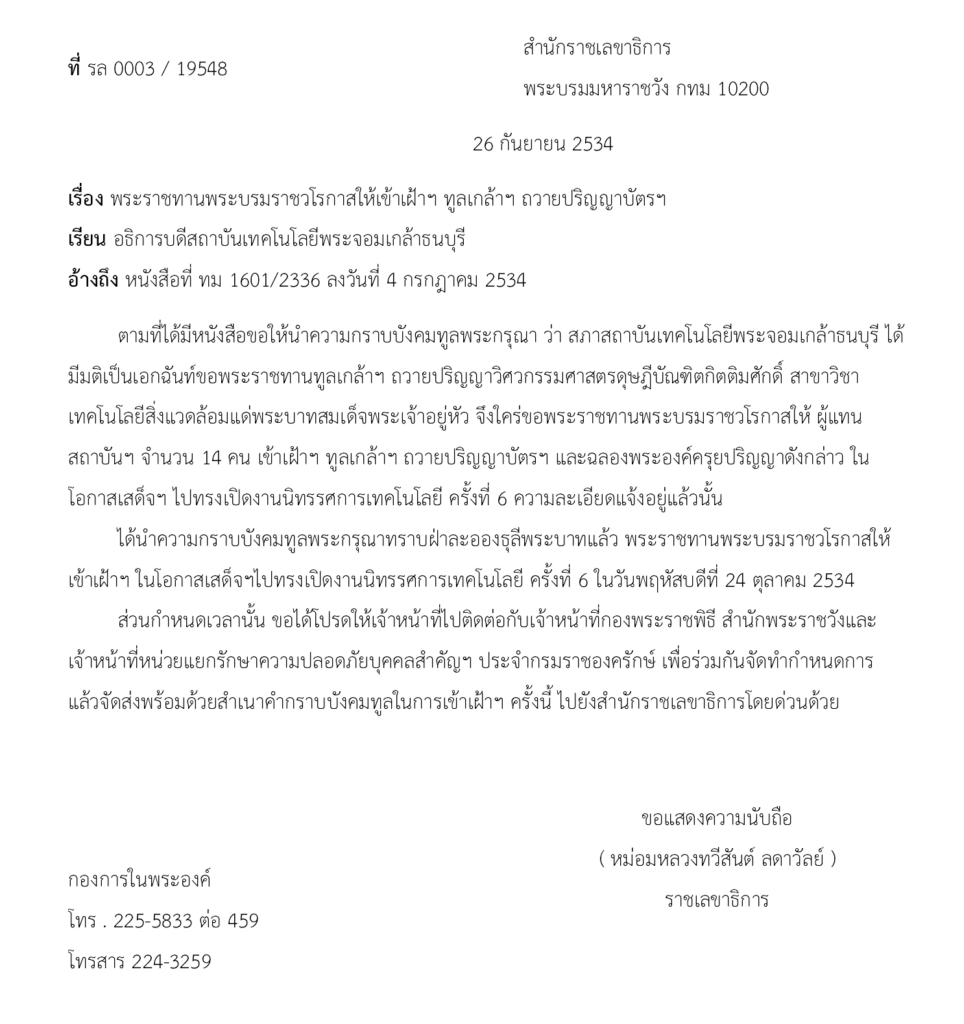
In 1986, King Mongkut’s Institute of Technology Thonburi was honored with the royal benevolence of His Majesty King Bhumibol Adulyadej (Rama IX), who graciously granted the Institute permission to use the name “King Mongkut’s Institute of Technology Thonburi.” This auspicious name serves as a reminder to current faculty, students, and alumni to follow in the footsteps of King Mongkut, who possessed remarkable intelligence and expertise in science, technology, and linguistics. In 1991, Deputy Secretary of the Royal Household, Professor Pawas Bunnag, respectfully submitted the Institute’s documentation to request that His Majesty visit the Sixth Technology Exhibition held at the Institute.
As this was the first occasion for His Majesty King Rama IX to personally grace the Institute with his presence as a source of inspiration and encouragement—and for the people of Thonburi to witness His Majesty’s benevolent reign closely and express their loyalty—His Majesty graciously consented to open the Sixth Technology Exhibition, as confirmed in the notification from the Royal Household Bureau.

————————————————————————————-
————————————————————————————-
Schedule
Opening of the 6th Technology Exhibition
at King Mongkut’s Institute of Technology Thonburi
Thursday, 24 October 1991
…………………
Time: 4:30 p.m.
– His Majesty the King proceeded by royal car from Chitralada Royal Residence, Dusit Palace, to King Mongkut’s University of Technology Thonburi (the royal car stopped in front of the King Mongkut monument).
– The University Council President, Rector, Vice-Rectors, Deans, Deputy Deans, Department Heads, and the Exhibition Organizing Committee attended to pay respects and welcome His Majesty.
– His Majesty proceeded to the King Mongkut Monument plaza.
– Laid a floral tribute.
– Lit incense and candles for the royal ceremonial offering.
– Paid respects.
– Entered the ceremonial pavilion.
– The exhibition chairman presented the program booklet and the 30th-anniversary publication to His Majesty.
– The Rector paid homage and reported.
– The Vice-Rector requested the donors to pay respects and present offerings for royal charity according to His Majesty’s discretion.
– His Majesty officially opened the 6th Technology Exhibition.
– Proceeded by royal car to the Chemical Engineering Department building.
– Viewed the mechanical engineering projects and Royal Projects exhibitions.
– Proceeded by royal car to the Main Classroom Building 1.
– Viewed the laser, computer, and medical equipment projects (Room CB 1209).
– Viewed the laser projects (Room CB 1204).
– Viewed the computer projects (Main Classroom Building 2).
– His Majesty proceeded to the seat in Room CB 2204.
– The University Council President paid homage and presented royal felicitations, requesting His Majesty to grant an audience to confer the honorary Doctor of Engineering degree in Environmental Technology.
– The Rector paid homage and presented the honorary Doctor of Engineering degree in Environmental Technology.
– The Vice-Rector paid homage and presented floral tributes, incense, candles, and a floral arrangement.
– His Majesty took a seated rest.
– Signed the commemorative book with His Majesty’s royal signature.
– Viewed the demonstration of water hyacinth removal.
– Viewed the soil stabilization project using lime.
– Proceeded by royal car.
– Returned from the visit.
Attire
Dress in the standard white uniform.
——————————————————————
(Signature)
8 October 1991
Between 1987 and 1991, the faculty and students conducted research in various fields, totaling 212 projects. The institute selected 47 of these projects to present for royal viewing and to seek the King’s guidance for further improvement and development. Dr. Krisanapong Keeratikorn, Vice President for Research and Development (currently serving as the University President), outlined the details of the 6th Technology Exhibition as follows.
The 6th Technology Exhibition
- To demonstrate the relationship between changes in Thailand’s economy and society, transitioning from an agricultural to a new industrial nation, based on domestically developed technology.
- To showcase achievements and advancements in science and technology created through self-reliance and applied externally.
- To illustrate the institute’s application and development of technology for society, particularly in the industrial sector.
- To highlight the use of modern technology for the benefit of contemporary industry, maximizing limited natural resources while minimizing environmental impact.
Objective
The direction of Thailand’s economic and social development should lead to a balanced society, one that is highly self-reliant, reduces dependence on foreign technology, and can compete broadly, while efficiently using resources and minimizing environmental impact.
Accordingly, the development of technology in Thailand should promote growth and support industries with comparative advantages that rely on the country’s natural resources (resource-based industries), such as food and agricultural product processing, petrochemical and plastic industries, and skilled labor–intensive industries like the gem industry, while also accelerating the generation of knowledge and technology.
This will serve as the foundation for industries that use minimal resources but generate high added value by leveraging science and technology, as well as for industries that are not resource-based (non-resource-based industries) and knowledge-based industries that do not rely on the country’s natural resources, while minimizing environmental impact. Examples include the computer and information industry, engineering industries producing and using modern materials, and the biotechnology industry. Among these, the food and agricultural product processing industry is of high importance because the country’s major exports are still largely based on agricultural raw materials. In addition, the majority of the population continues to earn their livelihood in rural agriculture.
The growth of industry and exports, particularly in the processing sector, leads to increased pollution if industrial waste is not properly treated. Moreover, the growth of communities alongside economic expansion not only contributes to pollution from residential areas but also increases energy demand—for transportation, industry, and electricity production—which can result in acid rain and greenhouse gas problems. Therefore, the development of technologies for environmental treatment and restoration, as well as pollution-free energy technologies, represents the desired direction for technological advancement.
Technology Exhibition Project
The 6th Technology Exhibition Project showcases the work of students, faculty, and researchers from the institute, encompassing teaching and research across the four faculties of the institution:
(1) Faculty of Engineering, comprising the following departments:
– Chemical Engineering
– Computer Engineering
– Mechanical Engineering
– Electrical Engineering
– Civil Engineering
– Industrial Engineering
– Food Engineering
(2) Faculty of Science, comprising the following departments:
– Mathematics
– Chemistry
– Microbiology
– Physics
(3) Faculty of Industrial Education, comprising the following departments:
– Mechanical Engineering
-Electrical Engineering
-Civil Engineering
-Industrial Engineering
-English for Science and Technology
(4) Faculty of Energy and Materials, comprising the following departments:
-Energy Technology
-Energy Management Technology
-Biotechnology
-Materials Technology
-Environmental Technology
Moreover, the exhibits also included works from the institute’s research and service units, namely: the Scientific Instrument Center for Standards and Industry, the Research and Development Operations Center, the Computer Center, and the Institute for Development and Training of Prototype Factories.
- 1. Exhibited Projects
The exhibited projects reflected the concepts described above and were organized into six main groups:
1.1 Computers for a Learning and Productive Society
This group of projects demonstrates the role and potential of computers as tools for education, both in formal and non-formal systems, as well as their use in supporting automated production processes to supplement or replace human labor. The aim is to enhance business and industrial efficiency, extending to the application of artificial intelligence systems that expand the scope and capability of decision-making, learning, and perception. The exhibited projects include the use of computers in education and in learning basic sciences, languages, education, and industrial fields; the use of computers for scientific study and design across disciplines, particularly the role of computers as design aids (Computer Aided Design); and the use of computers in controlling industrial equipment and manufacturing processes, both in engineering industries (such as materials forming) and in production industries. Computers and artificial intelligence systems (Artificial Intelligence), such as expert systems and computer-based language translation, are also presented, together with applications of computers in information systems, business enterprises, and recreation.
1.2 Prototype Devices and Machinery
Prototype devices and machinery for various applications have been developed by the Institute and are already in use within communities and industries. They can be classified according to their primary functions, including devices and machinery for households, village industries, and small-scale industries; machinery for the food industry and agricultural product processing, designed and constructed by the Institute’s faculty members and researchers for use in Royal Factories under the Royal Projects and Royal Development Projects, to process vegetables and fruits such as tomatoes and baby corn, and to produce concentrated fruit juice. Other devices and machinery serve engineering industries, such as engines and pumps, casting, metal forming, electronic instrumentation, measurement, and control, as well as electrical machinery emphasizing the integration of power electronics with microprocessors and computers for controlling, distributing, and utilizing electrical power. Additional developments include scientific analytical instruments, medical and physiotherapy equipment, and devices and machinery for addressing environmental and sanitation issues, such as water hyacinth removal boats and high-efficiency shredders and incinerators for waste materials.
1.3 Industrial Prototype Plants
An industrial prototype plant is a project designed to operate at a production scale or capacity of approximately one hundredth to one tenth of an actual industrial factory. Prototype equipment and machinery are assembled into systems for continuous or semi-continuous production testing under input and operating conditions closely resembling real manufacturing processes. Engineers use prototype plants to collect technical data on integrated production systems for scale-up and full-scale plant design. They can also be used for employee training, allowing workers to learn operational techniques and plant control, as well as for testing new production methods when changes in raw materials or production conditions occur—circumstances that real factories, which are typically designed for specific purposes, cannot accommodate. In addition, preliminary studies on technical and economic feasibility may be conducted using prototype plants. The Institute has continuously developed its capabilities in prototype plant systems for both process industries and manufacturing industries. The industrial prototype plants presented emphasize the food industry, soybean processing, value enhancement of cassava, and waste treatment.
1.4 Technology for Value Creation from Natural Resources and Knowledge-Based Industries
Modern technologies (Sunrise Technologies) support knowledge-based production, the creation of an information and learning society, and the enhancement of quality of life. Prominent examples of such technologies include electronics and computer technology, as well as pollution-free energy technology. The new technology projects on display include biotechnology for waste treatment, the utilization of by-products, and industrial processing, emphasizing the conversion of waste materials or the value addition of agricultural raw materials through the use of bacteria, yeast, fungi, and algae for the production of food, chemicals, and bioactive substances. Laser technology is also featured for applications in medicine, precision measurement, industry, and agriculture, utilizing various types of lasers designed and constructed by the Institute’s researchers, such as helium-neon lasers, organic dye lasers, carbon dioxide lasers, and nitrogen lasers. The modern materials technologies exhibited include thin-film technology developed through physical vapor deposition (vacuum evaporation and sputtering) and chemical coating techniques (thermal chemical vapor deposition).
To prepare protective coatings against corrosion and wear, thin films are applied to glass surfaces of residential and commercial buildings to regulate the transmission of light and heat. Other developments include high-temperature superconductors, amorphous metals, and studies on the enhancement and treatment of gemstones. Examples of pollution-free energy technology projects include solar-thermal energy generation, solar-powered water pumping systems for domestic, industrial, and agricultural use in rural areas, and photovoltaic systems for electricity generation in rural villages.
1.5 Educational and Training Equipment in Industrial Education
The Institute serves as an important educational institution for the training of teachers for technical and vocational schools and colleges, who in turn educate the nation’s future technicians. The Institute’s industrial education programs have consistently produced teachers and developed teaching equipment as well as educational technologies. The exhibition projects in this group include experimental and demonstration training kits in electronics, telecommunications, electrical engineering, engine mechanics, fluid mechanics, measurement and control, civil engineering, and other educational technologies such as instructional media.
1.6 Environmental Technology
The exhibition projects in this group include works related to the management and mitigation of pollution originating from communities and industries, such as canal water quality improvement, treatment of industrial wastewater using various techniques, air pollution control, and the design of equipment and machinery for solving environmental and sanitation problems. The exhibition also aims to promote understanding and awareness regarding environmental and natural resource conservation.
2. Supplementary Projects
2.1 Demonstrations of engineering and scientific experiments using the Institute’s instruments and equipment
2.2 Exhibitions of scientific and modern technological knowledge from both governmental and private organizations
2.3 Science quiz competitions for secondary school students
2.4 Science skill competitions for secondary school students
2.5 Environmental conservation awareness activities addressing issues arising from community and industrial growth
- The area in front of the Institute at the Monument of King Mongkut, which included the royal pavilion, three tents for honored guests and government officials, and the area designated for the opening ceremony of the exhibition.
- The ground floor of the Department of Chemical Engineering building, arranged for displaying research and development projects related to agricultural and industrial machinery.
- The first and second floors of the Classroom Buildings 1 and 2, including the front area of the former Language Building—now serving as the cooperative store and printing office—which was designated as the parking area for the royal motorcade and as the location for the band of Suthiwararam School students.
Projects Presented for His Majesty’s Observation at the 6th Technology Exhibition
King Mongkut’s University of Technology Thonburi
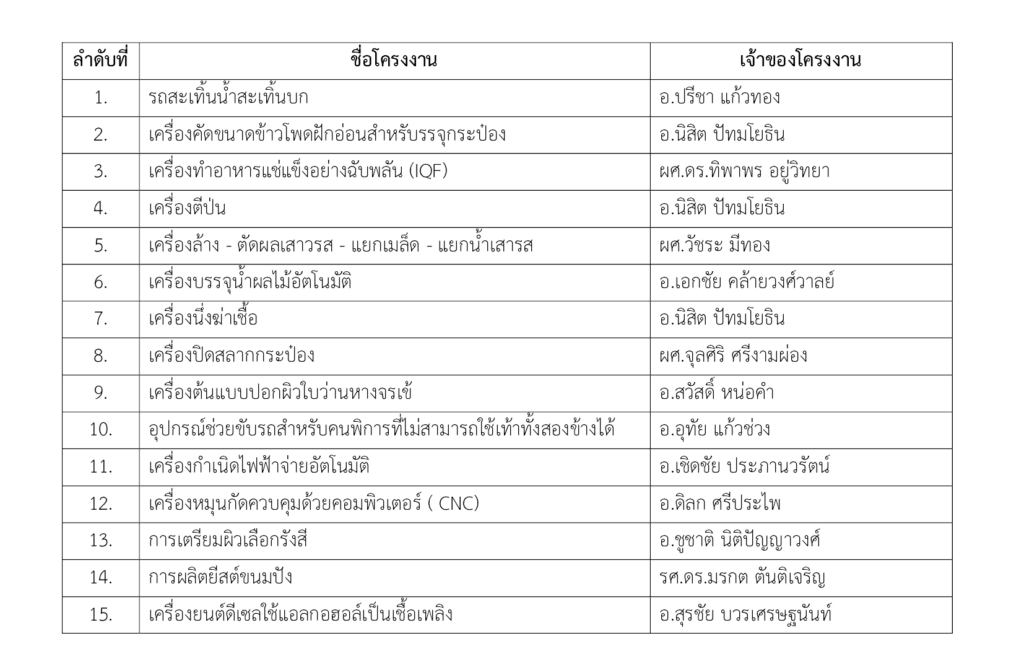
1. Chemical Engineering Building
The person presenting the report and inviting His Majesty to view the projects: Associate Professor Dr. Sakrin Phumiratana
2. Classroom Building 1, Room CB 1209
The person presenting the report and inviting His Majesty to view the projects: Dr. Krisanapong Kiratikorn

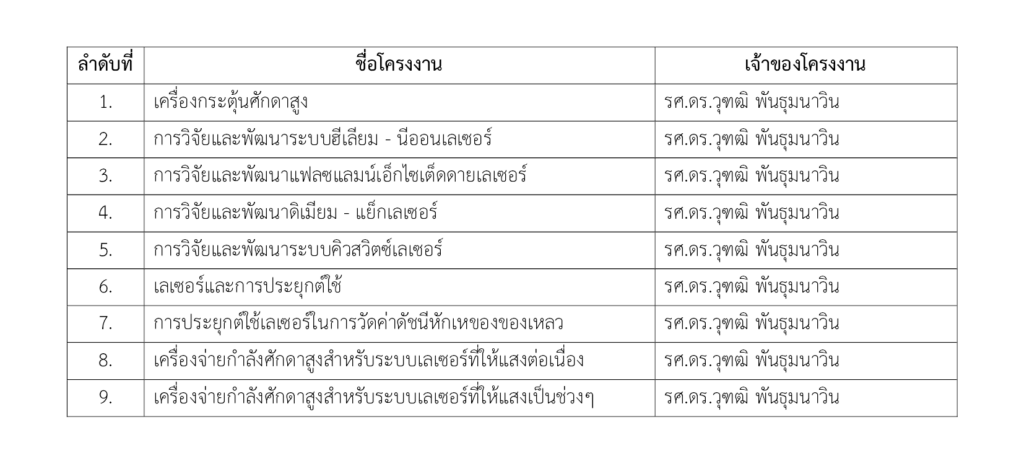
2. Classroom Building 1, Room CB 1204
The person presenting the report and inviting His Majesty to view the projects: Associate Professor Dr. Wutthip Phantumvanit
4. Classroom Building 2, Room CB 2206
The person presenting the report and inviting His Majesty to view the projects: Dr. Boworn Papasratorn
– Group of Computer Projects (three main groups)
These computer projects were developed by the Computer Center, the Department of Computer Engineering, and the Information Technology Services Unit, consisting of the following:
1. Information Processing Project
This project demonstrates the use of information in various forms, including data, images, and sound, within a computer network consisting of workstations and personal computers (PCs). It illustrates the use of computer networks as tools for teaching various subjects.
2. Electronic Design Automation Project
This project presents the design of integrated circuits using computers, including an example of the first integrated circuit designed by a Thai engineer. It also showcases design software developed in Thailand for both workstations and PCs.
3. Computer Aided Technology Project
This project demonstrates the design and production of items using computers, including examples such as the design and production of the royal monogram (Phor Por Ror). It also shows architectural design using computers, including a design example of the Queen Sirikit National Convention Center, as well as computer-aided cost estimation and bill of materials preparation, including an example for residential building construction.
5. Ground Floor Area, Classroom Building 2, by the Pond
The person presenting the report and inviting His Majesty to view the projects: Associate Professor Dr. Det Phutthacharoenthong
5.1 Water hyacinth removal boat
5.2 Water hyacinth conveyor belt
5.3 Water hyacinth shredder
6. Lawn Area, Classroom Building 2, by the Pond
The person presenting the report and inviting His Majesty to view the projects: Assistant Professor Kasem Petchkhet
Soil strength improvement
The day of the opening of the 6th Technology Exhibition had finally arrived. The long-awaited day was Thursday, 24 October 1991, at approximately 4:00 p.m. His Majesty King Rama IX, accompanied by Her Royal Highness Princess Maha Chakri Sirindhorn, arrived to officially open the 6th Technology Exhibition at the area in front of the Institute. The following presents the royal portrait and a description of His Majesty’s visit to the Institute.
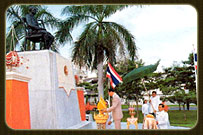


1. His Majesty King Rama IX proceeded to the forecourt of the Monument of King Mongkut (Rama IV), where He laid a floral wreath, offered incense and candles as royal tributes, and paid respects with a bow.
2. His Majesty proceeded into the ceremonial pavilion.
3. Associate Professor Dr. Paiboon Hangsparuk, President of the Institute, respectfully presented the report as follows.
Report Presented
by
Mr. Paiboon Hangsparuk
President of King Mongkut’s University of Technology Thonburi
On the Occasion of
His Majesty King Bhumibol Adulyadej’s Visit to Open the 6th Technology Exhibition
at King Mongkut’s University of Technology Thonburi
Thursday, 24 October 1991
————————————————————————————-
By the Grace of Your Majesty’s Presence,
I, Paiboon Hangsparuk, President of King Mongkut’s University of Technology Thonburi, respectfully beg Your Majesty’s gracious permission to present a summary report on the organization of the 6th Technology Exhibition as follows.
It is a special and most auspicious occasion, marking the first time that Your Majesty, accompanied by Her Royal Highness Princess Maha Chakri Sirindhorn, has graciously visited King Mongkut’s University of Technology Thonburi. Your Majesty’s visit brings great honor and encouragement to the Institute, granting royal permission for the conferral of an honorary Doctor of Engineering degree in Environmental Technology and presiding over the opening of this exhibition. We are deeply grateful and profoundly mindful of Your Majesty’s boundless grace, which inspires and strengthens us to carry out our duties to serve the nation to the utmost of our abilities.
On behalf of all who are privileged to serve at Your Majesty’s feet, I humbly offer our loyal wishes for Your Majesty’s enduring health and long life, and may You continue to be the guiding light for the Thai people for all time.
- To disseminate and honor the royal prestige of King Mongkut (Rama IV), whose royal monogram the Institute has been granted permission to use.
- To share knowledge resulting from academic research in science and technology for the development of the nation’s economy and society.
- Most importantly, to celebrate the occasion in which the Institute was granted royal permission to confer an honorary Doctor of Engineering degree in Environmental Technology upon His Majesty in 1990.
For these reasons, the faculty, staff, and students of the Institute have united to organize the 6th Technology Exhibition, presenting a total of 212 projects. These projects represent the academic work of students and staff over the four years since the previous exhibition. The projects can be categorized into six main groups: Computers for a Learning and Productive Society, Prototype Devices and Machinery, Industrial Prototype Plants, Technology for Value Creation from Natural Resources and Knowledge-Based Industries, Environmental Technology, and Educational and Training Equipment for Industrial Education.
Furthermore, the Institute has organized a number of projects presented for His Majesty’s observation. We humbly seek His Majesty’s guidance and advice on improving and developing these research works. This royal benevolence will serve as the highest source of inspiration, motivating faculty members and students to persevere and remain steadfast in their determination to unite their physical effort, dedication, and intellect in creating, preserving, developing, and disseminating knowledge, faithfully following in the footsteps of His Majesty without ceasing.
The auspicious moment has now arrived. I respectfully request permission to invite His Majesty to proceed to officially open the 6th Technology Exhibition, and to graciously allow the presentation of offerings by those presenting them, according to His Majesty’s royal discretion, as will be further reported by Mr. Suchart Perstipring, Chairman of the Coordination Committee for the 6th Technology Exhibition.
With utmost respect and loyalty, I humblysubmit.
3. Mr. Suchart Perstipring, Deputy President for Student Affairs, respectfully reported that 30 donors were invited to present monetary contributions according to His Majesty’s royal discretion. Subsequently, His Majesty graciously bestowed the entire sum to the Institute, which was then granted royal permission to establish the Phor Por Ror Fund for Research. The funds received were deposited into this research fund as detailed below.
History of the Fund
His Majesty the King graciously conferred the contributions offered by donors on the occasion of His visit to open the 6th Technology Exhibition at King Mongkut’s University of Technology Thonburi, totaling 804,920 Baht (eight hundred four thousand nine hundred twenty Baht), to be used for the Institute’s activities. The Institute established this sum as the “Phor Por Ror Fund for Research,” with royal permission to use the royal monogram Phor Por Ror (Por Ror) as the fund’s name.
Current Financial Status of the Fund (Fiscal Year 2004)
The fund currently amounts to 6,529,524.02 Baht (six million five hundred twenty-nine thousand five hundred twenty-four Baht and two satang).
Objectives of the Fund
1. To develop, promote, and support research by Institute staff and students to achieve progress, high efficiency, and benefits for economic and social development, both in urban and rural areas.
2. To encourage and support research for the benefit of the Institute.
3. To provide research grants for projects conducted by Institute personnel, either independently or in collaboration with external researchers.
4. To serve as awards of honor and encouragement for Institute personnel whose research work receives recognition in competitions or is honored by organizations both domestic and international, bringing prestige to the Institute in research and development.
5. To provide funding for participation in research conferences or the presentation of academic research abroad.
6. To support other research-related activities as deemed appropriate by the Committee.
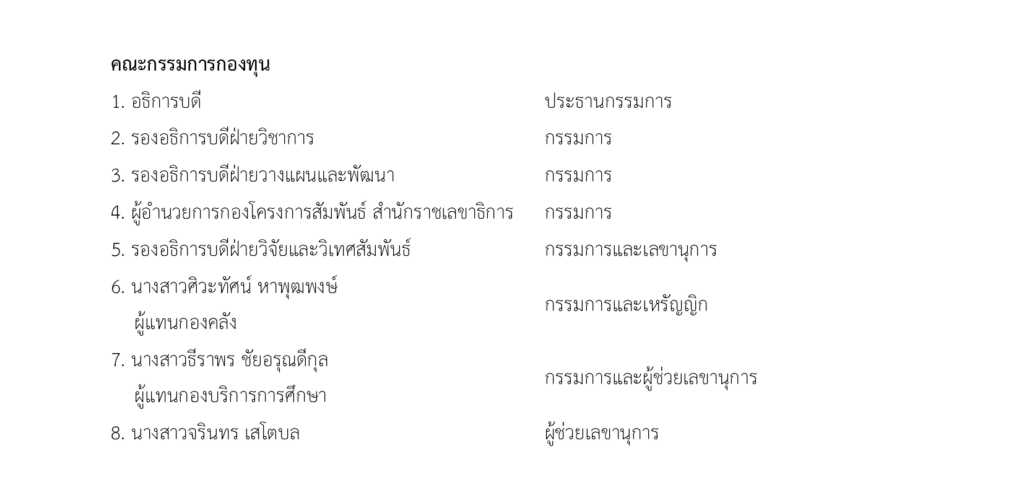
Objective
On the occasion of the 50th anniversary of His Majesty King Rama IX’s accession to the throne, and to preserve and enhance the royal-conferred fund for posterity, only the interest generated will be used to support research, study, and development in accordance with His Majesty’s royal initiatives, ensuring their usefulness and value, as pledged by the Institute. At the Fund Committee meeting on 2 May 1995, it was decided to campaign to raise no less than 10 million Baht within five years, with the initial contributors as follows:
1. A group of the Institute’s executives
2. The Institute’s Faculty Council
3. Associate Professor Kasem Petchkhet (former President of the KMUTT Alumni Association)
60,000 Baht
10,000 Baht
10,000 Baht
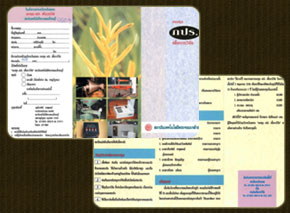
Phor Por Ror Fund for Research Brochure
His Majesty observed the amphibious vehicle.

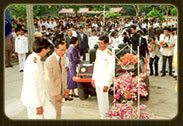
5. เสด็จฯ ทอดพระเนตรเครื่องคัดขนาดข้าวโพดฝักอ่อน

His Majesty observed the laser mole removal procedure.


His Majesty observed the helium-neon laser, one of the laser exhibition projects.

The President (Associate Professor Dr. Paiboon Hangsparuk) paid a ceremonial visit to present the honorary Doctor of Engineering degree in Environmental Technology.
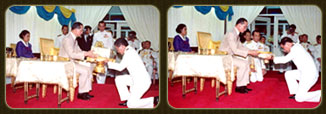
His Majesty observed the computer exhibition, including the Information Processing Project, the Electronic Design Automation Project, and the Computer Aided Technology Project.
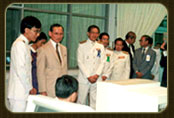
His Majesty observed the water hyacinth removal process.
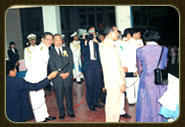
His Majesty observed the soil strengthening project using lime.
In 1990, Assistant Professor Dr. Prungchan Wongswiset, then Dean of the Faculty of Industrial Education, sent the 1990 New Year’s greeting card to the faculty members of the Faculties of Industrial Education and Science, regarding His Majesty King Rama IX’s royal address, which highlighted four weaknesses of the university.
His Majesty pointed out these four major shortcomings that the university should collaboratively address and correct.

On 3 October 1990, after the ceremonial presentation of honorary doctoral degrees in various fields to His Majesty King Rama IX at Dusit Thani Hall by the chairpersons of the councils of five universities—Ramkhamhaeng University, Sukhothai Thammathirat Open University, Silpakorn University, National Institute of Development Administration, and the Royal College of Surgeons—His Majesty graciously delivered royal guidance to those in attendance: “Universities normally aim to educate students to be capable, such as in academic knowledge, initiative, courage, and eagerness to advance. While this emphasis on capability seems beneficial, upon closer examination it may lead to several personal shortcomings. Most importantly:
- A lack of thorough and broad-minded consideration, due to impatience and the rush to complete tasks, resulting in errors, failures, or disruptions.
- A lack of respect and consideration for others, arising from a sense of personal superiority, leading to arrogance, neglecting the importance of others, causing conflicts, damaging friendships, and undermining unity.
- A deficiency in moderation and balance in one’s actions, as the focus on personal prominence and advancement may lead to selfishness and exploitation.
- A deficiency in ethics and understanding of right and wrong, as the pursuit of personal gain may result in wrongdoing, immorality, or corruption without any sense of conscience.”
He further stated, “Those who exhibit these shortcomings are often unable to grasp causes, effects, or principles correctly, and as a result, they frequently encounter problems and mistakes, failing to achieve true and stable progress for themselves or the nation. Therefore, in addition to teaching students to be capable, it is essential to cultivate their character as well. Only then will the country have quality individuals—both competent and virtuous—to serve as its strength. Competence provides the means and energy for creation, while virtue guides and supports that competence in the proper direction, producing beneficial and desirable outcomes.”
His Majesty King Rama IX also advised that if all universities work together to cultivate both competence and virtue simultaneously in students, the various mistakes, confusions, and problems in the country will gradually diminish, and genuine progress will be achieved more rapidly than by the hurried efforts currently being undertaken.