

His Majesty King Bhumibol Adulyadej The Great
Chapter 11: Royal Activities Related to Buddhism
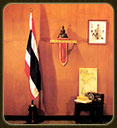
Since ancient times, Thailand has comprised three principal institutions: the Nation, Religion, and Monarchy. These three institutions are deeply interconnected and inseparable, especially the institution of religion, as the majority of Thai people have embraced Buddhism as the national religion since the Sukhothai period. Buddhism has been closely associated with the monarchy, with every king being a Buddhist and the Supreme Patron of all religions in the kingdom. The monarchs have undertaken royal duties to support and promote all faiths, granting royal funds and encouraging acts of merit and charity. His Majesty King Bhumibol Adulyadej the Great held profound faith in the teachings of the Buddha.
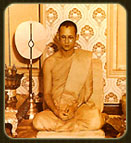
He therefore devoted himself to the continual nurturing and advancement of Buddhism, while also extending his royal patronage to other religions. In truth, with regard to Buddhism, His Majesty carried out numerous royal activities to promote the faith. One of the most significant was his ordination as a Buddhist monk, from 22 October to 5 November 1956, a period of 15 days. Although brief, due to his many other royal responsibilities, this act profoundly demonstrated his genuine faith in Buddhism. As he once remarked on the subject of Buddhism, in words bestowed upon representatives of Buddhist associations nationwide who were granted an audience on 13 December 1980:
“…You place your hopes in the merit of others to safeguard the nation—this is something worth reflecting upon. A country is made up of individuals, and each individual must act for themselves in accordance with the principles of Buddhism. What every person seeks is happiness, which is peace. And such happiness and peace can only arise from within oneself. Therefore, to rely solely on others for protection is difficult if one does not act for oneself. This is a most important teaching in Buddhism: those who consider themselves Buddhists must depend upon themselves, not on others. Yet it is possible to rely on others to some extent—by observing those who conduct themselves rightly and listening to the guidance they provide. In this way, one may benefit from others. But it still requires personal discernment to determine whether such a person is worthy of being observed or whether their advice should be followed. This is what enables an individual to attain success and true happiness…”
Another Royal Address, bestowed to be read at the opening of the 28th General Assembly of Buddhist Associations of Thailand on 6 December 1980, likewise reflected His Majesty’s profound understanding of Buddhist philosophy, stating that:
ChatGPT said:
“…The Dhamma, the teachings of the Buddha, reveal the ultimate truth as realized through the wisdom of the Noble Ones. Thus, it is the most exalted teaching, worthy of study and contemplation, to be clearly seen and understood through reflection—not to be grasped superficially without thorough consideration, for that would lead to misunderstanding, false views, and distortion of the Dhamma. You who have come together to promote and support Buddhism, as well as the moral conduct of the people, have the duty to study, practice, and disseminate the Dhamma at all times. It is most essential that you study, practice, and teach with the utmost care and diligence, so that the essence remains true to the Buddha’s precepts and explanations. In this way, your work in preserving and upholding the religion will yield results that are pure and complete in every aspect, in accordance with the faith and aspirations you uphold…”
And in the Royal Address bestowed to be read at the opening of the 29th General Assembly of Buddhist Associations of Thailand on 19 December 1981, His Majesty clearly explained:
“…The Dhamma in Buddhism is pure, flawless, and complete with reason. It is something that individuals can study and practice with wisdom and reflection, thereby gaining true benefit in the form of growth and happiness. This extends from the basic benefit of establishing oneself in a state of normal well-being, to the highest benefit of ultimate liberation from all attachments and bonds. This is the distinctive quality of Buddhism, which makes it supremely valuable…”
The royal activities of His Majesty King Bhumibol Adulyadej the Great in relation to Buddhism were as follows:
1. He performed royal acts of merit.
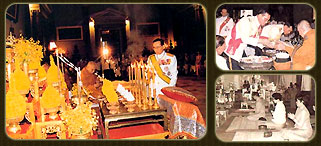
In principle, Buddhists, like followers of other religions around the world, share the belief that “religious holidays are highly significant to daily life.” For this reason, governments in various countries designate national religious holidays as public holidays, allowing believers to participate in important rituals. Major Buddhist observances include Magha Puja, Visakha Puja, Asalha Puja, the beginning of the Buddhist Lent, and the end of the Buddhist Lent—whether officially recognized as national holidays or observed locally within specific communities. His Majesty King Rama IX consistently performed acts of merit in Buddhism, both privately, such as offering alms at the royal residences, presenting personal Kathin robes, or the principal Kathin robe at various local temples, and publicly, through royal ceremonies in accordance with traditional royal customs, such as performing merit-making on Visakha Puja and Asalha Puja (the latter being a royal ceremony established for the first time in his reign). In addition, His Majesty also graciously appointed members of the royal family to perform acts of merit at various locations.
Moreover, at religious ceremonies organized by the public or government officials, when invitations were respectfully extended according to His Majesty’s discretion, he graciously accepted and attended to perform the rituals or serve as the presiding dignitary, without exception. Such ceremonies included the installation of the temple spire and the consecration of boundary stones (luk nimit). In addition, His Majesty also kindly appointed members of the royal family to attend these ceremonies organized by the people.
2. He supported and restored temples and monasteries.
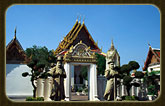
Wat Phra Chetuphon Vimolmangklararm (Wat Pho)
The temple is an essential factor for monks and novices in sustaining their livelihood and carrying out various duties such as studying, practicing, and propagating the Dhamma. In addition, the temple serves as the spiritual center of the community and as a hub for community development in all aspects. Therefore, the temple holds great importance both for monks, novices, and Buddhist laypeople.
The construction and restoration of temples has long been considered a most important yet highly demanding task. Beyond the allocation of land, it also requires financial resources and manpower to build various structures such as ordination halls, assembly halls, sermon halls, monks’ residences, and numerous other facilities. For this reason, it was often beyond the capacity of individuals or ordinary groups of people to accomplish such undertakings. Thus, Buddhists have traditionally believed that those who establish a temple will receive abundant spiritual merit. For example, it was believed that the construction of a monks’ residence would ensure rebirth in the Tavatimsa Heaven, where one would enjoy celestial wealth in a magnificent mansion adorned with the seven precious gems, attended by celestial maidens, and live in complete bliss for all eternity.
In earlier times, the responsibility of building a temple fell upon members of the community. If they were unable to establish one within their own village, they would have to perform merit-making in neighboring communities, which was often inconvenient due to difficulties in travel. The absence of a temple in a village was therefore regarded as a major hardship for the community and could even mark it as underdeveloped. Consequently, Thai monarchs since ancient times undertook the construction and restoration of temples and encouraged those with sufficient wealth to build temples and monasteries within their local communities.
In order to enable monks to carry out their daily religious duties and to provide Buddhists with opportunities for merit-making, temples gradually emerged in communities across the land. These temples served not only as centers for worship, study, and practice of the Dhamma, but also as places of general education and as focal points for community development in all aspects. They thus became an essential foundation for the country’s development, continuing into the present day.
His Majesty King Rama IX exemplified the noble traditions of former monarchs in this regard with utmost grace and completeness. Although the role of temples within communities has changed somewhat from the past, His Majesty continued to support their maintenance and restoration, ensuring that they could respond to the needs of local communities within their contemporary context. For instance, His Majesty would grant his personal funds or money presented to him for religious merit on the occasions of his visits to temples, the annual Kathin ceremony, or other royal occasions. Whenever he visited a temple, he would present such funds for its restoration, upkeep, and for the support of both monastic and community activities. Furthermore, he granted Visungkhamsima (ordination boundaries) to temples jointly built by the people, and in some cases elevated local temples to the status of royal temples.
These royal practices greatly strengthened the stability and prosperity of Buddhism, enabling communities to advance in many endeavors. They also set a moral example for Buddhists to emulate, inspiring faith and encouraging those with sufficient resources to establish temples and to continue supporting Buddhism. For this reason, His Majesty remains ever cherished in the hearts of the Buddhist faithful.
3. Royal Duties Concerning the Sangha
- 3.1 The Conferral of Ecclesiastical Titles upon Monks
His Majesty the King and members of the Royal Family maintained a close relationship with the monastic community, extending patronage both personally and officially. In official matters, His Majesty conferred ecclesiastical titles upon monks who diligently studied the Pali Canon, demonstrated profound knowledge of the Tipitaka, upheld the discipline of the Vinaya with steadfastness, and lived a life of exemplary conduct. The ecclesiastical ranks of the Thai Sangha conferred by His Majesty were as follows:
ChatGPT said:
Somdet Phra Ariyavongsagatayan, the Supreme Patriarch, Head of the Sangha (Enthronement Ceremony of the Supreme Patriarch, Chapter 13)
Somdet Phra Racha Khana, senior ecclesiastical dignitaries of the Suphanbat rank
Phra Racha Khana of the Hiranyabat rank, deputy to the Somdet level
Phra Racha Khana of the Thammamat rank
Phra Racha Khana of the Thepbat rank
Phra Racha Khana of the Rajabat rank
Phra Racha Khana of the Ordinary rank
- 3.2 Promotion of Monastic Education in the Pali Canon
The promotion of Pali Canon studies was intended to enable monks to progress in step with a changing society. In support of the Sangha, His Majesty granted patronage to novice monks who had successfully passed the ninth level of Pali Canon examinations, elevating them to the status of Nak Luang and ordaining them at Wat Phra Si Rattana Satsadaram. Owing to His Majesty’s merit and patronage, a greater number of novices attaining the ninth level of Pali Canon proficiency emerged during his reign than in any previous era.
4. Support and Dissemination of the Dhamma
The dissemination of the Dhamma is considered the best way to preserve Buddhism, as it ensures the teachings of the Buddha endure for future generations. In the past, commentators placed great importance on this, describing in detail the merit of those who contributed in various ways. For example, it was believed that compiling the entire Tipitaka in one effort would grant extraordinary merit: the person would become a great universal monarch for 84,000 kalpas, then ruler of vassal states for nine asankhya years, enjoy immense wealth as a Brahmin master for nine asankhya years, be a wealthy merchant for nine asankhya years, and partake in celestial treasures in the heavens of Catumaharajika, Tavatimsa, Yama, Tusita, Nimanarati, and Paranimmita-vasavatti, each for nine asankhya years. Upon rebirth in the human world, they would possess abundant knowledge, wealth, and attendants, be virtuous and diligent in merit-making, have a beautiful appearance, and a generous and kind heart toward others. In short, the merit of compiling the Tipitaka was considered “inconceivable.” Buddhists have long aspired to create such merit in spreading the Dhamma, and even if they could not contribute directly, they sought to rejoice in and support the efforts of others.
- 4.1 Revision of the Tipitaka
The revision of the Tipitaka involves carefully checking and correcting the text, whether inscribed or newly printed, to ensure accuracy, without altering or adding content according to personal preference. In this process, the edition to be printed is cross-checked against versions in various scripts, such as the Pali Tipitaka in Sinhala script, the Devanagari script of India, Burmese script, Mon script, and even the Roman script printed in England. Minor differences are noted as references, since errors or omissions may have occurred in previous inscriptions or printings. Through this careful revision, the text and characters are rendered accurate and complete, free from mistakes. During the reign of His Majesty King Rama IX, this marked the fifth such revision of the Tipitaka in Thailand.
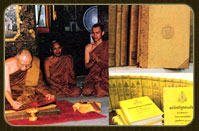
In the time of the Buddha, his teachings were not recorded in writing. Monks preserved them through memorization and oral transmission. About 200 years after the Buddha’s passing, these teachings and the essential doctrines of Buddhism were compiled and written in Pali, or in Magadhi—the language of the people of the Magadha region, which was a large and important kingdom at that time—to ensure their preservation for future generations.
The Tipitaka consists of three parts:
Vinaya Pitaka, which deals with the rules and regulations that the Sangha should follow.
Abhidhamma Pitaka, which contains the essential principles and core teachings of Buddhism.
Sutta Pitaka, which presents the general teachings of the Buddha and his disciples.
The teachings of the Tipitaka are highly valuable for elevating moral conduct in body and speech, and for cultivating virtues of the mind. They instruct followers to abstain from evil, practice goodness, and purify their minds.
Partial translations of the Tipitaka from Pali into Thai began as early as the Sukhothai period and continued through the Ayutthaya, Thonburi, and Rattanakosin periods, though not all volumes were completed. During the reign of His Majesty King Rama IX, he supported the Thai Sangha in revising the 80-volume Royal Tipitaka, which had been printed for the 25th Buddhist Century Celebration in 1957, into 45 volumes, corresponding to the Buddha’s age, and arranged for its publication and dissemination.
The Vinaya Pitaka was also reviewed, and the Tipitaka carefully revised on the auspicious occasion of His Majesty’s fifth cycle birthday in 1987. Thus, during the present reign, the Tipitaka, along with its commentaries in both Pali and Thai, was fully compiled and published in 1992 to honor Her Majesty the Queen on the occasion of her fifth cycle birthday.
4.2 The Computerized Tipitaka
In 1988, Mahidol University entered the Pali and Thai texts of the Tipitaka into a hard disk for use with computers. This project was funded by the personal resources of His Majesty King Rama IX, allowing anyone studying the Tipitaka to retrieve specific passages on the screen and print them for research within seconds. This achievement was completed before His Majesty’s birthday on December 5, 1991, marking a significant royal initiative in the promotion and support of Buddhism. It was also the first major accomplishment of its kind in the world and brought great honor to Thailand, which was recognized as a central hub of Buddhism. The World Fellowship of Buddhists subsequently designated Thailand as the permanent headquarters of the organization.In addition to supporting the revision of the Tipitaka, His Majesty King Rama IX also patronized numerous other initiatives for the study and dissemination of the Dhamma. For example, he supported the Phumipol Bhikkhu Foundation in its work of researching, translating, and publishing various Buddhist texts for wider dissemination.
In this regard, Mr. Maneepan Jarudul, Managing Director of the Phumipol Bhikkhu Foundation, cited the royal address of His Majesty King Rama IX, which he delivered to the Committee of the Buddhist Research Centers on the occasion of his third cycle birthday when they reported on their studies of Buddhism. His Majesty said:
“I rejoice in your work. Continue without stopping. I fully support this project one hundred percent. Keep going, as it helps people access the Dhamma. When translating Pali into Thai, be very careful; there must be no contradictions. If contradictions arise, it will create difficulties for future students. Wherever the meaning is unclear, there should be explanatory notes provided.”
The Committee of the Buddhist Research Centers adopted this royal guidance as the foundation of their work and later developed it into the present-day Phumipol Bhikkhu Foundation, which has become an important center for the study and dissemination of Buddhism.
This royal practice not only strengthened and widely spread Buddhism among the people, but also provided Thai and foreign Buddhists, as well as followers of other religions, with easier access to study and learn the Dhamma. It allowed those previously unaware to understand, those not yet devoted to develop faith, and those who had misunderstood Buddhist principles to gain correct understanding. The dissemination of the Dhamma on such a scale could not have been accomplished by lay Buddhists alone. This royal initiative is therefore a profoundly significant contribution, deeply rooted in the hearts of the Buddhist faithful.
5. Ordination of Royal Novices
His Majesty King Rama IX graciously supported young men in undertaking ordination in Buddhism, a practice known as “performing royal merit through temporary ordination and the ordination of royal novices,” which has continued since the beginning of his reign. In the first year, on July 6, 1946, he presided over the royal ceremony of temporary ordination and the ordination of royal novices at the Ubosot of Wat Phra Si Rattana Satsadaram. The royal novices included Mom Chao Suntharakorn Vorawan, Mom Chao Achawadis Diskul, Mom Rajawongse Yanthep Devakul, and Mr. Samer Jitpun.
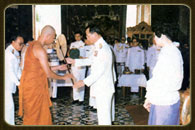
In the following year, this ceremony was formally established as the Royal Ceremony of Granting Royal Patronage for the Ordination of Royal Novices, a tradition that continues to the present day. His Majesty King Rama IX regularly presided over the ceremony, and in years when he was unable to attend, he graciously commanded members of the Royal Family to represent him. In addition, he arranged for the Crown Prince of Thailand to undergo temporary ordination according to this royal tradition.
By performing royal merit in this manner, His Majesty promoted faith, values, and the noble cultural traditions of Buddhism, which are a heritage of the nation, allowing Buddhists to recognize their significance and collectively preserve and develop them. This fostered traditions such as sponsoring the ordination of young men who wished to enter the monastic life but lacked the means to provide their own requisites, supporting the ordination ceremonies in local communities, and becoming lay patrons of monks and novices pursuing study despite financial limitations. These values encouraged mutual assistance within Thai society, created opportunities for education and learning, and contributed significantly to the development of the nation.
Royal Ceremony of Merit-Making through the Ordination of Royal Novices
On the 8th day of the waxing moon in the 8th month, or the intercalary 8th month according to the lunar calendar, the annual ordination of royal novices takes place at the Ubosot of Wat Phra Si Rattana Satsadaram. Today, those granted the King’s royal patronage to become royal novices include members of the Royal Family, royal descendants, high-ranking and lower-ranking civil officers serving in the King’s personal household, senior officials close to the royal court, and novices who have passed the ninth level of Pali Canon examinations. For civil officers in the King’s household, the Bureau of the Royal Household specifies that nominees must be lower than commissioned rank and endorsed by their superiors as officials who perform their duties with loyalty and integrity.
The modern royal ordination ceremony lasts two days: the first is the audience day to pay respects, and the second is the ordination day. The Bureau of the Royal Household compiles the list of those granted royal patronage and submits it for the King’s approval to set the audience day. On this day, the royal novices who are civil officers dress in their white official uniforms according to rank and department, line up in order, and place a table with a white cloth before them, arranging flowers, incense, candles, and other offerings.
When His Majesty King Rama IX arrived, the senior palace officials presented the royal novices, who offered floral cones and paid respect in order. The King then imparted royal guidance regarding the forthcoming ordination, completing the audience ceremony.
Before the ordination day, officials from the Royal Ceremonial Division arrange for the royal novices to visit Wat Sok to be measured for their monk robes and to receive instructions on the personal items they must prepare beyond those provided by the royal household. The current ceremony does not issue a public schedule but provides directives only to officials and those on duty. On the morning of ordination, the novices gather at the Sahathai Samakhom Hall in the Grand Palace for hair-cutting by palace dress attendants, after which parents or guardians may trim the hair before the official tonsure. Following this, the novices bathe in preparation for dressing.
Today, the royal novices dress similarly to traditional royal novices: wearing a white yerbub cloth (or, if unavailable, colored or purple cloth), a long-sleeved inner shirt covering only the left arm secured with a belt, and a ceremonial outer robe draped over the left shoulder in a diagonal sash style.
On the ordination day, the ceremonial setup in the Ubosot of Wat Phra Si Rattana Satsadaram includes incense, candles, the preceptor’s cone, paired chanting cones, and alms bowls containing a razor, sharpening stone, thread, needle, and nail clippers. A tray holding the monk’s robes and requisites is prepared for His Majesty the King to present to the royal novices, comprising 28 items such as robes, satchels, palm-leaf fans, lamps, flashlights, and document bags.
After dressing, in the afternoon the royal novices proceed from Sahathai Samakhom Hall into the Ubosot via the Gate of Kay. They offer incense and candles at the base of the Phra Buddha Maha Mani Rattana Patimakorn on the stone pulpit, then place flowers, incense, and candles provided by officials on the pulpit as a devotional offering. They pay respects to the Buddha image and the King in sequence. The Supreme Patriarch, serving as the preceptor, along with thirty monks (or fifteen each from the Maha Nikaya and Dhammayut Nikaya if both orders have novices) conduct the precept-taking ceremony according to Buddhist rites. Afterward, the novices don the saffron robes, carry the robes in procession to the center of the assembly, and are ordained sequentially as novices and then fully as monks. If His Majesty has not yet arrived, the royal household allows the parents and relatives of the novices to enter the Ubosot to observe and rejoice.
In the evening, His Majesty King Rama IX, accompanied by Her Majesty Queen Sirikit, the Queen Mother, presents the monastic requisites to the royal novices in the Ubosot. Upon completion of the royal ceremony, the ordained novices proceed to their assigned monasteries for their monastic residence.
Customarily, His Majesty King Rama IX and Her Majesty Queen Sirikit, the Queen Mother, attend and preside over the royal ordination ceremony of the royal novices every year. In exceptional years, when the King has royal duties or is unwell, he graciously commands members of the Royal Family to perform the ceremony on his behalf.
6. Construction of Buddha Images in Buddhism
In general, Buddhists believe and uphold that Buddha images are highly important symbols for veneration, serving to commemorate the virtues of the Buddha during rituals and various occasions. Thai monarchs and Buddhists throughout different eras have constructed Buddha images enshrined in temples across the country for worship, such as Buddha images from the Chiang Saen period, the Sukhothai period, the Ayutthaya period, and the Rattanakosin period.
In each era, Buddha images were crafted with meticulous care and exquisite artistry. Some of these images, in addition to their religious significance, possess such high artistic value that they are priceless, becoming a precious national heritage admired and venerated by Buddhists and people worldwide to this day.
His Majesty King Rama IX followed the exemplary practices of past monarchs with remarkable devotion and skill, constructing numerous Buddha images on significant occasions. These include the Buddha image in the Blessing posture (Phra Buddha Phra Bat), Luang Pho Chitralada, Phra Buddha Navaratchabophit, Phra Buddha Patimachaiwat of the reign, and the Elephant-back Victory Medal Buddha image. His Majesty graciously bestowed these Buddha images to various government offices, temples, and important locations throughout the country. He also personally presided over the casting of Buddha images at locations where Buddhists invited him to officiate.
By constructing Buddha images, His Majesty King Rama IX not only fostered the growth and stability of Buddhism and preserved the nation’s artistic and cultural heritage, but also provided local communities with Buddha images for veneration. This fostered pride among Buddhists, strengthened national unity, and encouraged collective efforts to perpetuate the Dharma widely. Buddhists deeply appreciate and revere His Majesty’s boundless grace.
- 6.1 The Phra Buddha Phra Bat (Phra B.P.R.) image was created on three occasions:
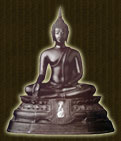
6.1.1 The Buddha Image in the Blessing Posture
On the occasion of the 72nd Anniversary of Siriraj Hospital in 1962, the hospital constructed Buddha images in the Blessing posture, as well as the image of King Mahitarathibet Adulyadejvikrom, the Royal Father, for public veneration. His Majesty King Rama IX personally presided over the casting ceremony at the front field of the Manusonakorn Witthayakhan building, Wat Bowonniwet School, on August 3, 1962.
6.1.2 In 1963, His Majesty King Rama IX, Her Majesty the Queen Mother, and Their Majesties the Crown Prince and Princess performed the royal merit-making ceremony to offer the principal Kathin robe at Wat Thewasangkharam, Kanchanaburi Province. The temple committee proposed the construction of a Buddha image in the Blessing posture as a commemorative piece for public veneration and requested royal permission to inscribe His Majesty’s initials, Phra B.P.R., on the golden cloth draping the Buddha image.
6.1.3 In 1965, Wat Bowonniwet Vihara requested royal permission to officially construct the Phra Buddha Phra B.P.R. image. His Majesty graciously appointed expert artisans to design the image, combining the distinguished artistic styles of Sukhothai, Chiang Saen, and Lanka into a seated Buddha on a double lotus base with a lion-naga pedestal. The right hand is raised in the gesture of bestowing blessings, draped with the golden cloth bearing the Phra B.P.R. initials. This new, special-style Buddha image embodies both religious and royal symbols, representing the nation in its entirety. His Majesty also granted an inscription for the base as a national symbol: “Thayya Chatya Samakkhyam Stisanchanen Phosachiyam Rakshanti” (The Thai people will preserve their independence through mindfulness in unity). On the rear of the base, the committee decided to inscribe: “Cast in the ceremony at Wat Bowonniwet Vihara on August 29, 1965.”
The Phra Buddha Phra B.P.R. image in the granting-blessings posture at Wat Bowonniwet Vihara is produced in three sizes: a 9-inch and a 5-inch wide image in dark bronze, and a small Phra Kring made of bronze. All sizes are exquisitely crafted with meticulous detail. During the casting of these Phra B.P.R. images, His Majesty King Bhumibol Adulyadej personally performed royal merit-making ceremonies at Wat Bowonniwet Vihara four times: on August 27 at 16:20, participating in the Buddha consecration ceremony in the ubosot; on August 28 and 29, in the royal merit-making ceremonies for the birthday of Somdet Phra Mahitalathibet Adulyadejvikrom Borommaratchonok; and in the consecration ceremony of the stupa and the casting of the granting-blessings Buddha image bearing the Phra B.P.R. initials. The temple has thus designated this auspicious occasion of casting the Phra Buddha Phra B.P.R. image as “Chaturamangal,” reflecting the fourfold blessings.
- 6.2 The Chaiwat Buddha Image of the Reign
It is one of Thailand’s unique traditions, found in no other nation. It is a royal custom of Thai monarchs, passed down through generations. Evidence suggests it originated as early as the Ayutthaya period, when each king commissioned Buddha images to be carried in processions, enshrined in royal halls, or placed as the presiding figure in royal ceremonies directly associated with the monarch, such as:
The Water-Pouring Ceremony of Sincere Oaths during Ayutthaya, where the Chaiwat Buddha Image was placed before the Phra Si Sihing; the same practice continued in the Rattanakosin period.
The Royal Tonsure Ceremony in Ayutthaya, where the Chaiwat Buddha Images were placed on the left and right of the Phra Si Sihing.
The Royal Coronation Ceremony in Rattanakosin, where Chaiwat Buddha Images of different reigns were brought together for the ritual.
During the birthday celebrations of King Chulalongkorn, the Chaiwat Buddha Image was also traditionally brought along.
The Lamp Ceremony featured the Ananta Naga boat, decorated with lamps and the Chaiwat Buddha Image.
During royal military campaigns, the Chaiwat Buddha Image would be brought along with the army. If the campaign was by river, the image would be specially placed on a boat. In the reign of King Naresuan the Great, when he sailed from Ayutthaya to capture Martaban, the Chaiwat Image was placed on the Suphan Hong (Golden Swan) boat. If traveling by land, the image was placed on the back of an elephant, hence the name Phra Chai Lang Chang (Buddha Image on Elephant Back).
For the royal coronation ceremony, the Chaiwat Image was enshrined in the ceremonial hall, a tradition dating back to the Ayutthaya period. At the beginning of the Chakri dynasty, King Rama I (Phra Buddha Yodfa Chulaloke the Great) considered the Buddha image he used during military campaigns—then called Phra Chai Lang Chang. To have a Buddha image available for worship at the royal palace, he graciously ordered the creation of a new image, named Phra Phuttha Patimachaiwat (Chaiwat Buddha Image of the Reign).
The Chaiwat Buddha Image is a relatively small metal statue in the subduing Mara posture, with a unique feature: the left hand holds a fan, and the posture is vajrasana (diamond meditative posture). Its small size allows easy relocation. After King Rama I, subsequent Chakri kings continued the tradition of commissioning a Phra Phuttha Patimachaiwat image after each royal coronation.
King Bhumibol Adulyadej (Rama IX) performed the royal coronation ceremony on May 5, 1950 (B.E. 2493), but did not immediately commission the Phra Phuttha Patimachaiwat of the reign due to extended royal duties abroad and the lack of a suitable occasion. It was not until 1963 (B.E. 2506) that His Majesty graciously ordered the creation of the Chaiwat Buddha Image according to the ancient royal tradition. He appointed Mr. Pimarn Mulpramook to model the Buddha statue and arranged the royal casting ceremony on Thursday, October 31, 1963, at Wat Phra Sri Rattana Satsadaram.
His Majesty entered the ubosot, observed precepts, and proceeded to the ceremonial hall in front of the ubosot. At the auspicious time from 7:12 to 7:22 a.m., astrologers struck the victory gong, and molten gold and silver were poured to cast the Buddha image. Thirty monks led by the Supreme Patriarch chanted the Chai Mongkhon blessings. Musicians played traditional instruments, and the artillery company from the 1st Royal Guard fired 19 ceremonial rounds under the command of Lieutenant Chuchat Hirunrak. Phra Kru Wamathep Muni offered holy water to the Buddha image. His Majesty offered food to the monks, who received the royal alms, and the Supreme Patriarch performed the candle-extinguishing ceremony while all monks recited the extinguishing verses.
After the casting was completed, His Majesty graciously ordered the royal consecration ceremony of the Buddha image to be included in the celebration of His Majesty’s 3rd cycle (60th) birthday in 1963.
The current Phra Phuttha Patimachaiwat of the reign is in the subduing Mara posture (Maravijaya), seated in vajrasana, with a five-tiered umbrella embroidered with gold thread. The image measures 7 inches across the lap, 9 inches from the base to the top of the halo, and holds a silver-handled fan in its left hand. Both the front and back of the base bear inscriptions.
จารึกด้านหน้า ความว่า
มานสํ วีริยํ ขฺนติ
ภูมิ เว อิทฺธิยา พลํ
อิทฺธิงคโต ส รญฺเชติ
ปฺณฑิโต ชยาฒฺทโน
This signifies that determination, diligence, and patience are the true forces leading to success. Those who achieve such success are wise and gain victory, bringing joy and happiness. This verse was composed by Somdet Phra Nyanasamvara (then Somdet Phra Sangharaja, Charoen Suwaddhano).
Inscription on the back reads:
“His Majesty King Bhumibol Adulyadej cast this on Thursday, October 31, B.E. 2506 (1963).”
His Majesty graciously ordered the current Phra Phuttha Patimachaiwat of the reign to be placed in the Hor Phra Suralai Phiman, Wat Phra Sri Rattana Satsadaram, alongside the Buddha images of all previous reigns. Whenever royal ceremonies occur, the image is brought out and placed in the ceremonial hall, continuing this tradition to the present.
6.3 Luang Pho Chitralada
In B.E. 2508 (1965), His Majesty King Bhumibol Adulyadej personally created a Buddha amulet (Buddha image or Buddha medallion) known as Phra Kamlang Phandin, also called “Phra Somdej Chitralada” or, among collectors, “Luang Pho Chitralada.”The purpose of creating this amulet was to grant it to those who requested it or according to His Majesty’s discretion, so that recipients would uphold good conduct befitting the honor. It was intended to serve as a “strength of the nation”, fostering unity and collective effort to preserve the kingdom for the future.
The “Phra Kamlang Phandin” amulet (design) was conceived by His Majesty in consultation with the artisans of the Handicraft Division, Fine Arts Department. It is triangular in shape, with a base width of 3 kra-biat 1 anu-kra-biat and a height of 1 inch 1 kra-biat. The Buddha image depicts the meditation posture (Dhyana Mudra), seated on a two-tiered lotus throne.
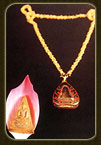
The sacred materials used to create the “Phra Kamlang Phandin” amulets were all highly auspicious:
A. Materials from the Royal Household (5 items):
Dried flowers from garlands offered by the public during His Majesty’s visits to change the attire of the Emerald Buddha image; these flowers, hung on the Buddha throughout the festival until replaced, were collected by royal command.
Royal hair strands, collected by officials after each royal tonsure ceremony.
Dried flowers from garlands hung on the Great White Umbrella (Maha Chedi Chatra) and the hilt of the royal sword during the Umbrella Ceremony (Chatra Mongkol).
Pigments scraped from canvases painted by His Majesty’s own hand.
Resin and pigments scraped from the sails of the royal barge during decoration.
B. Materials from provinces throughout the kingdom:
These included sacred items from revered sites or Buddha images worshiped locally, such as soil or dried moss from sacred sites, gold leaf used on Buddha images, incense powder from worship offerings, and water from sacred wells. Each province contributed 1–10 items, submitted to the King by the Ministry of Interior. Special materials were also collected from provinces such as Pathum Thani, Prachuap Khiri Khan, Uthai Thani, Trat, Nakhon Nayok, Mae Hong Son, Tak, Phetchabun, Surin, Sisaket, Ubon Ratchathani, Udon Thani, Khon Kaen, Maha Sarakham, Roi Et, Kalasin, Chumphon, Ranong, Krabi, Phatthalung, Satun, and Narathiwat, among others.
Creation process: His Majesty personally mixed these materials and pressed them into the amulet molds with His own hands.
Gilding: Recipients of the royal amulet gild the back of the amulet themselves.
Certificate of Authenticity: Recipients received a certificate confirming the royal bestowal, registered in the royal archives, bearing His Majesty’s royal cypher and the amulet’s sequential number, all personally recorded and preserved by the King.
6.4 Phra Buddha Navaratchabophit
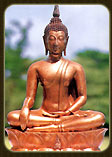
Phra Buddha Navaratchabophit is one of the most important Buddha images of the current reign. His Majesty the King conceived its creation to be bestowed and enshrined in various provinces as a symbol of the Triple Gem (Buddha, Dhamma, Sangha), which is revered most highly by Buddhists. It also serves as a symbol of unity and close connection between His Majesty King Rama IX and his subjects across all provinces of the kingdom.
Regarding the reason behind His Majesty’s wish to create this Buddha image, M.R. Sangsur Ladawan summarized in the article “The Bestowal of Phra Buddha Navaratchabophit to Bangkok” in the book “From Sky… to Earth” that:
From ancient times, there was a tradition of bestowing royal weapons to cities, sometimes for specific individuals to act on the King’s behalf. The primary purpose of bestowing royal weapons was to…
To empower the recipient, such as granting royal authority in certain cases.
To serve as a symbol representing the monarch.
To be used in important royal ceremonies, for example, dipping in the Phra Phivat Satya Water for officials to drink as an oath of loyalty to the nation.
In later periods, the bestowal of royal weapons to individuals for exercising authority became rare. Instead, they were mainly bestowed on provinces or administrative regions. During the Rattanakosin era, Kings Rama V, VI, and VII granted them to provinces visited by the monarch. Provinces receiving such bestowals regarded it as an important honor and auspicious privilege, although many provinces had yet to receive them.
After King Rama IX ascended the throne, He traveled to visit people in various localities, reaching farther than in previous reigns due to improvements in transportation that made travel more convenient. The provinces He visited wished to receive a royal bestowal of the ceremonial sword for the reign as a symbol of auspiciousness, and it was suggested that such a bestowal should be granted.
When this matter was brought to His Majesty’s attention, He considered that the royal sword was a symbol of the sovereign power of the monarch under an absolute monarchy. In the present constitutional monarchy, it would be inappropriate to bestow the sword as before. What should be bestowed instead was a symbol of the bond and unity between the King and His subjects. Accordingly, His Majesty graciously commanded the casting of the Phra Buddha Navaratchabopit in 1966 (B.E. 2509), intending to present it to each province in due course as appropriate.
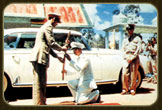
The Governor of Pattani Province respectfully presented the royal sword of the city to His Majesty.
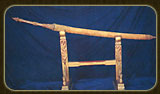
The provincial royal sword of Pattani.
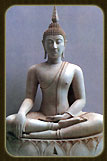
Phra Phuttha Nawaratbophit is a Buddha image in the Maravijaya posture, with a lap width of 23 centimeters and a height from the base to the top of the halo of 40 centimeters. His Majesty graciously commanded Mr. Paitoon Muangsombun, an official of the Fine Arts Department’s Handicraft Division, to sculpt the model of this Buddha image at Chitralada Royal Residence. During the sculpting, His Majesty personally inspected the Buddha’s features until satisfied, and then graciously commanded the ceremony for casting the Buddha image to be held on 28 April 1966. He also bestowed the name “Phra Phuttha Nawaratbophit” (Bangkok, 1996: 291–292).
At the lotus base of Phra Phuttha Nawaratbophit, a “Phra Kamlang Phandin” or “Luang Pho Chitralada” amulet was enshrined. Phra Phuttha Nawaratbophit is not only a symbol of the Triple Gem, highly revered by Buddhists, but also a symbol of the unity and bond between His Majesty the King and his subjects throughout all provinces of the Kingdom. The amulet enshrined at the lotus base contains sacred materials that have been venerated by the people across the Kingdom for generations.
Therefore, Phra Phuttha Nawaratbophit is one of the most important Buddha images of the reign of His Majesty King Bhumibol Adulyadej (Rama IX). The Royal Household Secretariat established the following regulations regarding Phra Phuttha Nawaratbophit on 10 March 1967:
Once a province has received the Buddha image, it shall be enshrined in an appropriate place within the provincial hall.
Whenever the province holds any ceremony requiring the veneration of the Triple Gem, Phra Phuttha Nawaratbophit shall be invited to be enshrined as the principal Buddha image in the ceremony. This excludes ceremonies conducted in any ordination hall, temple hall, or sacred site where another principal Buddha image or sacred object already presides, and excludes ceremonies that specifically require another Buddha image as the principal, such as Phra Phuttha Kanthararas.
Whenever His Majesty visits a province to preside over a royal ceremony or any provincial ceremony, the province shall have Phra Phuttha Nawaratbophit enshrined as the principal Buddha image for that ceremony. If the ceremony is held in a temple or sacred site where another principal Buddha image or sacred object already presides, Phra Phuttha Nawaratbophit shall be enshrined separately for His Majesty to pay homage.
Whenever His Majesty undertakes royal duties in a province, the province shall have Phra Phuttha Nawaratbophit placed at an appropriate altar for Him to venerate in the pavilion or residence arranged for the occasion. If the location is remote, difficult to access, or the visit is brief or in transit, the province may decide to forgo this as deemed appropriate.
Whenever His Majesty stays overnight in a province, the province shall have Phra Phuttha Nawaratbophit enshrined at the altar in the pavilion or residence throughout His stay and return it to the provincial hall upon His departure. The Royal Guards shall follow the same protocol as with the Royal Nine-metal Victory Buddha (Phra Chai Nawaloha) of the reign.
If the province deems it appropriate to allow the public to venerate Phra Phuttha Nawaratbophit during festivals, this may be done as considered suitable.
In addition, applying gold leaf directly on the Buddha image may slightly diminish its beauty. If the province places Phra Phuttha Nawaratbophit on a base made of material suitable for gold leaf, allowing the public to venerate it on that base is more appropriate.
His Majesty King Bhumibol Adulyadej (Rama IX) personally visited each province to present this Buddha image. During these visits, He would meet and address the local people, emphasizing national unity, the significance of Phra Phuttha Nawaratbophit, and encouraging the people to accept the image as a source of merit and spiritual inspiration. He urged everyone to work diligently, sincerely, cooperatively, and with honesty and compassion. For example, on 10 September 1969, His Majesty presented Phra Phuttha Nawaratbophit to Surin Province and gave a royal address to the governor and citizens awaiting the ceremony.
“… On this visit, I have brought Phra Phuttha Nawaratbophit to present to you. I created this Buddha image to serve as the principal Buddha image of the province. In its base, I have enshrined a small Buddha image made from sacred powders that I collected from all provinces throughout the kingdom, including the soil from in front of Luang Pho Phra Si, the principal Buddha of the ubosot at Wat Burapharam, Surin Province.
I regard Phra Phuttha Nawaratbophit as the highest symbol of the Triple Gem and as a symbol of the unity of Thailand and all Thai people. By enshrining a small Buddha made of these sacred powders, it becomes a significant Buddha image, which I present to you personally. You are to receive Phra Phuttha Nawaratbophit as a source of merit for the province and for yourselves, and as a spiritual anchor to guide you in performing good deeds …”
6.5 Buddha Image Commemorating the 50th Birthday
His Majesty King Rama IX ascended the throne on 9 June 1946. In 1977, marking the year of his 50th birthday, he had reigned for over ten thousand days, a particularly auspicious occasion. On this occasion, His Majesty graciously presided over the royal birthday ceremonies and the celebration of his ten-thousandth day on the throne.At that time, royal astrologers calculated that the king’s 50th year coincided with the change of the planetary ruler of his horoscope—from Saturn, which had presided over him for the previous ten years, to Jupiter. According to astrological tradition, a special ceremony was required to “receive and transfer” the planetary ruler. However, His Majesty graciously dispensed with that ceremony and instead commanded the casting of a life-sized Buddha image in the Leela posture for worship, to be enshrined in the ubosot of Wat Bowonniwet Vihara, along with three additional Buddha images for personal veneration. All four Buddha images in this royal ceremony hold special significance as follows:
6.5.1 Life-sized Leela Buddha Image (172 cm tall)
This image symbolizes His Majesty’s royal visits throughout rural areas across the kingdom, to relieve the suffering of the people, promote their well-being, and bestow peace and happiness upon the populace. His Majesty inscribed the plaque with the name:Phra Phuttha Siamaphiwat Bophit Phumiphon Narisathasahasthiwats Ratchakari Pannasawas Sri Upai Mahamongkhon
which translates to:
“The Buddha image who prospers the Siamese state, the great auspiciousness of the twofold blessing of honor and happiness.”
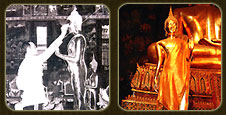
“…King Bhumibol, the revered sovereign over his people, had reigned for over ten thousand days and reached his 50th birthday,” and His Majesty graciously commanded that the image be enshrined in the ubosot of Wat Bowonniwet Vihara on a chukchee pedestal to the east of Phra Phuttha Chinnasi.
6.5.2 Buddha Image in the “Preventing Relatives” Posture (Monday Buddha)
This Buddha image, 69 cm tall, corresponds to the posture associated with Monday, the day of His Majesty’s birth. Notably, his 50th birthday on 5 December 1977 also fell on a Monday.
The nameplate at the base of the “Preventing Relatives” Buddha image bears the name Phra Phuttha Sakol Santikornbaphit Boromchakri Sorasatit Mongkhon, meaning:
“The Supreme Buddha establishes peace throughout the world, reigning in the dharmic wheel, bestowing blessings to sustain and uphold the ruler of the Chakri dynasty in accordance with Dharma.”
6.5.3 Buddha Image in the Nāga Prok Posture (Saturday Buddha)
This image represents Saturday, the day associated with Saturn, which had governed the King’s life for 10 years.
6.5.4 Buddha Image in the Meditation Posture (Thursday Buddha)
This image represents Thursday, the day associated with Jupiter, which governed the King’s life for the subsequent 19 years following Saturn, according to astrological tradition.
The last two images (Nāga Prok and Meditation postures) were not given specific names. His Majesty commanded that they be enshrined at the Chitralada Royal Residence for veneration.
The casting ceremony for these Buddha images, commemorating His Majesty’s 50th birthday, took place on 1 November 1977 at Wat Phra Si Rattana Satsadaram, within the Grand Palace. His Majesty the King and Her Majesty the Queen Mother poured the molten metal at the auspicious time of 17:36.
After the completion of the Buddha images’ finishing and decoration, His Majesty graciously presided over the Ceremony of Opening the Eyes and the Consecration of the Buddha Images on 4 December 1977 at the Ubosot of Wat Phra Si Rattana Satsadaram, in conjunction with the celebratory ceremony.
6.6 Phra Chai Lang Chang Medals
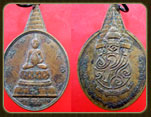
On the occasion of the auspicious 5th cycle (60th) birthday anniversary of His Majesty the King on 5 December 1987, the Sangha, under the Supreme Sangha Council, created the Chai Lang Chang (Victory on Elephant Back) medal. This was to commemorate the ecclesiastical merit of donors who contributed to the establishment of a fund in loyal homage by the people, and to further honor His Majesty’s virtues. The medal’s design details are as follows:
The medal features a replica of the Buddha image named “Phra Chai Lang Chang” (Victory on Elephant Back), with the royal cypher of His Majesty King Bhumibol Adulyadej (Rama IX) inscribed on the reverse side.
Materials and Sizes:
2.1 Alloy – medal height: 3.6 cm
2.2 Gold, niello, or silver – medal height: 3 cmBuddhabhiseka (Consecration Ceremony):
The consecration ceremony was held on 20 March 1986 at the Ubosot of Wat Phra Si Rattana Satsadaram, with Somdet Phra Ariyavangsagatayana, the Supreme Patriarch, presiding.
The Phra Chai is distinguished from ordinary Buddha images by the left hand holding a fan and the diamond posture seated position. Evidence suggests that such images existed at least as early as the Ayutthaya period, though the exact sizes are uncertain. They were typically small and portable so they could be carried to various ceremonies, such as the Ayutthaya-era Water Pledge Ceremony, where the Phra Chai was placed in front of the Phra Si Sihing image.
During the Royal Tonsure Ceremony (Sokan) in the Ayutthaya period, a Krailas platform was constructed on the third tier housing the Buddha relics, with small pavilions on either side containing miniature Phra Chai (Victory) images, and the Phra Si Sihing image served as the principal Buddha image.
In the Samphatcharachin Ceremony, several important Buddha images were used, including the Phra Chai images of different reigns. The Phra Chai was also included in ceremonies such as the Birthday Celebration, Loi Prathip (floating lantern festival), royal military campaigns, and royal tours to provincial cities, where it was brought along with the army. Even in the Royal Coronation Ceremony and the 200th Anniversary of Rattanakosin celebration in 1982 (B.E. 2525), the Phra Chai Lang Chang (Victory on Elephant Back) was brought into the ceremony.
During the reign of King Rama I (Phra Buddha Yodfa Chulaloke the Great), there were two Phra Chai images:
A smaller image, known as Phra Chai Lang Chang or “Small Phra Chai.” According to Prince Krom Phraya Naritsaranuwattiwong, this image was probably created before the king ascended the throne, intended to accompany military campaigns on elephants, hence the name “Victory on Elephant Back.”
A larger image, called Phra Chai of the Reign or Large Phra Chai, which was used as the principal royal Phra Chai.
6.7 Buddha Images Commemorating the King’s 5th Cycle Birthday (60 Years)
The year B.E. 2530 (1987 CE) was highly significant for the Thai people, as it marked the 5th cycle (60th) birthday of His Majesty King Bhumibol Adulyadej on 5 December 1987, a particularly auspicious occasion.
The Royal Birthday Ceremony that year was grander than usual, including special rituals. His Majesty graciously presided over the casting of Buddha images commemorating both the King’s birth anniversary and the 60th birthday, marking the beginning of the royal ceremony.
A Buddha image commemorating the King’s birth anniversary refers to a Buddha image created according to the day of the week of the monarch’s birth, following Buddhist traditions, for worship and as a source of auspiciousness. The images were created according to customary astrological principles:
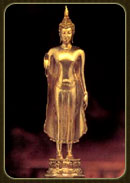

Sunday
Posture: “Offering the Eyes”

Monday
Posture: “Forbidding Relatives”

Tuesday
Posture: “Reclining”
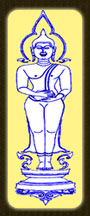
Wednesday
Posture: “Carrying alms bowl”
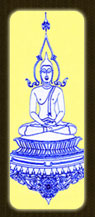
Thursday
Posture: “Meditation”

Friday
Posture: “Pensive posture”

Saturday
Posture: “Naga-protected posture”
The royal tradition of creating a Buddha image for the monarch’s birthday has been continuously practiced. However, during the reign of King Chulalongkorn (Rama V), whose birthday fell on a Tuesday, the usual posture for the birthday Buddha would have been the reclining posture. The King considered that the reclining posture would not harmonize aesthetically when placed together with Buddha images in other postures. Therefore, it was decided to create the “Prohibiting Quarrels” posture as the Buddha image for the day of the royal birthday.
The birthday Buddha image refers to a Buddha image created to correspond to the king’s age in years. King Chulalongkorn (Rama V) wrote in his book Royal Ceremonies of the Twelve Months that the tradition of creating birthday Buddha images began in the reign of King Nangklao (Rama III), who commissioned 37 Buddha images in various postures. These were in the meditation posture, about 3 inches across the lap, gilded, totaling 37 images—corresponding to the age before he ascended the throne. In subsequent years, one image was added each year to match the king’s advancing age.
The first 37 images were created without a ceremonial umbrella (chatra) because he had not yet ascended the throne. The yearly additions, after ascending the throne, were created with a three-tiered chatra. In the same period, King Nangklao also dedicated 73 birthday Buddha images to King Phutthayotfa Chulalok (Rama I) in the Mara Vichaya posture, 28 without a chatra; and 59 images to King Phutthaloetla Naphalai (Rama II) in the meditation posture, 43 without a chatra and 16 with a chatra.
By the reign of King Chulalongkorn (Rama V), it was decreed that if the king’s birthday fell in a year with regular seasonal rains and abundant water, the Buddha image for that year should be in the Kanthararas posture. This royal tradition of creating birthday Buddha images continued until the reign of King Ananda Mahidol (Rama VIII), when no images were made.
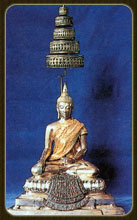
In the current reign, there had not yet been a royal ceremony to cast birthday Buddha images. Therefore, on the auspicious occasion of His Majesty the King’s 5th cycle birthday, the organizing committee, chaired by Prime Minister General Prem Tinsulanonda, respectfully requested permission for a royal ceremony to cast both birthday Buddha images and Buddha images for the royal age, following the historical royal tradition. His Majesty graciously approved: the ceremony produced a Buddha image in the “Prohibiting Quarrels” posture (for Monday, the king’s birthday) with a height of 9 inches, cast in silver and gilded; and a 5-cycle milestone Buddha image in the meditation posture (similar to the Phra Phuttha Nawaratbophit style) with an 18-inch lap, cast in a copper alloy and heavily gilded, with a five-tiered ceremonial chatra placed above.
On Monday, August 10, 1987 (B.E. 2530), His Majesty King Bhumibol Adulyadej (Rama IX) graciously presided over the royal ceremony for casting the birthday Buddha image and the milestone 5-cycle Buddha image at Wat Phra Si Rattana Satsadaram (the Temple of the Emerald Buddha) in the Grand Palace. The detailed schedule of the ceremony was as follows:
Transportation and Arrival: His Majesty and Her Majesty the Queen Mother traveled by royal car from Chitralada Royal Residence, Dusit Palace, to Wat Phra Si Rattana Satsadaram.
17:00: The royal procession entered the ubosot (ordination hall). His Majesty paid homage with incense and candles to the Phra Maha Mani Rattana Patimakorn, Phra Samut Phanni, the dressed Buddha images of King Phutthayotfa Chulalok (Rama I), and King Phutthaloetla Naphalai (Rama II). His Majesty and Her Majesty the Queen Mother lit incense and candles in offering, while the Supreme Patriarch presided over the closing of the precepts. Ten monks chanted the Buddhist scriptures and inscribed sacred mantras onto the metal sheets to be cast into the Buddha images.
17:45–18:09: At the auspicious time, the King moved to the casting platform in front of the ubosot. The court astrologer struck the ceremonial gong. His Majesty lowered the gold sheets into the mold and poured the molten metal to cast the birthday Buddha image and the milestone 5-cycle Buddha image. During the casting, monks recited the Chai Mongkhon mantra, Brahmins blew conch shells, waved ceremonial cloths, and musicians played gongs, conches, trumpets, and other instruments.
After the pouring was completed, Phra Kru Sathanandamuni performed the ritual sprinkling of holy water on the Buddha images. His Majesty re-entered the ubosot, offered alms and jatu-paccayadharma (ceremonial gifts) to the monks, who gave their blessings, and then the royal procession exited the ubosot, returning to the palace.
7. In promoting morality among the youth and the public through the principles of Buddhism
In matters concerning children and youth, His Majesty the King graciously commanded the organization of essay competitions on topics related to Buddhism, with the winning works published and presented on Visakha Bucha Day each year. He also graciously ordered the establishment of schools within temples, where monks would closely guide and instruct the students. Furthermore, His Majesty directed the Radio Station of the Volunteer Defense Corps at Dusit Palace to regularly broadcast Dhamma programs for both children and adults, and he patronized religious foundations such as the Phumiphol Foundation.
His Majesty’s royal determination regarding education for boys and girls was continuously expressed through His duties related to Buddhism. This was evident when, during the Royal Kathina Robe Presentation at Wat Sutthachinda, Mueang District, Nakhon Ratchasima Province, on 8 November 1974, His Majesty emphasized this determination, summarized as follows:
“His Majesty desired that temples throughout the country establish preschools for young children in order to lay a life foundation firmly rooted in Buddhism.” (Phra Thepworalangkarn, interview, 7 July 1996)
In addition to providing guidance to those concerned, His Majesty also personally initiated concrete actions. For example, during the Kathina ceremony at Wat Sutthachinda, His Majesty donated 220,000 baht from his personal funds. Following this, Phra Ratchaphisan Suthee implemented His Majesty’s initiative by founding Wat Sutthachinda Kindergarten, which has steadily developed until today, possessing assets worth 2.5 million baht, with 20 teachers and 370 students.
At Wat Phra Ram 9 Kanchanaphisek, in 1993, His Majesty graciously instructed the Chaipattana Foundation, in cooperation with the Bangkok Metropolitan Administration, to construct a school offering both preschool and lower secondary education. This became the first royal demonstration school in Bangkok, located adjacent to Wat Phra Ram 9 Kanchanaphisek, which had been graciously presented to His Majesty. He also graciously designated Her Royal Highness Princess Maha Chakri Sirindhorn to preside over the inauguration of the school building on 1 July 1996.
His Majesty’s continuous discussions with monks, community leaders, and citizens in various regions reflected his awareness of the importance of education as the foundation of Thai youth. He envisioned that temples and monks should play a central role in nurturing, guiding, and educating children in morality, ethics, manners, and knowledge, thereby cultivating quality citizens for the nation’s future.