

World Scientists and Thinkers in the Reign of King Rama IV
The Pioneer
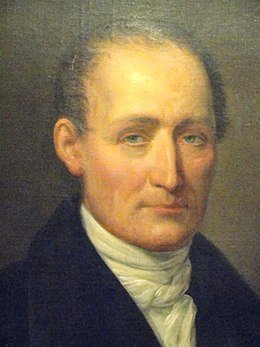
Nicéphore Niépce
People in the present day may find it difficult to imagine what the very first photograph at the beginning of its origin was like. This moment marked an important milestone of this French inventor, who is recognized as one of the pioneers of photography, named Nicephore Niepce (Nicéphore Niépce). He discovered a method of recording images that could be seen with the naked eye, resulting in the first permanent photograph in the world, and this discovery was further developed into photographic technology that continues to the modern era.
Table of content
Table of content
History
Joseph Nicephore Niepce (Joseph Nicéphore Niépce) was born on 7 March 1765 in the city of Chalon-Sur-Saone in eastern France. He was the second son of a wealthy family, with his father working as a lawyer. He received education in physics and chemistry at a university in the city of Angers, and also had the opportunity to serve as an active-duty soldier in the French Revolutionary forces in 1792. After leaving military service, Niepce went to live with his elder brother in the city of Nice in southern France.
Inspiration for Recording Images
One day, while he and his family were traveling in the region of Sardinia in Italy, which bordered the area where he was living, he became inspired to create images. After the death of his father in 1801, Niepce decided to return to live in his hometown of Chalon-Sur-Saone and began to seriously study methods of printing images onto materials. He started by studying the technique of lithographic printing, an artistic process involving drawing linear images on a smooth stone surface and printing them onto paper with the aid of grease-based chemical substances to help the image adhere more effectively to the paper. This method was commonly known as lithography. Although Niepce lacked skill in drawing and was unable to obtain suitable materials such as limestone to use for image printing, he continued experimenting in an effort to find a way to permanently fix images onto stone surfaces by using sunlight to trigger chemical reactions. Later, he used alloy metal plates composed primarily of tin (pewter), coating them with various light-sensitive chemical substances. He then placed drawn images on paper over the coated surface and exposed them to consistent sunlight for a period of time. However, as time passed, no visible images appeared on most of the pewter plates, and he experienced repeated failures in his experiments.
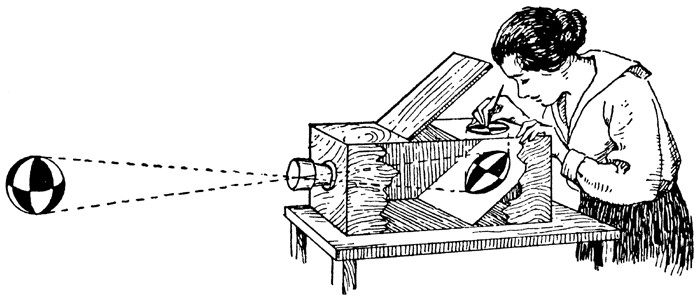
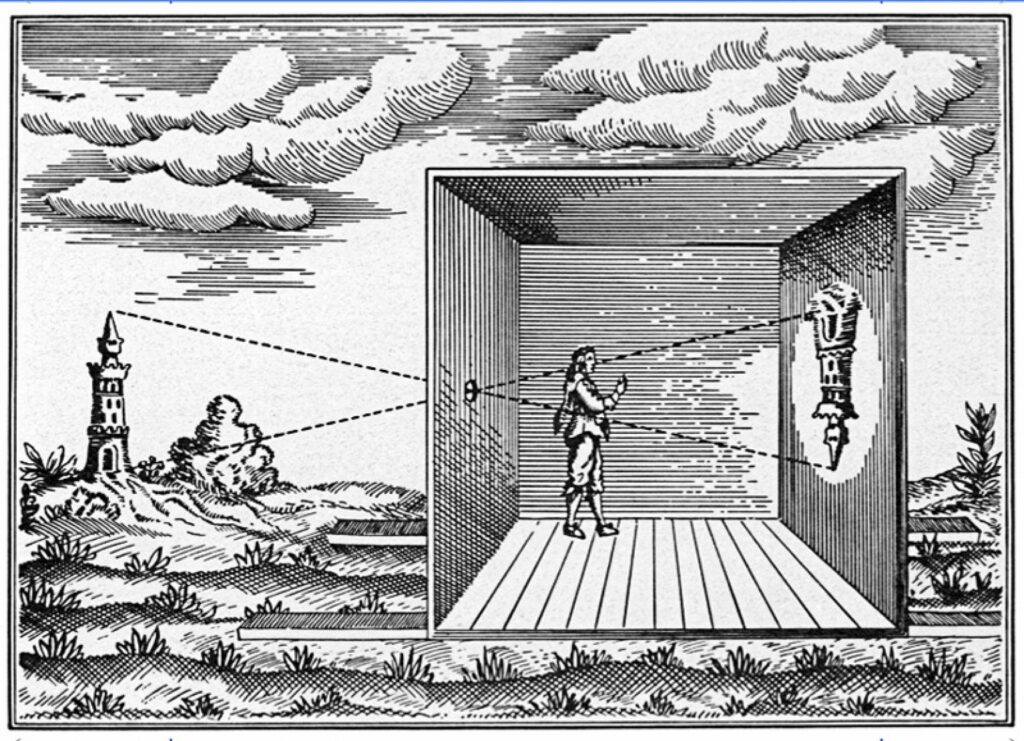
(An example image of the use of a camera obscura for tracing and drawing by artists of that period)
When He Met Daguerre
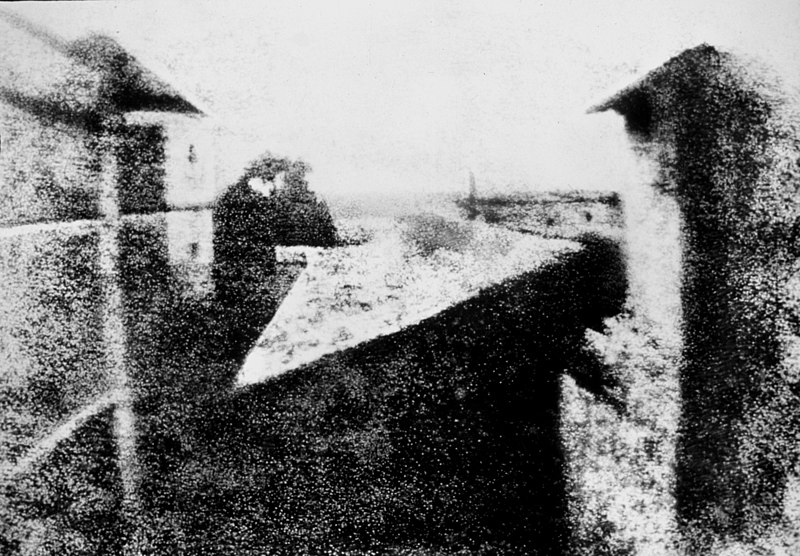
(View from the Window at Le Gras)
Eventually, he discovered a type of coating material known as Judea asphalt, or Bitumen of Judea, which hardened when exposed to sunlight but remained soft when kept in the shade or under low levels of light, and could be easily removed with lavender oil and turpentine oil. He therefore tested this material and found that when pewter plates coated with Bitumen of Judea were washed with these oils, linear images created by sunlight appeared and were permanently fixed onto the surface of the pewter plates. From this discovery, Niepce named his technique “Heliography,” or “Sun Drawing.”
In 1822, Niepce further developed his experiments by combining the camera obscura with the sun drawing technique, exposing the plate to light for as long as eight hours before washing it.
Obstacles in Publishing His Work
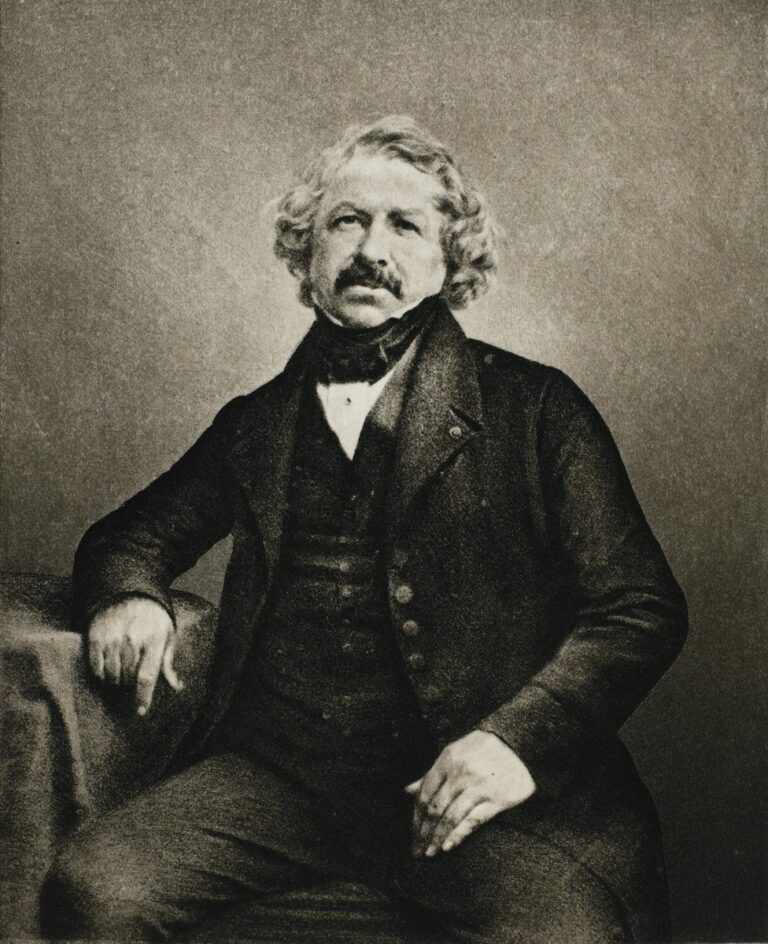
After achieving success in photography, Niepce decided to travel to visit his seriously ill elder brother in the town of Kew, southwest of London, in 1827. This visit gave him the opportunity to become acquainted with Francis Bauer, who recognized the significance of Niepce’s discoveries and advised him to submit his work to the Royal Society of London, a society of scholars in the natural sciences, for exhibition. However, the Royal Society requested detailed information and methods regarding the creation of his work, which he was unwilling to disclose at that time. As a result, he abandoned his intention and left all of his works with Francis Bauer before returning to France. Thereafter, Niepce continued to devote himself to research and the ongoing development of photographic techniques, eventually meeting Louis Jacques Mande Daguerre, an expert in the camera obscura. They collaborated and were able to develop several new techniques, including methods for fixing photographic images onto paper. After working with Daguerre for only four years, on 5 July 1833, Niepce passed away at the age of 68 from heart failure. At that time, he was living in poverty, and none of his inventions or works had yet received recognition under his name.
Commemorative Souvenir
Louis Daguerre continued to conduct research and further develop Niepce’s work. He built upon Niepce’s techniques in combination with new photographic methods he devised, enabling images to be produced with greater clarity and in a shorter exposure time. He named this new technique the “Daguerreotype,” which brought Daguerre immediate fame after the announcement of the discovery in January 1839. However, a close associate, Francis Bauer, intervened and successfully sought recognition for Niepce as the first inventor of the photographic process. Consequently, on 9 March 1839, the Royal Society of London formally acknowledged Niepce’s contribution and exhibited some of his surviving works that had previously been left with Francis Bauer. Bauer passed away before the first photograph in the world gained public recognition, and the image was subsequently inherited and transferred among various owners. At present, it is carefully preserved at the Harry Ransom Center Library and Museum, University of Texas at Austin, United States of America.

Finally, for those who are interested or wish to read books related to Nicephore Niepce, whether concerning specialized knowledge or general information, recommended book articles about Nicephore Niepce can be accessed at https://kmutt.me/book-niepce