

World Scientists and Thinkers in the Reign of King Rama IV
The Pioneer
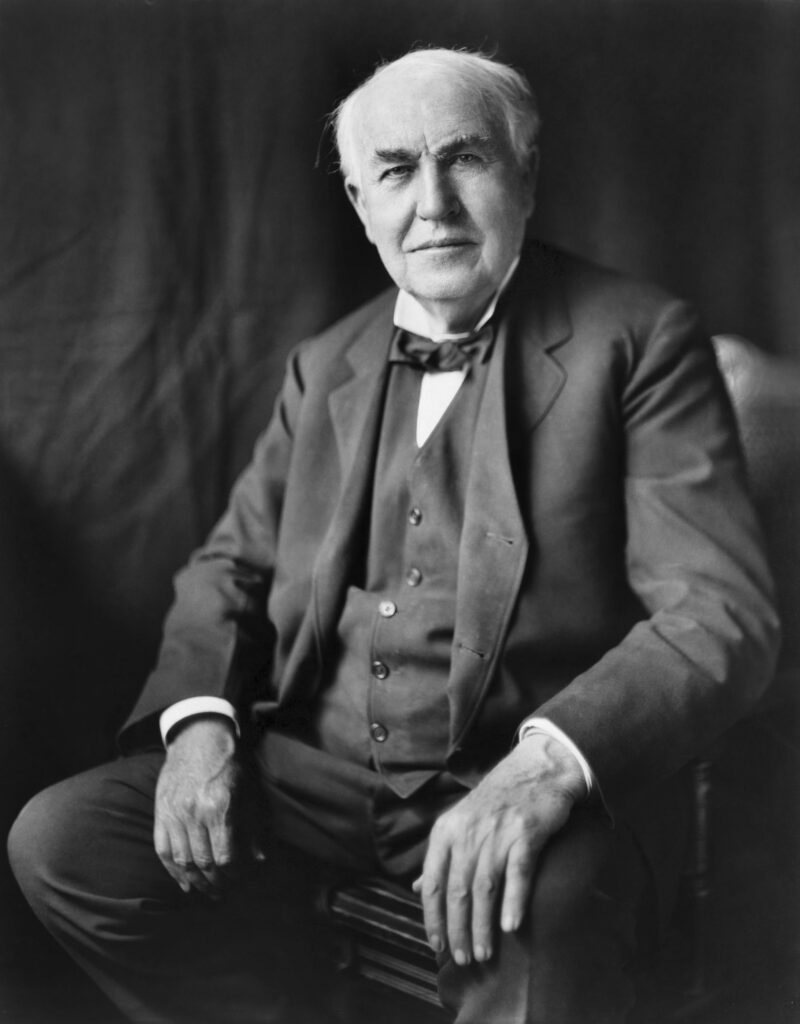
Thomas Alva Edison
A great scientist and world-changing inventor, he was a great inventor in the United States. He created more than 1,000 inventions, all developed from his own intellect, such as the electric light bulb, phonograph, motion picture camera, amplifier, sound box, and sound recording device. All of these inventions provided great convenience and were highly beneficial to the public. In addition, he also improved existing devices to make them more efficient, such as the telephone and the telegraph transmitter.
Table of content
What kind of person started working at the age of 12?
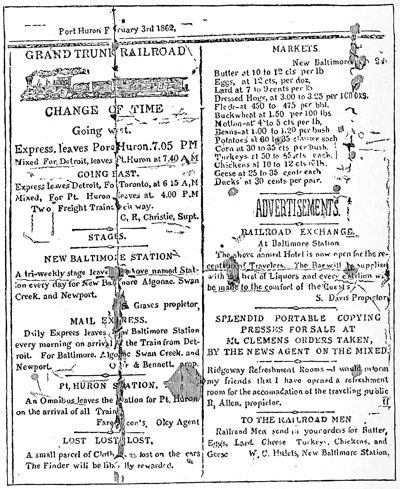
Grand Trank Herald
Thomas Alva Edison was born on February 11, 1847, in the city of Milan, Ohio, United States of America. Edison showed signs of being an intelligent child and was thoughtful and observant, especially about things around him, and sometimes his curiosity caused trouble, such as when he once set fire to a barn and nearly burned down the entire town. His father sent him to begin his education at a school in Port Huron, Port Huron, but he attended school for only three months before refusing to go any further. After he left school, his mother became his teacher, and after studying for only two years he was able to read and write fluently. What interested Edison the most was experimental science and inventing various objects. He built his own laboratory at home when he was 10 years old and often spent his time there. When he was 11 years old, he was able to build a telegraph based on the book by Samuel Morse. Therefore, he began working at the age of 12 to earn money to buy books and tools for setting up a scientific laboratory. Edison’s first job was with the Grand Trank Train Company, working as a newspaper boy on the Port Huron–Detroit train line. After working for some time, Edison was able to save a certain amount of money, which he used to buy a small printing press to print a newspaper for which he served as owner, editor, writer, and newspaper seller. Edison’s newspaper was called “Grand Trank Herald.”
The Wizard of Menlo Park
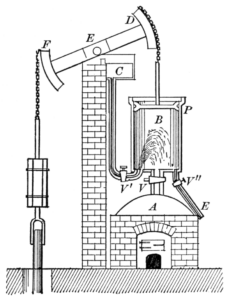
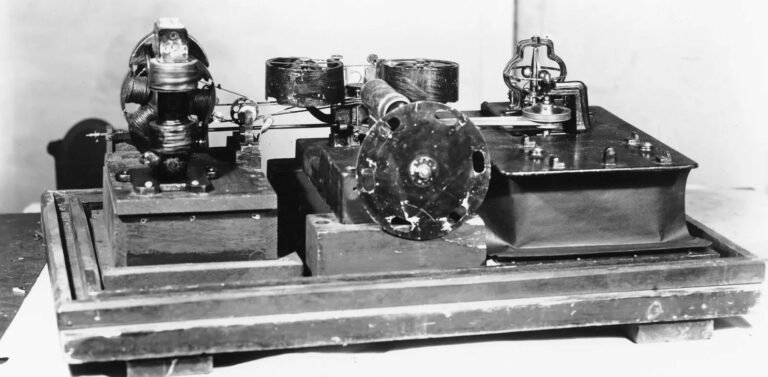
First model of Thomas Edison’s phonograph, 1877
Edison used his free time from his regular work to invent many devices, such as a voice vote recorder for the legislature, but when it was produced and sold it was not very popular. He therefore invented a stock market ticker and a two-way telegraph, which were very successful in transmission experiments. Edison presented this work to the Western Union Telegraph Company, which hired him to improve Bell’s telephone to make it more efficient. Edison’s improved telephone later became popular and sold well. However, the benefit Edison gained was not only money; while he was improving the telephone, he accidentally discovered that the vibrations of sound inside the telephone could be used to invent a phonograph, using the same principle as the telephone, in which sound passing through causes the metal inside to vibrate, producing sound. Edison therefore invented the phonograph in 1877. When this invention was released, it also became extremely popular, and later Edison continued to improve the phonograph to make it increasingly efficient.
Another of his inventions was the sound recording machine, which consisted of a cylinder with long spiral grooves, rotated by a crank. On both sides of the cylinder were small tubes equipped with a diaphragm and a needle. He sent the design of the sound recording machine along with instructions to John Kruesi, the chief assistant of the factory. When Kruesi brought the completed machine to Edison, he still did not understand what use the machine had, until Edison spoke into the cylinder, saying “Mary have a small sheep,” and turned the machine again, after which a sound was heard saying “Mary have a small sheep,” greatly astonishing the factory workers. The sound recording machine was considered the invention that Edison liked the most. Later, he improved the sound recording machine into an automatic telegraph repeater.
When both of Edison’s inventions were published in newspapers, the spread of this news made him well known and highly praised.
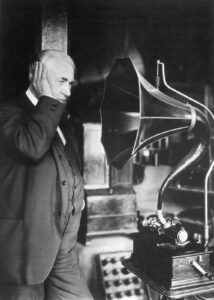
World-changing inventions
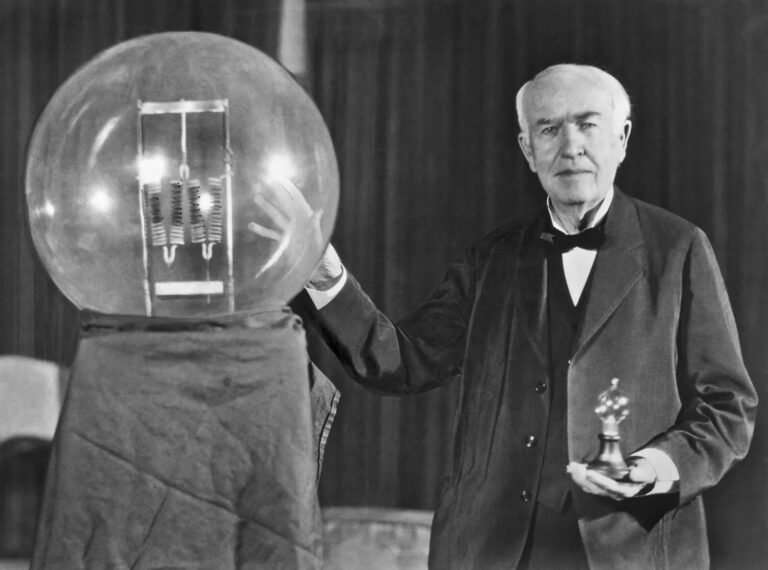
Another work that brought him the greatest fame was the electric light bulb. Previously, Sir Humphry Davy conducted experiments on electricity by connecting wires to the positive and negative terminals of a large battery. When the ends of the two wires were brought close together, sparks jumped back and forth, appearing slightly curved and emitting light. He later conducted this experiment in a vacuum, and from this experiment Davy invented a lamp, naming it the “Arc Light.” However, the wire could not withstand high heat, resulting in a short lifespan for this type of lamp. Based on Davy’s experiments, Edison attempted to find a conductor that could withstand high temperatures. Edison tested more than 10,000 materials as filaments for light bulbs, and in 1879 he discovered that cotton fiber spun into thread and then burned produced carbon that could withstand high heat. When placed inside a vacuum bulb, Edison’s light bulb could provide illumination for up to 45 hours. This type of light bulb was called the “Incandesent Electric Lamp.” Even so, Edison’s light bulb was not very popular at the time because the cost of electricity was very expensive.
Edison therefore returned to New York once again and founded a company called Edison Electric Limit Company to build electric power generators by improving the dynamo of Michael Faraday to make it more efficient. He named this power generator “Beauty Mary Ann,” after the name of his wife. Edison then installed electrical wiring throughout the city of New York, allowing everyone the opportunity to use electricity widely. It can be said that Edison was a pioneer of the electric power industry in the United States. In addition, he also created electric current meters and grounding systems to prevent electrical hazards. Edison’s business operated successfully, including both the sale of electric light bulbs and the sale of electric power.
Edison, the creator of motion pictures?
Later, in 1889, he invented equipment related to photography, using the same principle as the sound recording machine. At first, the recorded images could not move, but later, in 1912, he improved them so that the images could move and developed them into motion picture photography, or a motion picture camera. In addition to the motion picture camera, he also created a film projector. After that, Edison incorporated the sound recording machine as a component of film projection, enabling him to create the first talking motion picture in the world. He hired actors from Broadway to perform in a film titled Synchronized Move. Edison’s works included many other inventions, such as the phonograph, amplifier, duplicating machine, and batteries made from nickel and iron.
First model of Thomas Edison’s phonograph, 1877
Later life
Edison devoted his entire life to inventing and developing various devices continuously. He rested only three to four hours a day. His extremely hard work caused him to fall ill with stomach disease, diabetes, and uremia. Even when his condition improved, he refused to stop and rest, returning to strenuous work again, which caused his illness to worsen once more. This eventually led to his death on October 18, 1931, at the age of 84. His passing was remembered and commemorated as that of a national figure, and he was honored as the revolutionary pioneer of the electric power industry in the United States.

Finally, if anyone is interested in or would like to read books related to Thomas Edison, whether specialized knowledge or general knowledge, they can read the recommended book articles about Thomas Edison at https://kmutt.me/book-thomas
Phanthalak. (2003). The World’s Leading Scientists. Bangkok: Baan Nang Sue 19
Money Buffalo. (2022). An Insight into the History of Thomas Alva Edison, the Master Inventor Who Was Not the First to Successfully Produce the Light Bulb. [Online]. Available: https://www.moneybuffalo.in.th/history/thomas-alva-edison [31 March 2023]