

King Mongkut Studies Project
Royal Vision on Rights and Liberties
King Mongkut was keenly aware of the threat posed by Western imperial powers. During his monastic life, he pursued knowledge through newspapers and foreign books that he ordered or that were brought to him as offerings, and he exchanged ideas and opinions with foreigners. This enabled him to understand the national situation and the challenges the country would face while he was still a monk.
Upon ascending the throne, he therefore pursued policies to reform and develop the country along Western lines. Although he was a monarch within an absolute monarchy system, possessing supreme authority over others, he did not wish to exercise royal power in ways that would cause hardship to his subjects. He consistently emphasized that his position as king resulted from being chosen, as recorded in the Suphannabat inscription with the phrase mahachonnikon samosorn sammuti, meaning that the great mass of the people had come together to elect him (Chula Chakrabongse, Prince, Chao Chiwit, p. 359). In a royal letter to Lieutenant Colonel Butterworth, Governor of Prince of Wales Island, dated 21 April, he signed himself as “Newly Elected President or Acting King of Siam,” and in another letter dated 22 May as “Newly Enthroned King of Siam” (Malcolm Smith, A Western Doctor in the Siamese Court, p. 65). Even when issuing proclamations to dispel rumors, he affirmed that his royal authority derived from the consent and approval of all the people of the country, and thus he placed greater importance on the happiness of his subjects.
Accordingly, he held royal ideas aligned with democratic principles. For example, he was the first king to drink the water of allegiance, as his subjects did, demonstrating his pledge of loyalty to the people. Furthermore, he accepted the opinions of others by allowing members of the royal family, princes, and officials to deliberate and select judges to adjudicate legal cases, without regard to whether the candidates were personally favored by him; whoever received the majority of votes was appointed. Subsequently, he initiated measures to grant greater rights and liberties to the people, as follows:
Petitioning for Redress of Grievances and the Selection of Judges
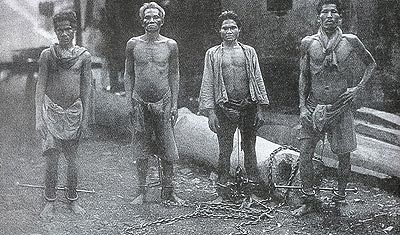
Prisoners convicted of serious crimes in shackles (image from the book Pictorial Album of Thailand, Vol. 2, n.d., p. 31)
He changed the traditional practice of submitting petitions for redress of grievances because the people did not receive justice and proceedings were sometimes delayed. He therefore granted the people the right to submit petitions directly to him. Anyone could present a petition to the king without having to go through senior officials and without being flogged beforehand. He would grant audiences to receive petitions on every wan kon day, and in cases where the petitioner could not submit the petition in person due to imprisonment, brothers, patrons, or guarantors were permitted to submit the petition on their behalf. As for drafting the petition, it could be written by the petitioner or by another person, provided that it was not verbose or lacking in substance.
In the submission of petitions for redress of grievances, petitioners were permitted to lodge accusations even against princes or officials close to the king. For example, the people of Rayong submitted a petition accusing the governor. In such cases, the king would appoint a panel of judges to adjudicate or settle the case with fairness. Petitioners were graciously granted one salueng each as an initial reward, and if they won the case according to the matter stated in the petition, they would be granted an additional one salueng as a reward. Those who submitted petitions before the throne were granted two salueng each as compensation for paper, pencils, and writing fees (Proclamations Nos. 81, 128).
In the adjudication of cases, there were instances where petitions accused judges of being unjust. Therefore, in order to ensure fairness in judicial decisions, a proclamation was issued to appoint and select a council of judges whom the litigants did not object to (Proclamation No. 298). This demonstrates that litigants had the right to choose judges whom they considered fair, and in cases where litigants believed they had not received justice, they were able to submit complaints directly to the king.
Religious Freedom
During his reign, many missionary groups entered the country to propagate their religions. The dissemination of religion was one strategy employed by Western powers; therefore, he permitted the people to enjoy the right and freedom to choose their religion according to their own inclination and to perform religious rites of their chosen faith. He advised the people to think carefully, reflect, and select a religion that could serve as an intellectual refuge, rather than choosing according to others or merely following tradition, as stated in his proclamation: moreover, the seeking and adherence to a religion that may serve as a refuge for the people of this nation is a good and most appropriate endeavor; thus all of you should deliberate and reflect with your own wisdom, and when you clearly perceive the merits of any religion, sect, or group as a suitable refuge in accordance with reason, you should adopt and practice that religion by your own conviction (Proclamation No. 165). As for the Buddhist monastic order, although he founded the Dhammayuttika Nikaya, he granted monks the right and freedom to choose whether to follow the Dhammayuttika Nikaya or the Mahanikaya tradition.
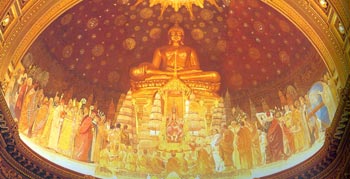
An image of King Rama IV promoting and upholding religion from the western dome of the Ananta Samakhom Throne Hall
(image from the book Dusit Palace: The Palace Complex. 2002. p. 212)
The Elevation of Women’s Status
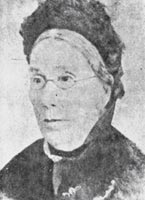
Mrs. D. B. Bradley (image from the book King Mongkut of Siam, Vol. I. 1973. p. 124)
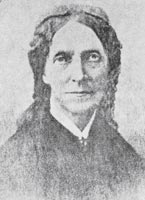
Mrs. Stephen Mattoon (or Mattoun) (image from the book King Mongkut of Siam, Vol. I. 1973. p. 124)
King Mongkut favored the abolition of cruel customs, particularly the use of force to abduct women. He granted women the right to choose their spouses and upheld equality between women and men, thereby honoring and elevating the status of Thai women to be equal to that of men. Previously, women had been oppressed like animals, while men were regarded as human beings. He prohibited husbands from selling their wives, forbade parents from selling their children, and banned the coercion of daughters into marriage against their will (Proclamations Nos. 271, 294). In the same manner, he permitted consorts, minor consorts, and women of the Inner Court to respectfully request leave in order to establish new families freely. At the same time, he elevated the status of women by granting them equal rights to education alongside men. He employed Mrs. Bradley and Mrs. Mattoon, the wives of missionaries, to provide instruction in the English language, literature, and science to consorts, royal concubines, and women of the Inner Court (Wilailekha Thawonthanasarn, The Thai Elite and the Adoption of Monetary Culture, pp. 81–82), for use in communication with Westerners who were beginning to play a role during that period.
The Expansion of Educational Opportunities to the Common People
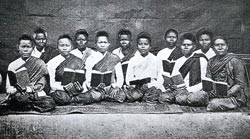
Female students at a missionary school during the reign of King Rama IV in a classroom where the wife of Dr. House taught literacy, sewing, and laundering
(image from the book Collection of Historical Images: The Reign of King Mongkut. 2006. p. 156)
He recognized the importance of education and supported the establishment of modern education, opening the world of learning to commoners and women. After founding the Royal Princes’ and Princesses’ Schools within the Grand Palace, he permitted missionaries to establish schools both in the capital and in provincial towns (Telling the Story of King Mongkut, 2004, p. 12). Princes and nobles sent large numbers of their sons and daughters to study. When a printing press was established, various official documents were printed and distributed to government offices and communities so that the people could learn. Later, books were printed for sale, including Jindamanee, Prathom Ko Ka, Prathom Mala, manuals on craftsmanship, and medical texts, which further expanded learning among common people. As a result, ordinary citizens gained greater opportunities to access information and news.
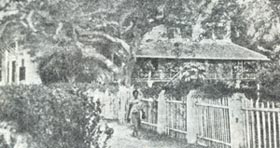
A public school for female students established by a missionary group in Phetchaburi Province in 1865
At present, it is Arunpradit School (image from the book King Mongkut of Siam, Vol. I. 1973. p. 156)
He recognized the importance of education, supported the provision of modern education, and opened the world of learning to commoners and women. After establishing the Royal Princes’ and Princesses’ Schools within the Grand Palace, he permitted missionaries to establish schools both in the capital and in provincial towns (Telling the Story of King Mongkut, 2004, p. 12). Princes and nobles sent large numbers of their sons and daughters to study, and when a printing press was established, various official documents were printed and distributed to government offices and communities so that the people could learn. Later, books were printed for sale, including Jindamanee, Prathom Ko Ka, Prathom Mala, manuals on craftsmanship, and medical texts, which expanded learning further among common people; consequently, ordinary citizens had greater opportunities to access information and news.
Theatrical Performances
In previous reigns, there were royal laws prohibiting members of the royal family, princes, and officials from training female theatrical performers. As a result, royal court theatre with exclusively female performers could be staged only within the Grand Palace. However, during the reign of King Mongkut, he permitted all-female theatre troupes to perform publicly without restriction to the royal court. He believed that having many theatre troupes would bring liveliness to the country and serve as an honor to the realm (Proclamation No. 70). He also allowed royal dramatic works to be performed publicly, whereas previously, performances outside the court were limited to Jataka tales or folk stories. At the same time, he prohibited the forced recruitment of sons or daughters who were unwilling to be trained as performers.
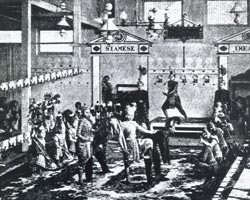
The Siamese Theatre of Phraya Burusrattanaratchaphanlop
(Pheng Phenkul, an adopted royal son in the reign of King Rama IV, who later became Chao Phraya Mahintharasakdithamrong)
It was later renamed the Prince Theatre. The photograph dates to around 1867, showing a theatrical performance using real male and female performers.
Land Ownership
He ordered the promulgation of a royal law concerning land prices so that people who owned houses, land, rice fields, and orchards would receive compensation according to their rightful landholding. Although he possessed royal authority, he did not seek to take advantage of his subjects, and he proclaimed that from that time onward, if the king wished to take houses, fields, or orchards to grant as palaces, residences, or farmlands to members of the royal family and officials of both the Outer and Inner Courts who had rendered service or enjoyed royal favor, or to construct royal monasteries in any place or locality, or to grant such property to anyone, payment must be made from the royal treasury of the realm to purchase houses, fields, and orchards and grant them to members of the royal family and officials of both the Outer and Inner Courts (Royal Teachings, Royal Biography, and Royal Duties of King Mongkut, 1999, p. 125). Moreover, people who owned land with red title deeds were able to sell, mortgage, or pledge their land, and if they wished to redeem it, they had to pay a price acceptable to the new owner. At the same time, those who owned land, fields, or orchards within designated areas could sell their land outright to foreigners in order to obtain higher prices, as foreigners were often generous buyers; the money received would then circulate within the country (Proclamation No. 86).
Rice Trade and Employment with Foreigners


Warehouses along Bang Luang Canal (Bangkok Yai Canal), Thonburi side
(image from the book Collection of Historical Images: The Reign of King Mongkut. 2006. p. 188)
Previously, overseas trade by water with foreign countries was an exclusive right of the Royal Storehouse, members of the royal family, princes, and officials. Later, following the Bowring Treaty, the economic system shifted from a monopoly system to a free trade system (Phensri Duk, Foreign Relations and Thailand’s Independence and Sovereignty, 2001, p. 7). He permitted the export of rice as a commodity for the first time, allowing the people to trade rice freely and to work with foreigners, which increased their income and led to widespread commercial activity (Proclamations Nos. 92, 95, 120). At times, large quantities of rice were exported overseas, causing domestic rice prices to rise, or in some instances, when demand for rice was high, sellers raised prices excessively, as stated in the proclamation that those who had rice and wished to obtain money, and those who feared hunger and bought rice to store, were not opposed by the king, who allowed the people to trade freely according to their wishes. However, when floods occurred and farmers produced insufficient rice for domestic consumption, the king at times issued proclamations warning sellers not to hoard rice to inflate prices and advising that rice be reserved for adequate consumption, prohibiting its export for sale abroad (Proclamations Nos. 95, 243).
Freedom of Expression and Access to Information
When Dr. Dan Beach Bradley introduced the Thai movable-type printing press and published the Bangkok Recorder, in addition to disseminating religion and knowledge, it provided the people with opportunities to express opinions and criticize public affairs. Even the king himself was subject to criticism. Consequently, King Mongkut issued proclamations warning the public not to believe information written in the Bangkok Recorder and permitted the people to present questions to him regarding rumors (Proclamations Nos. 333, 335), indicating that the people possessed the right to express opinions.
Subsequently, he ordered that comprehensive tax and duty schedules be formulated and printed for distribution to every district and subdistrict so that all people would be informed (Proclamations Nos. 56, 180), in order to prevent exploitation by officials and local authorities (Proclamation No. 94). If the people suffered hardship, they had the right to file complaints (Proclamation No. 143). The issuance of proclamations to inform and admonish the populace, as well as the printing and distribution of the Royal Gazette for the public to consult on various administrative matters (Proclamation No. 116), demonstrates that the people had the right to access information.
Royal Audience
During his provincial tours, he graciously allowed the people to attend royal audiences to behold his royal presence and provided opportunities for them to present various matters to him. In addition, he permitted foreigners who received the royal procession to pay respect according to their own customs, as stated in the proclamation.
Officials of the provincial administration, district officers, and officials of the Phrai Luang Department who went to sit in clusters and form circles must not drive villagers far away. Officials in the royal procession, as well as provincial and district officers, must not sit in clusters forming circles and admonish or reprimand villagers who come to sit and wait to receive the royal procession, nor should they interfere with foreigners who wish to pay respect according to their own traditions (Proclamation No. 108).
With the far-sighted vision of King Mongkut, Siam was thus able to preserve its independence at a time when Western imperial powers were competing to acquire colonies.