

King Taksin the Great
Chapter 18: The Royal Family and Noble Lineages of Royal Descent
How many members were there in the royal family of King Taksin the Great, and what were their names?
King Taksin the Great, who reigned as the monarch of the Thonburi Kingdom, had royal sons and daughters, as well as royal relatives and lineages descended from His Majesty, as follows.
18.1 The primary royal lineage includes
1. Her Majesty the Queen Mother, whose original name was Iang or Nok Iang, is presumed to have been a noblewoman during the reign of King Borommakot of Ayutthaya. When King Taksin of Thonburi ascended the throne, he elevated his mother to the title of “Krom Phra Thepamat.” Prior to her passing, she suffered from a severe illness identified as phra yot akkanesan (Woramai Kabilsingh, 1997: 71).
2. Her Royal Highness the Royal Aunt, whose original name was An, was elevated to the royal title of “Krom Luang Thewin Suda.” After the change of reign, her royal rank was reduced to Mom An.
3. Her Majesty the Chief Queen Consort, whose original name was Son, was elevated by King Taksin the Great to the royal title of “Krom Luang Bat Boricha,” but she was commonly known as the Chief Queen Consort of the Central Residence. After the change of reign, her royal rank was reduced to Mom Son.
4. Chao Chom Manda Princess Chim, a consort of King Taksin the Great, held the rank of princess because she was the middle daughter of the ruler of Nakhon Si Thammarat (Nu), the leader of the Nakhon Si Thammarat faction. When King Taksin the Great led an expedition to suppress the Nakhon Si Thammarat faction, the ruler of Nakhon Si Thammarat fled to seek refuge with the ruler of Pattani but was captured and sent to be imprisoned at Thonburi, and he presented his daughter as a royal attendant. Princess Chim received royal favor and was graciously appointed as a principal royal consort at the residence of Krom Luang Boricha Phakdi Si Sudarak.
She later became Chao Chom Manda to His Royal Highness Prince Thatsaphong, His Royal Highness Prince Thatphai, His Royal Highness Prince Narenthararatchakuman, and Her Royal Highness Princess Panchapapi. Subsequently, during the reign of His Majesty King Phra Phutthaloetla Naphalai, King Rama II, all three royal sons were demoted in rank to Phra Phong Narin, Phra In Aphai, and Phra Narentharatcha, respectively. The year of death of Chao Chom Manda Princess Chim does not appear in any surviving evidence.
Note: Nakhon Si Thammarat
During the Thonburi period, the ruler of Nakhon Si Thammarat (Nu) governed the city. Before the fall of Ayutthaya to the Burmese, Nakhon Si Thammarat was a tributary state and therefore had various official positions similar to those of a tributary polity, including an uparat, a phraya chakri, and officials corresponding to the Chatusadom system, among others. Members of the ruling family were also appointed to high ranks, such as Chao Phraya Chakri. The ruler of Nakhon Si Thammarat (Nu) had three daughters, namely:
The eldest daughter was named Chum, sometimes called Nuan, and was referred to at that time as “Thun Kramom Ying Yai.” She was the wife of the uparat of Nakhon Si Thammarat (Phat) (Sathuen Suphasophon, 1984: 101; Sang Phatthanothai, n.d.: 260).
The middle daughter was named Chim. She was presented as a royal consort to King Taksin the Great and was greatly favored. She was honored as the queen consort of the left and elevated to the title of Krom Luang Boricha Phakdi Si Sudarak. The people of Nakhon Si Thammarat called Princess Chim “Thun Kramom Ying Klang.” She bore three royal sons and one royal daughter.
The youngest daughter was named Prang (or Nu Lek). She was a royal consort of King Taksin the Great, and the people of Nakhon Si Thammarat called her “Thun Kramom Ying Lek.” Later, after the death of Thun Kramom Ying Yai, Chum, King Taksin the Great bestowed the uparat (Phat) upon her, even though Chao Chom Manda Prang, or Thun Kramom Ying Lek, was pregnant. If she had given birth to a royal son or daughter, the child would have become the adopted child of the uparat (Phat) and would thereby have gained authority and influence in Nakhon Si Thammarat, a tributary state in the southern region (Chulalada Phakdiphumin, “Phra Ong Suea and Phra Ong Chang,” Sakunthai 48(2488): 25 June 2002: 27, 49).
5. Chao Chom Manda Chim Yai
Chao Chom Manda Chim Yai in the reign of King Taksin the Great was the third royal daughter of King Phra Phutthayotfa Chulalok the Great and Queen Amarindra Borommarachini. It is presumed that she was born in 1761, since her father, Somdet Chao Phraya Maha Kasatsuek, was highly favored by King Taksin the Great and rendered distinguished service. Therefore, Khun Chim was elevated to the rank of principal royal consort (royal spouse), commonly known as Chao Chom Chim Yai.
Chao Chom Manda Chim Yai passed away in 1779, during the Thonburi period as the capital, at the age of eighteen, only twelve days after giving birth to a royal son, Prince Suphanthawong. When Somdet Chao Phraya Maha Kasatsuek returned from a royal military campaign, he arranged her funeral with full honors in every respect. Later, when Somdet Chao Phraya Maha Kasatsuek ascended the throne, he graciously elevated Chao Chom Manda Chim Yai, in her status as a royal daughter, to Somdet Phra Chao Borommawong Thoe Chao Fa Chim Yai, while Prince Suphanthawong was graciously elevated to the rank of Somdet Chao Fa Krom Khun Kasattranuchit.
King Taksin the Great
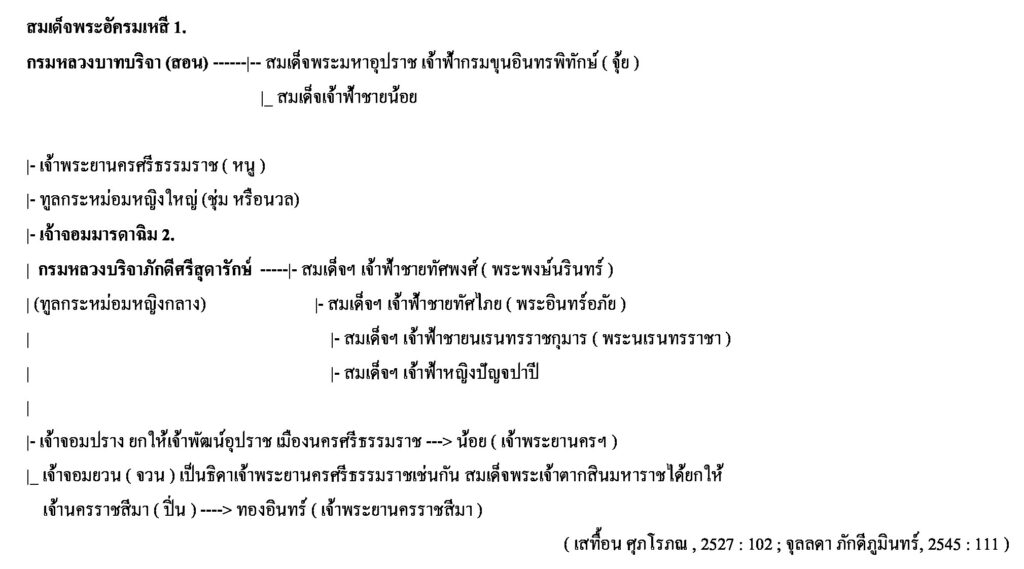
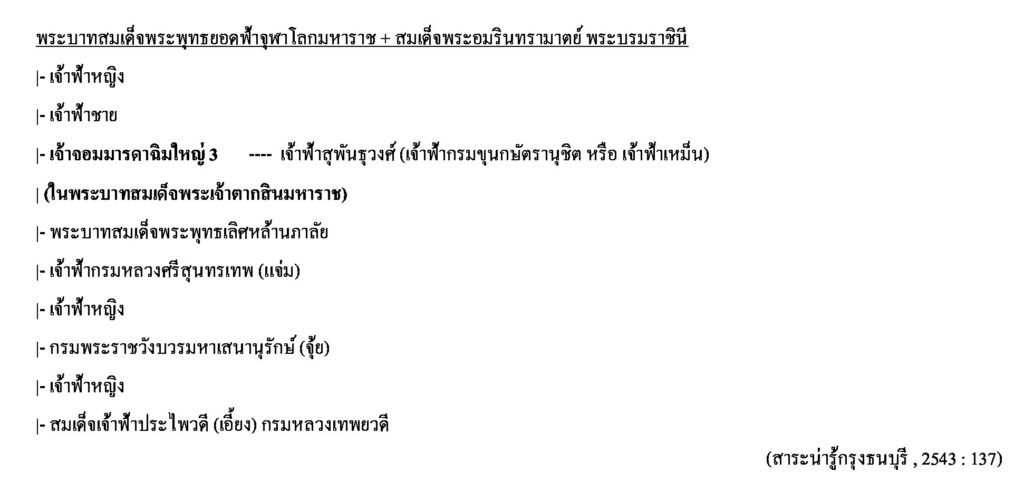
6. Royal consorts consisted of royal princesses from the Ayutthaya period who became consorts of King Taksin the Great, totaling twelve persons, as follows:
6.1 Princess Suriya
6.2 Princess Chanthawadi
6.3 Princess Phinthawadi
6.4 Princess Fakthong
All four were royal daughters of King Borommakot.
6.5 Princess Thapthim, a royal daughter of King Phra Phutthachao Suea.
6.6 Princess Mit, a daughter of Krom Phra Ratchawang Bowon Mahasenaphithak (Prince Kung).
6.7 Princess Prathum, a royal daughter of King Uthumphon.
6.8 Mom Chao Princess Buppha (or Bupha), a daughter of Krom Muen Chit Sunthon, a granddaughter of King Borommakot.
6.9 Mom Chao Princess Ubon, a daughter of Krom Muen Thepphiphit, a granddaughter of King Borommakot.
6.10 Mom Chao Princess Mani, a daughter of Krom Muen Sepphakdi, a granddaughter of King Borommakot.
6.11 Mom Chao Princess Chim, a daughter of Prince Chid (or Chit).
6.12 Mom Chao Princess Krajat, a daughter of Krom Muen Chit Sunam, a granddaughter of King Borommakot.
7. Other consorts of the rank of chao chom and mom ham included:
7.1 Chao Chom Manda Amphan, a daughter of Chao Uparat Chan (Nakhon Si Thammarat), the progenitor of the Chantarotwong lineage.
7.2 Chao Chom Manda Ngoen.
7.3 Chao Chom Manda Thim, a daughter of Thao Song Kandanthong Mon.
Note: Somchot Ongsakun (1954: 1–3) wrote in the book “Khwam Rak Phuea Phaendin, from Lanna to Tha Phra Chan” that “… after the campaign to restore order in Chiang Mai in 1770, a beautiful woman from Lampang followed to serve as a royal attendant of King Taksin of Thonburi, one person, offering her service for the realm and fostering good relations between Thonburi and Lanna, but no record of the story of this woman who followed him has been found …” The details are as follows.
First presentation of a woman. The Thonburi Royal Chronicles, Phan Chanthanumat (Jerm) version, record events after the successful restoration of order in Chiang Mai. One passage states: “… On Thursday, the second lunar month, waning third day, His Majesty resided at the riverside royal pavilion of Chiang Mai and proclaimed that a Lao ruler had come to submit in loyalty under royal protection, having rendered meritorious service in fighting the Burmese. His Majesty bestowed long firearms, pistols, spears, and clothing upon Phra Ya Chaban, granting him royal authority as Phra Ya Wichian Prakan to govern Chiang Mai … On that day, Phra Ya Wichian Prakan presented a woman as a royal attendant, one person” (Somchot Ongsakun, citing the Thonburi Royal Chronicles and the Daily Military Records of the Thonburi period, Collected Chronicles, vol. 40, Bangkok: Khurusapha, 1969, pp. 67–68).
However, King Taksin did not accept her, considering that it would be “taking away someone’s child,” and therefore returned her along with one chang of money and one set of cloth. The Thonburi Royal Chronicles record: “… His Majesty graciously bestowed one chang of money and one set of cloth, and then sent that woman back to Phra Ya Wichian Prakan …” (ibid., p. 68).
Second presentation. The royal army of Thonburi departed from Chiang Mai and arrived at Lampang, where Phra Ya Kawila awaited the royal arrival. The Thonburi Royal Chronicles record: “… At dawn on Tuesday, the second lunar month, waning eighth day, the army moved from Hang Chat to encamp at Lampang. At four o’clock in the afternoon, His Majesty proceeded to pay homage and take leave of the Phra Borommathat, making offerings with gold and silver flowers, and scattering royal alms to the Lao people in great quantity … Moreover, Phra Ya Kawila presented a woman as a royal attendant, one person” (ibid., p. 69).
King Taksin initially ordered that the woman be returned to Phra Ya Kawila and bestowed one chang of money together with one set of cloth, as he did not wish to “take away someone’s child,” in the same manner as he had done with Phra Ya Wichian Prakan at Chiang Mai. However, Phra Ya Kawila and the uparat of Lampang submitted a petition recorded as follows: “… now the woman herself consents, and her parents and all relatives are also in agreement, and it will not be considered an offense arising from separation from her parents …” King Taksin therefore accepted her, as recorded in the Royal Chronicles: “… His Majesty reflected that their loyalty was sincere, and thus allowed her to accompany the royal procession …” (ibid., pp. 69–70). The woman from Lampang thereafter entered the royal court of Thonburi, in accordance with the intention of Chao Kawila of Lampang (who was later appointed by King Phra Phutthayotfa Chulalok the Great as Phra Ya Mangrao Chiraprakan Kamphaeng Kaeo, ruler of Chiang Mai, http://www.lannaworld.com/person/kingcm1.htm , 16/9/2547)
18.2 Lineages of the Royal Sons and Royal Daughters
There were a total of thirty persons: twelve of the rank of Chao Fa, sixteen of the rank of Phra Ong Chao, and two commoners. For many of them, the names of their royal mothers do not appear in the records.
- The rank of Chao Fa comprised a total of twelve persons, whose names are listed in order of seniority as follows.
1. Somdet Phra Maha Uparat, Chao Fa Krom Khun Intharaphithak (Jui), a son of the Chief Queen Consort Krom Luang Bat Boricha, was executed together with his royal father in 1782.
1.1 The sons and daughters of Somdet Chao Fa Krom Khun Intharaphithak (Jui) numbered four persons, namely Princess Maduea, Princess Sali, an unnamed prince, and Prince Thong-in (or Thong-in).
Note: Princess Maduea became a mom ham in the household of Krom Muen Narathewet, the eldest son of Krom Phra Ratchawang Bowon Sathan Phimuk (the Rear Palace). Princess Sali became a mom ham in the household of Krom Luang Seni Borirak, the youngest son of Krom Phra Ratchawang Bowon Sathan Phimuk as well. Prince Thong-in served in the reign of King Rama I and attained the rank of Phra Ya Kalahom Ratchasena (Chulalada Phakdiphumin, “The Royal Family of Thonburi and the Chakri Dynasty,” Sakunthai 48(2483): 21 May 2002: 78).
1.2 The lineage of Somdet Chao Fa Krom Khun Intharaphithak (Jui), the Maha Uparat of Thonburi, is divided into two branches as follows:
a. The “Sinsuk” branch, with Chao Phraya Yommarat (Suk), son of Prince Thong-in, a royal son of the Maha Uparat, as the founding ancestor.
b. The “Intharayothin” branch, with Khun Chai Nut, younger brother of Chao Phraya Yommarat (Suk) and son of Prince Thong-in, as the founding ancestor.
Note:
a. Chao Fa Krom Khun Intharaphithak (Jui)
Chao Fa Krom Khun Intharaphithak, whose original name was Jui, was the eldest royal son of King Taksin the Great and the Chief Queen Consort Krom Luang Bat Boricha (Son). He held the rank of Somdet Phra Maha Uparat and served as heir apparent. Throughout his life, he assisted extensively in state affairs and military campaigns. In mid-1781, when King Taksin the Great ordered the mobilization of troops to attack Cambodia, Chao Fa Krom Khun Intharaphithak was in the monkhood, but he requested disrobing and joined the campaign as a supporting force. This was because His royal father intended to establish him as the king of Cambodia. It is conjectured that King Taksin the Great may have intended to expand the territory and authority of the kingdom, and therefore sent his royal son, Chao Fa Krom Khun Intharaphithak, born of the chief queen, to govern Cambodia. A royal command was given to Somdet Chao Phraya Maha Kasatsuek that once the situation in Cambodia had been fully pacified (at that time Cambodia was embroiled in a succession conflict), Somdet Chao Phraya was to conduct the ceremony to install Krom Khun Intharaphithak as the ruler of Cambodia (Chulalada Phakdiphumin, “Phra Ong Suea and Phra Ong Chang,” Sakunthai 48(2488): 25 June 2002: 27, 119).
However, unrest broke out in Thonburi, leading to a change of reign before these plans could be realized. In the final period of King Taksin the Great’s reign, the kingdom was in turmoil. Somdet Chao Phraya Maha Kasatsuek intervened to suppress the disorder, and the officials agreed to carry out the execution of King Taksin the Great. Somdet Chao Phraya Maha Kasatsuek was subsequently crowned as the first monarch of the Chakri dynasty.
Chao Fa Krom Khun Intharaphithak remained in Cambodia at the time of the change of reign. He later fled to Khao Noi, but was captured and executed together with his royal father, along with Phra Ya Kamhaeng Songkhram (that is, Phra Ya Nakhon Ratchasima [Pin], a military commander who had fought alongside King Taksin the Great in every campaign). The Chief Queen Consort Krom Luang Bat Boricha (Son) was reduced in rank to “Mom Son,” and the royal sons and daughters of the rank of Phra Ong Chao were likewise demoted, though they continued to be respected and loved by the people. They maintained close ties with members of the Chakri royal family and formed marital alliances with princes and princesses who became founders of several royal lineages, with descendants continuing to the present day. Chao Fa Krom Khun Intharaphithak was the progenitor of the Sinsuk and Intharayothin lineages (Lek Phongsamakthai, “Genealogical Connections between King Taksin’s Royal Line and the Chakri Dynasty,” Silpa Watthanatham 23(6): April 2002: 63).
b. Prince Thong-in (Khun Chai Thong-in) was a son of Chao Fa Krom Khun Intharaphithak (Prince Jui), the Uparat, who was regarded as the principal royal son of King Taksin the Great.
Khun Chai Thong-in later became Phra Ya Kalahom Ratchasena. It is said that Somdet Phra Baworrachao Maha Surasinghanat, during the reign of King Rama I, greatly favored him and regarded him as akin to an adopted son. After Somdet Phra Baworrachao passed away, when Prince Lamduan and Prince Inthapat plotted a rebellion, Phra Ya Kalahom Ratchasena (Thong-in) joined them and was therefore sentenced to death together with Prince Lamduan, Prince Inthapat, and several other conspirators (Chulalada Phakdiphumin, “Phra Ong Suea and Phra Ong Chang,” Sakunthai 48 (2493): 30 July 2002: 86).
2. Somdet Chao Fa Chai Noi, a son of the Chief Queen Consort Krom Luang Bat Boricha, was executed together with his royal father.
3. Somdet Chao Fa Prince Thatsaphong, a son of Krom Borichaphakdi Si Sudarak (Princess Chim, daughter of the ruler of Nakhon), later served as a royal physician during the reigns of King Rama I and King Rama II, and was the progenitor of the Phongsin lineage.
3.1 The sons and daughters of Prince Thatsaphong numbered seventeen persons, namely Khun Ying Sila, who served in the inner court; Khun Chai Sawat, who later became Khun Chai Phonphai; and Khun Ying Sangiap, who became the wife of Phra Ya Sanehamontri (Noi Iat) of the Chaturongkun lineage.
Note: Phra Ya Sanehamontri (Noi Iat) was a son of Chao Phraya Nakhon Si Thammarat (Noi), who was a royal son of King Taksin the Great and Chao Chom Prang (the younger sister of Krom Luang Borichaphakdi Si Sudarak). Therefore, Khun Ying Sangiap and Phra Ya Sanehamontri (Noi Iat) were paternal cousins. During the reign of King Mongkut, King Rama IV, Khun Ying Sangiap held the position of deputy to Chao Khun Ying Num, daughter of Somdet Chao Phraya Yommarat Mahaphichaiyat. Chao Khun Ying Num held the rank of Chao Khun Phra Ratchaphan, third class, and was the paternal granddaughter of Chao Khun Ying Nuan, Chao Khun Phra Ratchaphan, first class (a lady-in-waiting to Queen Amarindra Borommarachini in the reign of King Rama I). Khun Palat Sangiap later served as a royal nurse to King Chulalongkorn, King Rama V, and was greatly favored, being addressed as “Khun Rat Noi” (likely derived from the term “Khun Palat Noi”).
– Khun Ying Kulap, Khun Ying Phueak, Khun Ying Chin, Khun Ying Klib
– Khun Ying Wek, Khun Chai Nut
– Khun Chai Rat, who became Phra Narin, progenitor of the Phongsin lineage
– Khun Ying Phlap, consort of Krom Muen Phumintharaphakdi, progenitor of the Ladawan lineage
Note: Khun Phlap had three children. The eldest daughter was named Mom Chao Saraphi. Mom Chao Saraphi was greatly favored by His Majesty King Chulalongkorn. The royal sons and daughters of King Chulalongkorn and Phra Wimada Thoe Krom Phra Suthatsininat addressed her as “Pa Phi,” and King Chulalongkorn likewise came to address her as “Pa Phi.” In his royal writings entitled “Far from Home,” he mentioned “Pa Phi” on several occasions.
– Khun Ying Chan served as a royal nurse to His Majesty King Chulalongkorn.
– Khun Ying Chip, Khun Ying Run, Khun Chai Chup, Khun Chai Chai.
– Khun Ying Khao served as a royal nurse to Somdet Chao Fa Krom Phra Chakkraphong, the middle royal brother sharing the same royal mother with King Chulalongkorn.
3.2 The lineage of Somdet Chao Fa Thatsaphong consists of a single branch, namely the “Phongsin” lineage, with Khun Chai Rat (Phra Narin), son of Prince Thatsaphong, as the founding ancestor.
4. Somdet Chao Fa Princess Komon, the name of her royal mother is unknown.
5. Somdet Chao Fa Princess Buppha, the name of her royal mother is unknown.
6. Somdet Chao Fa Prince Singhara, the name of his royal mother is unknown.
7. Somdet Chao Fa Prince Sila, the name of his royal mother is unknown, progenitor of the Silanon lineage.
7.1 The sons and daughters of Somdet Chao Fa Prince Sila numbered four persons, namely Khun Ying Thap, consort of Krom Phra Itsaret, progenitor of the Suriyakun lineage; Khun Ying Phlap, consort of Krom Muen Kasat Si Sakkidet, progenitor of the Itsarasena lineage; Khun Ying Nu; and Khun Chai Im, who became Luang Ratcha Nararak, progenitor of the Silanon lineage.
7.2 The lineage of Somdet Chao Fa Prince Sila has a direct line of descent through his son, Khun Chai Im, who held the title Luang Ratcha Nararak, forming the “Silanon” lineage.
8. Somdet Chao Fa Prince Lek, the name of his royal mother is unknown.
9. Somdet Chao Fa Prince Thatphai, a son of Krom Luang Borichaphakdi Si Sudarak, was executed in 1785 on the charge of having an illicit relationship with a consort of King Phra Phutthaloetla Naphalai.
9.1 The sons and daughters of Somdet Chao Fa Prince Thatphai numbered thirteen persons, namely:
– Khun Chai Dan, who became Luang Mongkhonrat during the reign of His Majesty King Mongkut.
– Khun Ying Noi, who became Chao Chom Manda to His Majesty King Mongkut (and had two royal sons before his accession to the throne, namely Prince Nopphawong, Krom Muen Mahesuan Siwilat, and Prince Suppradit, Krom Muen Witsanunat Niphatthon).
– Khun Ying Luk-in
– Khun Ying Aran (or Hiran)
– Khun Chai Rao
– Khun Ying Phum
– Khun Ying Fai
– Khun Chai Mangkon
– Khun Chai Lek
– Khun Ying Phueak
– Khun Ying Nu
– Khun Chai Jui
– Khun Chai Noi
Note:
a. Phra Phong Narin – Phra In Aphai (Somdet Chao Fa Thatphong and Somdet Chao Fa Thatphai). Somdet Chao Fa Thatphong, when Somdet Phra Chao Taksin the Great entered the monkhood, followed His Majesty the royal father to reside within the ordination hall as well. At that time, he was 12 years of age and had not yet undergone the tonsure ceremony.
His Majesty King Phra Phutthayotfa Chulalok the Great held deep respect and affection for Somdet Phra Chao Taksin the Great. After the affairs of the kingdom had returned to peace and order, His Majesty graciously ordered that the royal remains of Somdet Phra Chao Taksin the Great be exhumed and cremated with royal honors at Wat Bang Yi Ruea Tai. His Majesty personally attended the ceremony together with Somdet Krom Phra Ratchawang Bowon Maha Surasinghanat, and wore white royal garments as an expression of reverence and to render the highest honor to Somdet Phra Chao Taksin the Great.
As for the royal sons and daughters of Somdet Phra Chao Taksin the Great, King Rama I of the Chakri Dynasty extended royal benevolence by nurturing them and appointing them to various official positions. He graciously bestowed the titles “Phra Phong Narin” and “Phra In Aphai” upon Somdet Chao Fa Thatphong and Somdet Chao Fa Chai Thatphai respectively, and allowed their descendants of the Mom Rajanikul rank to serve in the royal court. His Majesty King Phra Phutthayotfa Chulalok the Great (King Rama I) showed particular royal favor toward Chao Fa Thatphong, nurturing him together with Nak Ong Eng (son of the King of Cambodia), whom His Majesty adopted as a royal foster son. He further graciously granted that they be ordained together with Somdet Phra Chao Luk Ya Thoe Chao Fa Krom Khun Senanurak, with a grand and magnificent ordination celebration conducted simultaneously (Julada Phakdiphumin, “The Royal Family of Thonburi and the Chakri Royal Dynasty,” Sakun Thai 48 (2483): 21 May 2002: 78).
Because the two royal sons of Somdet Phra Chao Taksin the Great possessed medical knowledge and held positions granting them audience following the senior ministers, and because their medical duties required close familiarity and frequent access to the Inner Palace, Phra In Aphai became involved in an illicit relationship with a royal consort of His Majesty King Phra Phutthaloetla Naphalai. When the matter reached the royal hearing, His Majesty ordered an investigation. Upon establishing the truth, His Majesty graciously commanded that both Phra In Aphai and the royal consort be put to death. The incident occurred in the 10th lunar month of the Year of the Monkey, B.E. 2355 (http://pantip.inet.co.th/caf?/library/topic/K1578551/K1578551.html, 27/6/2002).
b. Chao Chom Manda Noi
The second daughter of Phra In Aphai (Somdet Chao Fa Thatphai) was Khun Ying Noi, also known as Chao Chom Manda Noi. She became a consort of His Majesty King Mongkut while he held the rank of Somdet Chao Fa Mongkut. She gave birth to two royal sons: Phra Ong Chao Nopphawong, Krom Muen Mahesuan Siwilat, progenitor of the royal lineage Nopphawong na Ayutthaya, and Phra Ong Chao Supadit, Krom Muen Wisanu Nat Niphatthon, progenitor of the royal lineage Supadit na Ayutthaya.
In the Year of the Monkey, B.E. 2367, His Majesty King Phra Phutthaloetla Naphalai graciously commanded Somdet Chao Fa Mongkut to enter the monkhood. At that time, Phra Ong Chao Nopphawong and Phra Ong Chao Supadit were aged two years and two months respectively.
During the period in which Somdet Chao Fa Mongkut remained in the monkhood, His Majesty King Phra Phutthaloetla Naphalai, the royal father, passed away without designating any royal successor. The senior officials and members of the royal family therefore offered the royal sovereignty to Phra Chao Luk Ya Thoe Krom Muen Jessadabodin, who later ascended the throne as King Rama III of the Chakri Dynasty. Consequently, Somdet Chao Fa Mongkut continued in the monastic order for a total of 27 years during the reign of His Majesty King Nangklao (King Rama III).
Chao Chom Manda Noi resided with Phra Phong Narin (Somdet Chao Fa Thatphong), her paternal uncle, who raised and cared for Phra Ong Chao Nopphawong. As for Phra Ong Chao Supadit, Somdet Chao Fa Chutamani (His Majesty King Pinklao) of the Thonburi Palace was the one who fostered and supported him.
Chao Chom Manda Noi was a woman of pitiable circumstances. Her royal grandfather, King Taksin the Great, had been executed; her father, Somdet Chao Fa Chai Thatphai or Phra In Aphai, had likewise been put to death. Her personal life was fraught with hardship, as her royal consort remained in the monkhood for as long as 27 years. When His Majesty King Mongkut ascended the throne, he did not favor or grant any special distinction to Chao Chom Manda Noi. As a result, she exhibited unusual behavior, which may have been an attempt to seek attention.
On one occasion, His Majesty King Mongkut traveled by royal barge procession from the Water Pavilion to Wat Khema Talat Kaeo. A cabin boat followed and raced alongside the royal barge. Chao Muen Sanphetphakdi (later Chao Phraya Mahintharasak Thamrong [Pheng]) called out to inquire, but received no reply. The female attendants in the cabin boat laughed mockingly. Upon investigation, it was discovered that the cabin boat belonged to Chao Chom Manda Noi. This act caused great displeasure, and the already distant relationship became irreparably severed. Evidence of this appears in a royal letter in which His Majesty King Mongkut recounted the incident to Chao Chom Manda Phueng, dated Wednesday, the 15th day of the waxing moon of the 12th month, B.E. 2398, stating:
“I set out by royal barge procession from the Water Pavilion on the 16th day of the 12th month, shortly before dawn at about eleven o’clock and six baht, arriving at Wat Khema Talat Kaeo at one and a half hours past morning with four baht. A cabin boat paddled after and raced with my royal barge, overtaking the police boats and all the attendant barges, racing until it drew level with my royal barge. At first I thought that Nang Nu Luk Ramphoei (meaning Her Royal Highness Princess Chanthramonthon) might be crying and that her mother wished to place her in the cabin boat to send her to me. I therefore called out to ask whose boat it was. The boat was fully curtained, with several women seated at the stern. The police boats assumed it to be an inner procession boat and thus did not stop it, allowing it to paddle on. Sanphetphakdi called out many times but received no answer. I myself asked repeatedly what it was, whose boat it was, but no reply was given. The female attendants at the stern laughed mockingly to an excessive degree, causing those in my royal barge to become angry at the derisive laughter.
I considered ordering gunfire according to the law, but feared that if someone were killed, people would spread rumors that I was cruel and quick to take lives. The boat continued racing and pursuing my royal barge for a long time. Seeing that the situation was improper, I ordered the police to pursue and arrest it. When the police boat attempted to seize it, the cabin boat paddled away. After a long chase, the boat was finally captured. It was found to be the boat of the mother of Krom Muen Mahesuan Siwilat, acting playfully and teasing me before the ladies of the court, most reprehensible. I ordered Phra Intharathhep to seize the boat and bring the person in charge for detention. The attendants were ordered to be detained as well.
I wrote a letter informing Krom Muen Mahesuan of this matter, and issued orders to Thao Si Satcha and Thao Sophan Niwet to detain her securely until my return. I even felt inclined to have her beheaded according to her paternal lineage, for people of that clan often behave thus, like Khun Samli, mother of Phra Ong Chao Natta. Though the child was beloved and raised with great care, the mother could not be restrained and was taken to be beheaded, as has occurred before.”
This royal letter clearly demonstrates the depth of royal displeasure. As for the subsequent fate of Chao Chom Manda Noi, there is no definitive evidence. It is only known that she was detained within the Inner Palace together with Mae Talap and Mae Yoi, who were seated in the same boat (Sansani Wirasilpchai, 1996: 80–82).
When Chao Chom Manda Noi passed away, His Majesty King Mongkut graciously ordered the royal cremation to be held at the rear garden of the palace of Phra Chao Luk Ya Thoe Krom Muen Wisanu Nat Niphathorn. After the funeral rites for Chao Chom Manda Noi were completed, Krom Muen Wisanu Nat Niphathorn then conceived the plan to construct a temple on the site of the rear garden of his palace, which had been used as the cremation ground for Chao Chom Manda Noi. The method by which His Royal Highness Krom Muen Wisanu Nat Niphathorn planned the construction of the temple was to scatter money throughout the area designated as the temple site, and then order his servants and retainers to clear the trees and vegetation in order to collect the money. This, in effect, was his method of paying wages to the laborers.
Before the construction of the temple was completed, Phra Chao Luk Ya Thoe Krom Muen Wisanu Nat Niphathorn passed away in the Year of the Dog, B.E. 2405, at the age of only 38. His Majesty King Mongkut then graciously ordered Phra Chao Luk Ya Thoe Krom Muen Mahesuan Siwilat to continue the construction of the temple. However, Krom Muen Mahesuan Siwilat also passed away later, in the Year of the Rabbit, B.E. 2410. His Majesty King Mongkut therefore assumed responsibility for continuing the construction himself.
His Majesty graciously appointed Phraya Ratchasongkhram as the chief overseer to continue the construction until completion, after which he bestowed the name of the temple as “Wat Trithosthep,” meaning “the temple built by three deities.” He then graciously ordered the ceremonial procession of Phra Khru Chulanunayok (Khong), the left deputy abbot and ecclesiastical subordinate of Somdet Phra Maha Samana Chao Krom Phraya Pavares Variyalongkorn of Wat Bowonniwet Vihara, to assume the abbacy of Wat Trithosthep as its first abbot.
c. Krom Muen Mahesuan Siwilat and Krom Muen Wisanu Nat Niphathorn
His Royal Highness Krom Muen Mahesuan Siwilat was at birth granted the rank of Mom Chao, bearing the name Mom Chao Nopphawong (or Naphawong). When His Majesty King Mongkut ascended the throne, he graciously promoted him to the rank of Phra Ong Chao, granting the ceremonial name inscribed on the golden tablet as “Phra Ong Chao Nopphawong Worong-ek Akkha Maha Mongkut Paramuttamarachorot,” and further elevated him to the status of a Phra Ong Chao of a separate department, with the title “Phra Chao Luk Ya Thoe Krom Muen Mahesuan Siwilat.” During the reign of His Majesty King Nangklao, Krom Muen Mahesuan Siwilat did not hold any official post. However, in the reign of His Majesty King Mongkut, his royal father, he was appointed as the commander of the palace-encircling troops.
His Royal Highness Krom Muen Wisanu Nat Niphathorn was at birth granted the rank of Mom Chao Supadit. When His Majesty King Mongkut ascended the throne, he graciously promoted him to “Phra Ong Chao Supadit Worritthirach Maha Mongkut Burutsayarat Ratchawororot,” and elevated him to the status of a Phra Ong Chao of a separate department, bearing the title Phra Chao Luk Ya Thoe Krom Muen Wisanu Nat Niphathorn. He was entrusted with the supervision of the Royal Treasury Department and was also sent to study matters of administration and national development in Singapore. His Majesty King Mongkut graciously allowed him to travel on this study visit together with Somdet Chao Phraya Borom Maha Sri Suriyawong (Chuang Bunnag), who at that time held the rank of Chao Phraya. Thus, His Royal Highness Krom Muen Wisanu Nat Niphathorn became the first royal son to travel abroad for the purpose of study.
10. Somdet Chao Fa Chai Narinthararachakuman, a royal son born to Krom Luang Borichaphakdi Srisudarak.
10.1 The royal sons and daughters of Somdet Chao Fa Chai Narinthararachakuman numbered 18 persons, as follows:
– Khun Chai Jui, who served as Nai Chalong Naiyanat in the reign of King Nangklao.
– Khun Chai Wong, who became Phra Narong.
– Khun Chai Kasem, who became Luang Mahawisut Kosa (he had daughters, Chao Chom Manda Iam and a Chao Chom Manda in the reign of King Pinklao).
– Khun Ying Kham.
– Khun Chai Nut, who served as Phra Bamroe Rat and was later promoted to Phraya Uthaitham (he had one granddaughter, named Sila, who married into the Thammasarot family).
– Khun Chai Nat, who became Phra Ratchaphimont.
– Khun Chai Nak, who became Luang Phiphatthanasunthon.
– Khun Ying Chan.
– Khun Ying Saeng.
– Khun Chai Rung, who became Phraya Samphoppai and was later promoted to Phraya Chirayumontri, founder of the Rungphairoj lineage.
– Khun Ying Uam, Khun Ying Foi, Khun Ying Thap, Khun Ying Prik, Khun Chai Inthanin.
– Khun Ying Amphon, Khun Ying Ampan.
– Khun Ying Sut, who had a daughter named Malai, a royal consort of King Pinklao.
10.2 The lineage of Somdet Chao Fa Chai Narinthararachakuman has one direct line of descent through his royal son, Khun Chai Rung, or Phraya Samphoppai, namely the “Rungphairoj” lineage.
11. Somdet Chao Fa Chai Suphanthawong, Krom Khun Kasatranuchit (Chao Fa Men), a royal son of Chao Chom Manda Chim Yai, a royal daughter of King Phutthayotfa Chulalok the Great, was executed in the year B.E. 2352.
11.1 The royal sons and daughters of Somdet Chao Fa Chai Suphanthawong, Krom Khun Kasatranuchit, whom the Chakri dynasty permitted to retain princely rank, numbered 13 in total, namely:
– Mom Chao Chai Yai, who was executed together with his father.
– Mom Chao Ying Talap.
– Mom Chao Ying Pom.
– Mom Chao Chai Suwan, who was executed together with his father.
– Mom Chao Ying Yi Sun.
– Mom Chao Chai Nu Phueak, who was executed together with his father.
– Mom Chao Chai Sawat, who was executed together with his father.
– Mom Chao Ying Samli.
– Mom Chao Ying Saraphi.
– Mom Chao Chai Lek, who was executed together with his father.
– Mom Chao Ying Mui.
– Mom Chao Chai Daeng, who was executed together with his father.
– Mom Chao Ying of unknown name.
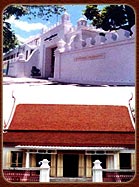
Tha Phra Palace is currently Silpakorn University, Tha Phra Campus.
(Image from the commemorative book for the 60th anniversary of Silpakorn University)
Note:
a. Somdet Chao Fa Suphanthuwong, Krom Khun Kasattranuchit
When King Taksin the Great had completed his coronation and ascended the throne, Phra Phutthayotfa Chulalok—at that time holding the title of Somdet Chao Phraya Maha Kasatsuek—presented his eldest royal daughter, Somdet Chao Fa Ying Chim Yai (the senior female royal consort), to be a royal consort of King Taksin the Great. She later gave birth to a royal son, Somdet Chao Fa Chai Suphanthuwong, commonly known as Chao Fa Maen, in 1779 (B.E. 2322). Twelve days after the birth, his royal mother passed away. King Taksin the Great honored Somdet Chao Fa Ying Chim Yai with exceptional royal dignity in the royal cremation ceremony, granting Mom Chao Madar Chim Yai funeral honors equivalent to those of a Chao Fa, because Chao Fa Suphanthuwong was the maternal grandson of Somdet Chao Phraya Maha Kasatsuek.
During the reign of King Phutthayotfa Chulalok (Rama I), Somdet Chao Fa Suphantawong—grandson of King Taksin—held the status of a royal grandson and was granted a new name: Chao Fa Aphaitibes, commonly shortened by officials to Chao Fa Aphai. Rama I observed that this name conflicted with the names of two previous Chao Fa from the Ayutthaya period, so he graciously bestowed a new name: Chao Fa Thammathibes, later elevated to the title Chao Fa Krom Khun Kattaranuchit. His residence was on the west side of Na Phra Lan Road, known as Tha Phra Palace.
It is presumed that King Taksin intended for his son, Chao Fa Suphantawong—son of Chao Mom Chom Chim Yai—to ascend the throne, with his grandfather (Rama I) serving as a key supporter, since Chao Mom Chom Chim Yai was the eldest daughter of Somdet Chaophraya Maha Kasatsuek (later Rama I of the Chakri dynasty) (Julaladda Phakdipoomin, “Phra Ong Suea and Phra Ong Chang”, Sakol Thai 48(2488): 119).
On Thursday, 7 September 1809, late at night, King Phutthayotfa Chulalok passed away. On Friday morning, his body was bathed and enshrined at Phra Thinang Dusit Maha Prasat.
On Sunday morning, 10 September 1809, King Phutthaloetla Naphalai (the Prince of the Front Palace) went out to give alms in front of the Grand Palace. While cracking eggs to eat, he discarded the eggshells onto the ground. Phraya Aphai Phuthon (Noi), acting as Samuhakaya, noticed a mysterious note inside the shell. The note revealed that the sons and daughters of King Taksin—Chao Fa Krom Khun Kattaranuchit, Prince Ornipha (Nu Dam), and Chao Mom Samliwan
They conspired with several officials to stage a rebellion and seize the throne, so the king graciously commanded the senior prince, Krom Muen Jesadabodin (King Nangklao, Rama III), to investigate; the investigation confirmed the plot and implicated many officials, including Chao Phraya Phon Thep (Bunnak, Ban Maela), Phraya Phetpani (Klom), Phraya Ram (Thong), Phra Indet (Kratai), Chamuon Sathan Montien (On), Nai Khun Nen, grandson of Chao Phraya Phon Thep, Saming Rod Songram; Saming Siri Khundot, son of Chao Phraya Maha Yotha (Jeng), Saming Patberd (Muang), Saming Pintala, along with ten servants of Chao Fa Krom Khun Kattaranuchit, totaling forty people, and three other members of the royal family.
King Phutthaloetla Naphalai ordered that the royal rank of Chao Fa Krom Khun Kasatranuchit be stripped, reducing him to Mom Muen, and that he be executed by sandalwood clubbing at Wat Pathum Khongkha.
As for Prince Aranipha (Nu Dam), Princess Samliwan, and the officials who conspired together, he ordered that all of them be punished by beheading.
As for the six sons of Chao Fa Krom Khun Kasatranuchit, or Mom Muen, they were also punished and were taken to be drowned at the mouth of the bay (some say at the mouth of the Chao Phraya River
(Pramin Khruathong, 2004: 108–115; Sujit Wongthet, 1988: 62–63; and http://pantip.inet.co.th/caf?/library/topic/K157851 /K1578551 .html, 27/6/2002).
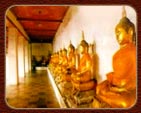
The Buddha images in the cloistered gallery of Wat Pathum Khongkha.
Regarding the case of the rebellion of Chao Fa Muen, Pramin Khruathong (2004: 108–115) raised questions in his article entitled “The Rebellion Case of Chao Fa Muen: Heir of King Taksin,” suggesting that this case likely “…had more background causes than what appears in the evidence, with several underlying factors, and many aspects lacking logical consistency, especially the fact that all those involved in the plot were former royal retainers of King Rama I. This contradicts the evidence as to why the rebel group would think of elevating Chao Fa Muen as king, since these ‘former retainers’ were the very people who had participated in the overthrow of King Taksin of Thonburi.”
12. Princess Chao Fa Ying Panchapapi, Royal Daughter of Krom Luang Borichaphakdi Srisudarak
Princess Chao Fa Ying Panchapapi was the eleventh daughter and was another daughter of King Taksin the Great who had marital ties with the Front Palace princes of the Chakri royal family, as she was married to Prince Chao Fa Krom Khun Itsaranurak, the son of Princess Chao Fa Krom Phra Srisudarak, who was the elder sister of King Phutthayotfa Chulalok the Great, and Chao Khrua Ngoen.
Prince Chao Fa Krom Khun Itsaranurak served as superintendent of the Ministry of the Interior during the reign of King Phutthaloetla Naphalai and was the progenitor of the Isarangkun na Ayutthaya royal lineage (Lek Phongsamakthai, “Royal Lineage Connections between King Taksin and the Chakri Dynasty,” Sinlapa Watthanatham, 23(6): April 2002: 63, 65). The sons and daughters of Princess Chao Fa Ying Panchapapi, who was the consort of Chao Fa Krom Khun Itsaranurak (son of the younger royal elder sister in the reign of King Rama I), founders of the Isarangkun lineage, numbered five, namely:
– Mom Chao Yai Isarangkun
– Mom Chao Klang Isarangkun
– Mom Chao Ying Srifa Isarangkun
– Mom Chao Suntara Isarangkun
– Mom Chao Ying Rotsukhon Isarangkun
- At the rank of Phra Ong Chao, there were sixteen princes and princesses, bearing the following names in order of age:
1. Prince Amphanwan, son of Chao Chom Manda Thim. Prince Amphanwan was a royal son of King Taksin with Mom Thim, who was the third daughter of Thao Songkandan (Thong Mon), who supervised and safeguarded the royal palace keys in Thonburi. It is assumed that Thao Songkandan was a minor consort of a Mom Chao (a son of a Phra Ong Chao or Chao Fa of the Ayutthaya royal family), residing at Tha Sip Bia, Ayutthaya, an area of Mon settlement. Mom Thim had only one child of the rank of Phra Ong Chao, namely Prince (male) Amphanwan, who was the third royal son among the thirty children of King Taksin, and who in the Rattanakosin period was later known as “Khun Wan.” Khun Wan had only one eldest son named “Khun Chai Rai,” followed by six daughters (Chullada Phakdiphumin, “The Thonburi Royal Family,” Sakunthai 48(2493): 30 July 2002: 86).
1.1 The sons and daughters of Prince Amphanwan numbered seven, namely:
– Khun Chai Rai, who had a daughter named Khun Klin, who served as a royal wet nurse to Somdet Krom Phraya Phanuphantuwong Woradet
– Khun Ying Saeng, consort of Krom Phra Phithak Thewet, progenitor of the Kunchon lineage
– Khun Ying Sanguan
– Khun Ying Thomya, a minor consort of Krom Phra Phithak Thewet
– Khun Ying Phueng, a minor consort of Krom Khun Ratchasihawikrom, progenitor of the Chumsai lineage
– Khun Ying Phrom
– Khun Ying Luk In, a minor consort of Krom Phra Phithak Thewet
2. Prince Aranipha (Nu Dam), son of Chao Chom Manda Amphan (the elder brother born of the same mother as Chao Chom Manda Samliwan), was executed during the reign of King Phutthaloetla Naphalai in 1809 for conspiring to overthrow the Chakri dynasty. The sons and daughters of Prince Aranipha numbered six, namely:
– Khun Chai Klin
– Khun Chai Pheng
– Khun Chai Chang
– Khun Chai Pan
– Khun Chai Talap
– Khun Ying Khli
3. Princess Sumali, whose mother’s name is unknown.
4. Prince Thamrong, whose mother’s name is unknown. The daughters of Prince Thamrong numbered three, namely:
– Khun Ying Somthap
– Khun Ying Phlap Chin
– Khun Ying Saisoi
5. Prince Lamang, whose mother’s name is unknown, became Phraya Sombatiban during the reign of King Rama III.
6. Princess Chamchuri, whose mother’s name is unknown.
7. Princess Sangwan, whose mother’s name is unknown.
8. Princess Samliwan, daughter of Chao Chom Manda Amphan, was executed during the reign of King Phutthaloetla Naphalai for conspiring to overthrow the Chakri dynasty.
Note:
Chao Chom Manda Samliwan.
Princess Samliwan was the eighth daughter of King Taksin the Great, born to Chao Chom Manda Amphan, the only daughter of Uparat Chan (or Uparat Chanthra, Sujit Wongthet, 1985: 63–64) of Nakhon Si Thammarat. When King Taksin the Great captured Nakhon Si Thammarat, he ordered the ruler of Nakhon Si Thammarat (Nu) and Uparat Chan to enter royal service in Thonburi. Uparat Chan was appointed Phraya Inthra Akkharat in the Department of Elephants, then promoted to Phraya Surintharachanaratbodi Srisuriyasak, Left Deputy Chief of the Elephant Department, and later sent to reside at Thalang to supervise the Phuket towns (in the manner of a regional superintendent). He was subsequently promoted to Chao Phraya Surintharacha. When Chao Phraya Mahasena (Pli) passed away during the reign of King Rama I, it was intended to appoint Chao Phraya Surintharacha as Samuha Kalahom, but he respectfully declined on the grounds of old age and continued to serve in provincial administration until his death. His descendants of the rank of Phraya Worarutchai were granted the surname “Chantarochanawong” (Sujit Wongthet, 1985: 63–64).
Princess Samliwan became a royal consort of Somdet Phra Boworacha Chao Maha Senanurak while he still held the royal title of Phra Chao Luk Ya Thoe Somdet Chao Fa Krom Luang Senanurak (the Front Palace during the reign of King Rama II, who was said to be very handsome, kind-hearted, gentle in disposition, and especially attached to his mother, as he was the youngest royal son and was five years younger than King Phutthaloetla Naphalai).
Chao Chom Manda Samliwan had been a royal consort of Somdet Phra Boworacha Chao Maha Senanurak since the reign of King Rama I. It is said that Chao Chom Manda Samliwan was a woman of resolute character and was likely more strong-willed than her royal husband. She bore six sons and daughters, and during the reign of King Rama II she was judged to have conspired with Chao Fa Krom Khun Kasatranuchit (Chao Fa Muen), her elder half-brother, and was therefore executed. It is recounted that Somdet Phra Boworacha Chao Maha Senanurak mourned deeply for his royal consort, but Chao Chom Manda Samliwan accepted her punishment with great courage (Chullada Phakdiphumin, “The Front Palace in the Early Rattanakosin Period,” Sakunthai 48(2490): 9 July 2002: 64).
8.1 The sons and daughters of Princess Samliwan, who was a royal consort of Krom Phra Ratchawang Bowon Maha Senanurak, the Front Palace in the reign of King Phutthaloetla Naphalai, numbered six, namely:
– Prince Yai, born in the Year of the Pig, 1791, died in infancy
– Princess Prachumwong, born in the Year of the Tiger, 1794
– Princess Natda, born in the Year of the Dragon, 1796
– Princess Khanittha, born in the Year of the Horse, 1798
– Prince Phong Itsaret, Krom Muen Krasat Srisakkidet, born in the Year of the Monkey, 1800, progenitor of the Itsarasena na Ayutthaya lineage
– Princess Niramon, born in the Year of the Rat, 1804
(http://pantip.inet.co.th/caf?/library/topic/K157851 /K1578551.html, 27/6/2002; Sujit Wongthet, 1985: 63)
Note:
Prince Phong Itsaret, Krom Muen Krasat Srisakkidet
Prince Phong Itsaret was the eighth royal son of Somdet Phra Boworacha Chao Maha Senanurak and Princess Samliwan. He was born in November of the Year of the Monkey, 1800. He was especially favored by his royal father, as he was the “paternal grandson” of King Phutthayotfa Chulalok the Great and the “maternal grandson” of King Taksin the Great. He was the only Front Palace prince who was a royal grandson of both kings mentioned above. In the Year of the Dog, 1862, King Mongkut graciously elevated Prince Phong Itsaret to the title of Phra Chao Ratchaworawong Thoe Krom Muen Krasat Srisakkidet, who became the progenitor of the Itsarasena na Ayutthaya lineage.
The consort of Phra Chao Ratchaworawong Thoe Krom Muen Krasat Srisakkidet was Khun Ying Phlap, daughter of Somdet Chao Fa Chai Sila, the eighth royal son of King Taksin the Great.
Khun Ying Phlap had three sons, namely Mom Chao Krachang Itsarasena, Mom Chao Chantri Itsarasena, and Mom Chao Saowarot Itsarasena.
Mom Chao Saowarot was the father of Chao Phraya Woraphongphiphat (Mom Rajawong Yen Itsarasena), Minister of the Royal Household during the reign of King Prajadhipok.
Phra Chao Ratchaworawong Thoe Krom Muen Krasat Srisakkidet passed away in the eighth lunar month of the Year of the Dog, 1874, during the reign of King Chulalongkorn, King Rama V, at the age of seventy-five (Lek Phongsamakthai, “Royal Lineage Connections between King Taksin and the Chakri Dynasty,” Sinlapa Watthanatham 23(6): April 2002: 64–65).
Note: Royal sons and daughters of the King use the title prefix “Phra Chao Boromwong Thoe” or “Somdet Phra Chao Boromwong Thoe” for Chao Fa, while royal sons and daughters of the Front Palace during the reigns of Kings Rama I–IV use the title prefix “Phra Chao Ratchaworawong Thoe,” but the Front Palace during the reign of King Rama V uses the title prefix “Phra Ratchaworawong Thoe.”
9. Prince Khanthawong, whose mother’s name is unknown.
10. Prince Mekhin, whose mother’s name is unknown.
11. Prince Isinthon, whose mother’s name is unknown.
12. Princess Praphaiphat, daughter of Chao Chom Manda Ngoen.
13. Prince Bua, whose mother’s name is unknown.
14. Prince, whose mother’s name is unknown.
16. Prince Nu Daeng, whose mother’s name is unknown.
17. Princess Sutchatri, whose mother’s name is unknown.
- There were two individuals of the lineage who were commoners, namely:
1. The lineage of Chao Phraya Nakhon (Noi). King of Thonburi granted Chao Chom Prang (or Khun Nu Lek), daughter of Chao Phraya Nakhon, to be the wife of Chao Phat, the uparat of Nakhon Si Thammarat, even though she was already pregnant, and Chao Phat was obliged to accept her as the consort of the ruler of Nakhon Si Thammarat. She later gave birth to a son at Nakhon Si Thammarat named “Noi” in the Year of the Horse, 1774 (Sang Phatthanothai, n.d.: 262). However, some documents state that Chao Phraya Nakhon Noi was born on Monday, the 13th waxing day of the 10th lunar month in the Year of the Dog, Atthasok, Chulasakarat 1138, corresponding to 27 August 1776, at Nakhon Si Thammarat, and that at the time of Chao Chom Prang’s delivery, the King of Thonburi ordered royal insignia equivalent to those of a royal child to be ceremonially presented at Nakhon Si Thammarat (http://www.navy.mi.th/navy88/files/Nakorn.doc, 31/03/2004).
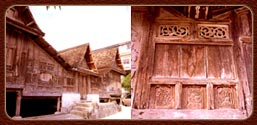
Thai-Style Kuti, Wat Wang Tawan Ok, Nakhon Si Thammarat Province (image from Thai Journal)
Note: Methinee Srirungruang (2004: inside back cover) wrote about the residence of Chao Chom Prang in the Thai journal article entitled “Thai-Style Kuti, Wat Wang Tawan Ok, Nakhon Si Thammarat Province,” stating that “…Wat Wang Tawan Ok is located along Ratchadamnoen Road. It was originally known as the garden of Wang Tawan Ok, which was the residence of Chao Chom Prang. Later, Chao Phraya Nakhon (Noi) donated Wang Tawan Ok and its garden to be established as a temple as well. The garden area thus became Wat Wang Tawan Tok. In 1888, Phra Khru Kachat (Yong), together with his disciples, constructed a group of monastic residences consisting of three traditional wooden houses built with interlocking wooden components. Each house has a gabled roof, and the roofs are connected to one another. The walls are made of paneling, with doors, windows, and ventilation openings decorated with patterns that are distinctive of Nakhon. In 2353 BE, the Association of Siamese Architects selected the monastic residence of Wat Wang Tawan Ok as an Outstanding Conservation Building in the category of religious sites and monasteries. Later, Than Noi, the son of Chao Chom Prang, became Chao Phraya Nakhon (Noi). He was sometimes referred to as ‘Noi Khuen Mueang’ (it is said that King Mongkut bestowed this epithet upon him; Sansanee Weerasinchai, 1996: 81) because when he was young he served in Bangkok for many years and then returned to govern Nakhon Si Thammarat after Chao Phat (his adoptive father) and Phra Chao Nakhon Si Thammarat (Palat Nu), the father of Chao Phat, who had previously ruled the city. Chao Phraya Nakhon Noi was regarded as the most powerful governor of Nakhon Si Thammarat. He held authority over all the southern cities, including Saiburi, Trengganu, and Perak, and also served as the supreme commander of military campaigns in the southern and western regions. The duties he carried out during his tenure were as follows.”
1. In the aspect of warfare, he conducted many military campaigns as follows:
1.1 When he held the rank of Phra Borirak Phubet, while serving as an assistant official of Nakhon Si Thammarat, he commanded troops to construct warships and patrol boats and led forces to attack the Burmese at Thalang. After completing the royal mission, he captured many Burmese soldiers and firearms and sent them to Bangkok, which greatly earned the royal trust of King Phutthaloetla Naphalai.
1.2 After assuming the position of governor of Nakhon Si Thammarat, he conducted four wars against the city of Saiburi as follows:
The first campaign was an attack on Saiburi in 2364 BE. Saiburi had been a tributary state of Siam since 2328 BE, during the reign of King Phutthayotfa Chulalok. At that time, the ruler of Saiburi was named Mokuramza. When this ruler passed away, a royal command appointed Tunku Pangeran as the new ruler of Saiburi, with the title “Phraya Rattan Songkhram Ramphakdi Sri Sultan Maha Mahat Rattanarajabodin Surin Wongsa, Phraya Saiburi.” The reason for this campaign was that this ruler of Saiburi, after pledging allegiance to Siam for only a short time, turned to pledge allegiance to Burma. When Chao Phraya Nakhon Noi learned of this, he became suspicious of the conduct of Phraya Saiburi Pangeran and therefore hired a Chinese man named Thalai to investigate Phraya Saiburi Pangeran, who was residing on Penang Island. In addition, Tunku Mom, the younger brother of Pangeran, was dissatisfied with his brother’s rule and came to report his brother’s actions to Phraya Nakhon Noi.
In addition, there was a Chinese merchant from the capital named Lim Hoi, who returned from trading on Penang Island and inspected a Burmese vessel, where he discovered a secret letter from King Bodawpaya of Burma. The letter stated that “Phraya Saiburi Pangeran should distance himself from Siam and persuade the city of Saiburi to raise troops to attack Siam in the south together with Burma.” When Chao Phraya Nakhon Si Thammarat was certain of this information, he submitted a report to King Phutthaloetla Naphalai. The court in Bangkok then issued a royal command for Chao Phraya Nakhon Noi to lead an army to attack Saiburi, stating that “…Phraya Saiburi has clearly shown favor toward the enemy. If Saiburi is left as an internal enemy in the south, order Chao Phraya Nakhon Noi to mobilize the southern provincial forces to attack Saiburi and bring it completely under control.” In this campaign, Chao Phraya Nakhon Noi did not immediately attack by force as one in authority might do, but instead employed a political stratagem by sending a formal letter to Phraya Saiburi Pangeran, ordering him to prepare and stock rice as provisions for the army, claiming that they would soon wage war against Burma, which was expected to invade southern Siam. As anticipated, Phraya Saiburi refused outright, in accordance with Chao Phraya Nakhon Noi’s expectations. Chao Phraya Nakhon then used this refusal as a pretext for disobedience of orders and immediately launched the attack. Chao Phraya Nakhon Noi led forces from Nakhon Si Thammarat, Songkhla, and Phatthalung to attack Saiburi simultaneously, with a total force of 7,000 troops, both land and naval. The Siamese side lost 700 men, while the Saiburi side lost 1,500 men. Phraya Saiburi Pangeran led his followers to flee and seek refuge with the British on Mak Island (Penang). From that time onward, the city of Saiburi fell under the authority of Chao Phraya Nakhon Noi.
After successfully capturing Saiburi, Chao Phraya Nakhon Noi appointed “Phra Phakdi Borirak (Saeng),” his own son, as the governor of Saiburi, and assigned another son named Nuch as the deputy governor on an interim basis. He himself then submitted a report to King Phutthaloetla Naphalai, who graciously promoted Phra Phakdi Borirak (Saeng) to the rank of “Phraya Aphai Thibet Maha Prathet Ratchathibodin Inthara Isawan Khanthasema Matayanuchit Sitthisongkhram Ramphakdi Phiriya Paha Phraya Saiburi,” and promoted Nuch to the rank of “Phra Senanuchit” in the position of deputy governor of Saiburi.
In that same year, King Phutthaloetla Naphalai graciously promoted the rank of the governor of Nakhon Si Thammarat to “Chao Phraya Nakhon Si Thammarat” and granted the cities of Saiburi and Perak to be under the absolute authority of Chao Phraya Nakhon Si Thammarat as the regent governing and overseeing both cities thereafter. This greatly enhanced the political prominence and power of Chao Phraya Nakhon Noi.
The second campaign was an attack on Saiburi in 2365 BE. In that year, a rebellion broke out in Saiburi, led by Tunku Mahamat, Tunku Yoso, and Raya Pattani Sindra, who were relatives of Phraya Saiburi Pangeran and resided in Saiburi. They gathered approximately 2,000 followers and conspired to stage a rebellion on the day of the oath-taking ceremony. However, Chao Phraya Nakhon Si Thammarat learned of the plot in advance and was able to suppress the rebellion, causing it to collapse before it could take effect.
The third campaign was an attack on Saiburi in 2369 BE. Although Saiburi was defeated in every previous campaign, these defeats were due to forced submission, and the country was never truly at peace. There were always undercurrents of unrest, because Phraya Saiburi Pangeran regarded Saiburi as his rightful possession, inherited through political lineage from his ancestors, and he continually sought to reclaim it. He therefore sought assistance from the British, but the British remained indifferent. Consequently, Phraya Saiburi Pangeran sent a letter of protest to the governor of Penang named Fullerton, stating that “If the British Company does not assist me, then I shall follow my own fate, but I cannot comply with the Burney Treaty, because Saiburi was not a gift bestowed upon me by Siam, nor was I appointed as ruler by Siam in any way. Saiburi is the property of Phraya Saiburi Pangeran, inherited through political succession from my ancestors. I would rather die than comply with the treaty.”
Regarding this matter, Chao Phraya Nakhon Noi conducted negotiations with Mr. Henry Burney, a representative of the British company in Nakhon Si Thammarat, and a treaty was concluded between the Siamese government and the British company’s representative in Bangkok on 20 June 2369 BE. As a result, the Governor of Penang ordered the removal of Phraya Saiburi Pangeran from Penang Island, preventing him from using Penang as a base for rebellion any longer. He then turned to supporting his nephew named “Tunku Den,” who was the son of Tunku Raya, in the year 2374 BE.
In 2374 BE, Tunku Den led approximately 3,000 followers to seize the city of Saiburi from the Province Wellesley side and, together with a naval force, blockaded the mouth of the Saiburi River. Phraya Aphai Thibet (Saeng), the governor of Saiburi at that time, was unable to resist and fled with his men to Phatthalung, allowing Tunku Den to seize the city with ease. When Chao Phraya Nakhon Noi learned of this conflict, he considered that the forces of Nakhon Si Thammarat alone were insufficient to suppress it. He therefore requested Phra Surin, an official of the Department of the Front Palace who was then assisting Nakhon Si Thammarat, to mobilize troops from Songkhla and all the Malay towns, including Yaring, Yala, Saiburi, Nong Chik, Pattani, Raman, and Ra-ngae, to assist in the Saiburi campaign. However, the ruler of Songkhla refused to cooperate due to prior resentment toward Chao Phraya Nakhon Noi, and Yaring also refused and even rose in rebellion. Consequently, Chao Phraya Nakhon Noi had to lead 7,000 troops from Nakhon Si Thammarat, together with 300 war elephants, to attack Saiburi in 2374 BE.
In this campaign, Chao Phraya Nakhon Noi was able to defeat Saiburi with ease, capturing the fort of Saiburi and entering the city within the same year. Tunku Den, the leader of the rebellion, was killed in battle, and his head was severed and sent to Bangkok. After the campaign, Chao Phraya Nakhon Noi led forces to suppress the rebellious Malay towns by dividing his army into two divisions: the naval force blockaded the mouth of the Saiburi River, while the land force joined with troops from Bangkok and Songkhla to attack the Malay towns separately. It appeared that the rebellions were completely suppressed smoothly, easily, and more rapidly than expected.
Moreover, in this Saiburi campaign, Chao Phraya Nakhon Noi was extremely angered by his two sons, namely Phraya Aphai Thibet (Saeng), the governor of Saiburi, and Phra Senanuchit (Nuch), who were defeated by Tunku Den without displaying competence befitting their positions and even fled. He therefore ordered that each of his sons be flogged thirty strokes, even though they had already been wounded by enemy weapons, in order that no one might take their conduct as an example among the troops thereafter.
The fourth campaign against Saiburi took place in 2381 BE. Phraya Saiburi Pangeran did not abandon his efforts to reclaim Saiburi from Siam and therefore prepared another rebellion, with Tunku Mat Sa-at and Tunku Abdullah, a pirate operating in the western seas, acting as leaders, reinforced by Huan Malee, the leader of Malay pirates from Ko Yao (in present-day Phang Nga Province). They seized the city of Saiburi by both land and sea. Phraya Aphai Thibet (Saeng), the governor of Saiburi, together with Siamese officials, fled once again to Phatthalung. After the rebels had taken control of Saiburi, they advanced to attack Trang, while another force moved to attack Songkhla, Pattani, and all seven Malay towns. At that time, the ruler of Songkhla (Seng) and Chao Phraya Nakhon Noi were attending the royal cremation ceremony of Somdet Phra Sri Sulalai, the Queen Mother. Upon receiving news of the rebellion, Chao Phraya Nakhon Noi returned to mobilize forces from Nakhon Si Thammarat and Phatthalung to form an army, assigning Phraya Aphai Thibet (Saeng), Phraya Wichitsorakrai (Klom), and Phra Senanuchit (Nuch), his three sons, to command approximately 4,000 troops to attack Saiburi, which resulted in victory. Chao Phraya Nakhon Noi, however, fell ill with a paralytic condition after the capture of Saiburi and before he could lead the army back, he passed away thereafter. Bangkok then dispatched Phra Wichit Narong (Phat) and Phra Ratchawarin to command approximately 800 troops from Bangkok to assist in safeguarding Songkhla. When the rebels who were besieging Songkhla learned that Saiburi had been defeated and that Siamese forces, together with troops from Bangkok, were advancing toward Songkhla, they became fearful and dispersed, abandoning any attempt to attack Songkhla. Thus, the forces of Nakhon Si Thammarat were once again able to suppress Saiburi with ease, though it was unfortunate that Chao Phraya Nakhon Noi had no opportunity to demonstrate his military ability in this campaign, as he had already passed away due to his illness.
The role of Chao Phraya Nakhon Noi as regent of Saiburi and Perak had two major aspects:
1. He was able to maintain control over Saiburi without losing it to the rebels, ensuring that Saiburi remained under Siamese rule.
2. He conducted contacts and negotiations with the British company, eventually leading the British to acknowledge that Saiburi was a tributary state of Siam and to refrain from supporting the return of Phraya Saiburi Pangeran to rule Saiburi again.
In addition, Bangkok assigned Chao Phraya Nakhon Noi to extend authority into the city of Perak as well, but control could only be maintained for a period of time, and it became necessary to allow Perak to fall under British influence around 2369 BE in order to avoid hostility with the British company at that time.
2. In the aspect of diplomacy
Chao Phraya Nakhon Noi is regarded as one of the country’s most important diplomats. He possessed keen intelligence and political acumen, which enabled Nakhon Si Thammarat to exert influence over the Malay towns and to be respected and feared by the British company, which was expanding its commercial and political influence into Southeast Asia. His diplomatic achievements were as follows:
2.1 Negotiations with John Crawfurd in 2365 BE
After Chao Phraya Nakhon Noi led an army to attack Saiburi in 2364 BE on the grounds that it had distanced itself and made contact with Burma, Phraya Saiburi Pangeran fled to seek British protection on Penang Island. Chao Phraya Nakhon Noi requested the extradition of Phraya Saiburi Pangeran from the Governor of Penang (Robert Philipps), but Philipps refused to hand him over. Chao Phraya Nakhon was greatly angered and protested to the British company. When the British Governor-General in India learned of the matter, he sent John Crawfurd from India to Penang, emphasizing trade matters rather than the issues of Saiburi and Perak. The first round of negotiations began on 21 May 2365 BE. In this negotiation, Chao Phraya Nakhon Noi did not participate, as he was well aware that Crawfurd tended to yield to the Governor of Penang. The outcome was as expected: the Governor of Penang agreed to allow Phraya Saiburi Pangeran to return to rule Saiburi as before. The Siamese side did not agree, and the negotiations therefore failed.
2.2 Negotiations with the British company on Penang Island in 2365 BE
After Crawfurd had departed, Chao Phraya Nakhon Noi received orders from Bangkok to continue making repeated attempts to contact the Governor of Penang to request the extradition of Phraya Saiburi Pangeran, who was guilty of rebellion, but these requests were consistently refused. Chao Phraya Nakhon Noi then sought a countermeasure by instructing Siamese officials in Saiburi to levy export duties on goods purchased by the British from Saiburi. This caused hardship to the British, who then requested that Siam, through Chao Phraya Nakhon Noi, suspend the collection of export duties from Saiburi, claiming that when Phraya Saiburi (Mokuramza) had permitted the British to lease Penang Island, there had been an agreement that no duties would be levied on goods purchased by the British company from Saiburi and shipped to Penang. Seeing this position, Chao Phraya Nakhon Noi replied that Saiburi was a dependency of Bangkok and had never authorized Phraya Saiburi (Mokuramza) to conclude any treaty with the British. The British had made such an agreement with Mokuramza on their own initiative, and he therefore could not comply with it. As a result, the British had to accept the hardship themselves, as they had implicitly supported Phraya Saiburi Pangeran. This negotiation significantly reduced British influence to a considerable extent.
2.3 Negotiations with Henry Burney at Nakhon Si Thammarat in 2368 BE
The British company on Penang Island repeatedly attempted to contact Chao Phraya Nakhon Noi to request negotiations, as it was suffering hardship from the export duties on goods from Saiburi and wished for Pangeran to return to rule Saiburi. Chao Phraya Nakhon Noi, however, remained unresponsive. When these attempts proved unsuccessful, the Governor-General of the British company stationed in Bengal, India, appointed Mr. Henry Burney as an envoy to negotiate with Siam. At the same time, Chao Phraya Nakhon Noi was convening military councils of Trang and Satun to prepare for an expedition against Perak and Selangor. In order to prevent Chao Phraya Nakhon Noi from expanding his territory into Malay lands, the British company sought to restrain him by dispatching warships to blockade the mouth of Trang Bay, causing Chao Phraya Nakhon Noi to suspend the planned attacks on the two cities. This situation led to negotiations at Nakhon Si Thammarat in July 2368 BE. The outcome of the negotiations was a preliminary agreement signed on 31 July 2368 BE at Nakhon Si Thammarat, to serve as a framework for further negotiations with the Siamese government, with the main points as follows:
– Chao Phraya Nakhon Noi would not send troops into Perak and Selangor, and the British would likewise not occupy or intervene in either city.
– The British company would not interfere in the administration of Saiburi in order to restore Phraya Saiburi Pangeran to rule Saiburi again. The British company would compel Saiburi to send gold and silver tribute to Siam in the amount of 4,000 dollars per year, and Chao Phraya Nakhon Noi promised that if the Siamese monarch agreed to allow Pangeran to return to rule Saiburi, he would withdraw all Siamese officials from Saiburi and would not attack Saiburi again. The reason Chao Phraya Nakhon Noi agreed to these terms was his desire to employ a conciliatory approach; if he were to remain uncompromising, it would lead to conflict with the British company, and the long-standing problems in the Malay towns would be difficult to resolve. On the contrary, such rigidity would only exacerbate the problems further, especially at a time when Britain was actively seeking colonies in Asia, and if hostilities were to break out, the responsibility would inevitably fall upon Chao Phraya Nakhon Noi.
2.4 Negotiations with Henry Burney’s diplomatic mission in Bangkok in 2368 BE
Burney traveled to India to seek approval for negotiations with the Siamese government in Bangkok from the Governor-General in Bengal, and then returned via Penang, Singapore, and Trengganu, arriving at Nakhon Si Thammarat on 28 October 2368 BE. He stayed in Nakhon Si Thammarat for eight days before traveling to Bangkok by sea, with a son of Chao Phraya Nakhon Noi serving as his guide. Chao Phraya Nakhon Noi himself later traveled by land and arrived in Bangkok on 4 February 2369 BE, approximately two months after Burney had arrived.
In the negotiations in Bangkok, King Nangklao arranged for a number of important negotiators to take part, namely Krom Muen Surintharak, Chao Phraya Aphai Phubet, Chao Phraya Mahasena, Chao Phraya Phra Khlang (Dis), and the person in whom he placed the greatest trust was Chao Phraya Nakhon Noi, who bore the heavy responsibility of acting as an intermediary to coordinate mutual understanding between King Nangklao and Burney’s diplomatic mission. The negotiations proceeded smoothly, and a treaty was signed on 20 June 2369 BE. The main provisions were as follows:
Article 12 Siam shall not obstruct trade in the cities of Trengganu and Kelantan. British merchants and subjects may continue to travel and trade conveniently in both cities. Britain shall not harass, attack, or cause any disturbance whatsoever in either of these cities.
Article 13 Siam promises Britain that it will continue to govern the city of Saiburi and will provide appropriate protection to Saiburi and all its inhabitants. Siam further promises that after Chao Phraya Nakhon Noi departs from Bangkok, it will allow the family members, slaves, and retainers of the former ruler of Saiburi to return freely as they wish. Britain promises Siam that it no longer desires to take possession of Saiburi and will not allow the former ruler of Saiburi and his retainers to disturb or cause harm to anything in Saiburi or other cities subordinate to Saiburi. Britain further promises to arrange for the former ruler of Saiburi, Pangeran, to reside in another city, not permitting him to live in Saiburi, Penang, Perak, Selangor, or Burmese cities. If Britain fails to arrange for Pangeran to reside elsewhere according to this agreement, Siam shall be entitled to levy export taxes on unhusked rice and milled rice from Saiburi as before.
Article 14 Siam and Britain agree that the ruler of Perak shall continue to rule Perak, and that the ruler of Perak shall present gold and silver tribute as before, according to his own wishes, without British obstruction. Chao Phraya Nakhon Noi may send Siamese, Malay, or Chinese persons of good conduct to Perak in the number of 40 to 50 persons, and Britain shall not prevent Siam from doing so. Britain shall not send troops to disturb Perak, nor allow Selangor to disturb Perak, and Siam shall likewise not disturb Perak.
The outcome of this treaty brought satisfaction to both Siam and Britain. Britain was able to restrain Chao Phraya Nakhon Noi from further expanding territory into the Malay states and was also relieved from paying export taxes as before. On the Siamese side, Britain formally acknowledged in writing that Saiburi was a tributary state of Siam, and it was also possible to bring to an end the major conflicts between Siam and the British company on Penang Island. In the early stages of the negotiations, it was said that many Siamese representatives opposed and disagreed with Chao Phraya Nakhon Noi, believing that Siam was at a significant disadvantage. However, through the wisdom and skill of Chao Phraya Nakhon Noi, this issue was successfully resolved, as he recognized that the solution to international political problems did not lie solely in warfare, but that diplomatic methods must also be employed so that various disputes could be brought to a satisfactory conclusion.
3. Shipbuilding, Chao Phraya Nakhon Noi possessed great expertise in shipbuilding, as follows:
3.1 He constructed royal merchant ships for transporting elephants for sale overseas, which enabled the kingdom to earn substantial revenue from the elephant trade.
3.2 He built warships ranging from small to very large vessels that required two tiers of oarsmen. The warships constructed during his time were larger than any previously built. He built as many as 150 warships, and Chao Phraya Nakhon Noi himself possessed a very large fleet of warships stationed at the city of Trang, numbering up to 300 vessels, which is understood to have been the largest naval force of its time. Even Bangkok itself only began to place serious emphasis on building a navy during the reign of King Rama III, in 2371 BE, when Siam began to become hostile toward Vietnam.
3.3 He built warships suitable for both inland waterways and the open sea. King Nangklao expressed his royal wish that Chao Phraya Nakhon Noi construct a vessel with a prow shaped like a fish’s mouth and a stern like a merchant ship, modified to accommodate two banks of oarsmen, with masts and sails for sailing at sea. The prow was to be 9 sok and 1 khuep wide, and the vessel 11 wa in length, to be presented to the King. King Nangklao bestowed upon it the name “Ruea Mahaphichai Ruek,” and this vessel became the prototype for the construction of another 30 ships. On that occasion, the King praised him, saying: “…Among the governors of the western southern provinces, none possesses discernment like this Chao Phraya of Nakhon. Whatever he undertakes is executed with thoroughness and refinement like that of a craftsman, and he understands how to judge what is good and what is bad…” King Nangklao granted him the epithet “Naval Architect.”
4. AdministrationChao Phraya Nakhon Noi enjoyed a high degree of royal trust from the capital, and was granted the following powers:
4.1 He was vested with authority to govern all southern provincial cities, extending to Trengganu, Saiburi, and Perak, making him a governor with greater power than other provincial rulers.
4.2 He also held the position of supreme commander responsible for military campaigns in the western southern region.
4.3 He was appointed as a member of the diplomatic mission to negotiate with the British company, in which he was the most important figure, and the negotiations achieved highly favorable results.
4.4 He was appointed regent-governor of Saiburi and Perak, giving him absolute authority in governing those cities, with full trust from the capital.
4.5 He was a strong and decisive administrator who showed no favoritism, as evidenced by his order to have his two sons flogged for abandoning their posts without first demonstrating their full capabilities in warfare. Even the prayer of Khun Phum (Busaba Tha Ruea Chang), a female poet of the Rattanakosin period, stated: “May I never be an oarsman of Chao Phraya Nakhon,” because it was said that oarsmen under his command were required to row swiftly and in perfect unison, mastering every maneuver. If any fault was committed, the boat would be carried ashore and overturned, and all the oarsmen would be required to lift the boat together, which was one form of punishment imposed upon the oarsmen.
Chao Phraya Nakhon Noi was born on Monday, the 13th day of the waxing moon of the 10th lunar month, Year of the Dog, Attasok, Chulasakarat 1138, corresponding to 27 August BE 2319 (1776 CE), at Nakhon Si Thammarat. He later passed away suddenly from acute illness after leading an attack on Saiburi, achieving victory, and before he was able to return his forces to Nakhon Si Thammarat. He experienced dizziness and vomiting of thick saliva with phlegm pressing against the chest, with symptoms beginning on the 8th day of the waning moon of the 6th lunar month. On the 14th day of the waning moon of the 6th lunar month, Chulasakarat 1210, in the same year, shortly after 11 p.m., corresponding to Tuesday, 14 May BE 2382 (1839 CE), he passed away, at the age of 64 years.
**Those descended from Chao Phraya Nakhon (Noi), founders of the Na Nakhon, Komarakul Na Nakhon, and Chaturongkul lineages, comprised a total of 34 sons and daughters. Among the males, three served in the royal court of the Chakri dynasty kings, three served as governors, five as acting governors, three as deputy governors, and one as an assistant to provincial administration. Among the females, ten served as royal consorts and royal concubines to King Nangklao, two served as royal concubines to King Mongkut, one served as a royal concubine to King Pinklao, one served as a lady-in-waiting of the Inner Court, and five did not enter royal service.
**The lineage of Chao Phraya Nakhon (Noi) has direct family lines that branch into three lines:
the “Na Nakhon” line, with Chao Phraya Nakhon (Noi) as the direct progenitor
the “Komarakul Na Nakhon” line, directly descended from Chao Phraya Mahasiritham (Mueang, or Noi Yai), son of Chao Phraya Nakhon (Noi) and Than Ying In (of the Bang Chang royal lineage)
the “Chaturongkul” line, directly descended from Khun Chai Noi Iat, son of Chao Phraya Nakhon (Noi) and Than Ying In.
2. The lineage of Chao Phraya Nakhon Ratchasima (Thongin or Thong In). Natthawut Sutthisongkhram (1966) researched and compiled in the book “The Secret Son of King Taksin” that when Chao Phraya Nakhon Ratchasima (Pin) served as the vanguard during the campaign in which King of Thonburi led an army to subdue Vientiane, and his wife happened to pass away, the King granted Princess Yuan or Juan, who was a royal consort and the younger sister of Krom Luang Borijaphakdi Sri Sutharak (daughter of Chao Phraya Nakhon (Nu)). The princess was already pregnant, and when she went to reside in Nakhon Ratchasima, she gave birth to a son. Chao Phraya Nakhon Ratchasima, as the adoptive father, named him “Thongin,” who later became Chao Phraya Nakhon Ratchasima (also known as Chao Phraya Kamhaeng Songkhram). Although there is no documentary or chronicle evidence, both Chao Phraya Nakhon (Noi) and Chao Phraya Nakhon Ratchasima (Thongin) are generally accepted as sons of King of Thonburi.
2.1 Those descended from Chao Phraya Nakhon Ratchasima (Thongin) have not yet been fully identified in detail. Only the names and numbers are known: there were 28 males and 22 females. Among the males, 20 entered royal service and received noble ranks. Among the females, three served as royal concubines to King Nangklao, and one served as a royal concubine to King Pinklao.
2.2 The lineage of Chao Phraya Nakhon Ratchasima (Thongin), also known as Chao Phraya Kamhaeng Songkhram, who had several principal wives and secondary wives. His descendants branched into 13 family lines, namely: Intharakamhaeng, Mahānarong, Inthasophat, Nillananon, Niam Suriya, Chukrit, Inthanuchit, Khachawong, Siriphon, Choenthongchai, Menaruchi, Athinan, and Phromnarot.
18.3 Lineages of the Grandchildren’s Generation
(Grandchildren by the paternal grandfather and maternal grandfather) totaling 105 persons
- The male royal grandchildren for whom evidence exists number four persons, namely,
1. Chao Narasuriyawong, a senior royal grandchild whose paternal lineage is not clearly recorded. He was elevated to be the ruler of Nakhon Si Thammarat, succeeding Chao Nakhon (Nu). He died in 2319 BE. No descendant lineage is recorded.
2. Krom Khun Anurak Songkhram, originally named Bunmi. Before being established as a member of the royal family, he was elevated as “Chao Ramalaksana.” He rendered meritorious service in military affairs but was later executed in 2325 BE.
3. Krom Khun Ramphubet, originally named “Bunchan.” Before being established as a member of the royal family, he was elevated as Chao Bunchan. He was captured and executed by officials of King Phutthayotfa Chulalok the Great while on a military campaign in Cambodia in 2325 BE.
4. Krom Khun Surinthara Songkhram, of whom no biographical details are recorded.
- The female royal grandchildren of King Taksin who served in royal service include
1. Chao Chom Manda, The female royal grandchildren of King Taksin the Great who served as Chao Chom Manda in the reigns of King Rama III and King Rama IV were daughters of Chao Phraya Nakhon (Noi), who presented nearly all of his daughters to serve as royal consorts of both monarchs.
1.1 The eldest daughter, Chao Chom Manda Noi Yai (born to Than Phuying In, of the Bang Chang royal lineage), served as Chao Chom Manda to King Rama III. She gave birth to a royal son, Phra Ong Chao Chaloem Wong.
1.2 The thirteenth daughter, Chao Chom Manda Bua (born to a secondary wife), served as Chao Chom Manda to King Rama IV. She gave birth to the following royal sons and daughters.
– Phra Ong Chao Chaloemlaksanloet, who passed away in early childhood.
– Phra Ong Chao Si Sithithongchai, later titled Krom Khun Sirithatchasangkhat, progenitor of the Sithawat na Ayutthaya royal lineage.
– 3. Phra Ong Chao Ying Orathai Thepkanya.
– 4. Phra Ong Chao Watthananuwong, later titled Krom Khun Marupong Siriphat, progenitor of the Watthanawong na Ayutthaya royal lineage.
5. Phra Ong Chao Damrongrit, who passed away in early childhood.
2. Consorts and secondary wives of front-palace princes of the Chakri dynasty. Several royal grandchildren of King Taksin the Great became consorts and secondary wives of front-palace princes of the Chakri royal family, for example:
2.1 Khunying Saeng, the eldest daughter of Phra Ong Chao Amphawan, the third royal son of King Taksin the Great, became the consort of His Royal Highness Prince Krom Phra Phithak Thewet, progenitor of the Kunchar na Ayutthaya royal lineage.
Krom Phra Phithak Thewet was the twenty-second royal son of King Phra Phutthaloetla Naphalai. He served in charge of the Department of Cavalry and was granted the rank of Krom Muen during the reign of King Nangklao. In the reign of King Mongkut, he was graciously promoted to the rank of Krom Phra and was additionally placed in charge of the Department of Royal Elephants. Krom Phra Phithak Thewet constructed Wang Ban Mo in the area of the eastern city moat, the present location being Atsadang Road opposite the Territorial Defence Department. Wang Ban Mo is an architectural work from the early Rattanakosin period and is among the oldest architectural styles outside the Grand Palace and the Front Palace. A distinctive surviving feature is the throne hall, regarded as the prototype of throne halls in palaces of princes of the rank of Phra Ong Chao.
Khunying Saeng had a son and a daughter, namely Mom Chao Singhanat Kunchar, the eldest son of Krom Phra Phithak Thewet, and Mom Chao Ying Lamun Kunchar. Mom Chao Singhanat served during the reign of King Chulalongkorn, commanding the Department of Royal Cavalry and the Department of Court Entertainments, and was elevated to the rank of Phra Ong Chao with the title Phra Worawongse Thoe Phra Ong Chao Singhanat Ratchadurongkharit. He was the father of Chao Phraya Thewetwong Wiwat (Mom Rajawong Lan Kunchar), who served as commander of the Department of Cavalry and the Department of Court Entertainments, and later became Minister of Public Works and Minister of Agriculture respectively, passing away in the Year of the Dog, B.E. 2465, during the reign of King Vajiravudh.
2.2 Khunying Phueng, the fourth daughter of Phra Ong Chao Amphawan, became the consort of His Royal Highness Prince Krom Khun Ratchasihawikrom, the twenty-first royal son of King Nangklao. His former rank was Phra Ong Chao Chumsai, and he resided and carried out his duties at Wang Tha Phra. Krom Khun Ratchasihawikrom was a prince of stern temperament, earnest and strict in matters of official duty. He rendered devoted service to His Majesty King Nangklao, and continued to serve into the reign of King Mongkut. His disposition was similar to that of King Nangklao, in that he favored large-scale construction works that did not emphasize elaborate ornamentation. He possessed skill in calculations according to traditional Thai architectural principles and was placed in charge of the Department of Stone Artisans and the Department of the Ten Craftsmen. His Royal Highness Prince Krom Khun Ratchasihawikrom was the progenitor of the Chumsai na Ayutthaya lineage. He passed away in the Year of the Dragon, B.E. 2411.
2.3 Khunying Phlap, daughter of Somdet Chao Fa Thatthaphong, or Phra Phong Narin, became a secondary wife of His Royal Highness Prince Krom Muen Phuminthoraphakdi, the fifteenth royal son of King Nangklao. He served in the Department of the Ten Craftsmen. Khunying Phlap bore three sons: Mom Chao Prince Saraphi Ladawan, Mom Chao Prince Ladawan, and Mom Chao Prince Phueak Ladawan. In his later years, His Royal Highness Prince Krom Muen Phuminthoraphakdi fell gravely ill, suffering from cataracts and losing his sight. At that time, Chao Phraya Thiphakorawong Mahakosathibodi (Kham Bunnag) was afflicted with a similar eye disease. King Mongkut graciously ordered that Western physicians be contacted to perform surgery on the eyes of Chao Phraya Thiphakorawong Mahakosathibodi, and likewise ordered surgery on the eyes of His Royal Highness Prince Krom Muen Phuminthoraphakdi, resulting in the full restoration of his eyesight. A royal photograph was taken and presented to the Western physician as a keepsake. His Royal Highness Prince Krom Muen Phuminthoraphakdi passed away in the Year of the Dog, B.E. 2417, during the reign of King Chulalongkorn.
2.4 Khunying Thap, daughter of Somdet Chao Fa Sila, the eighth royal son of King Taksin the Great, became a secondary wife of His Royal Highness Prince Krom Phra Ram Isares, the twenty-second royal son of King Phra Phutthayotfa Chulalok. He served in the Royal Petitions and Appeals Court and was the progenitor of the Suriyakula na Ayutthaya lineage.
3. Close service to the royal court. In addition to serving in the Inner Court as Chao Chom Manda or royal consorts to King Nangklao and King Mongkut, or as consorts of Front Palace princes of the Chakri Dynasty, many women of the lineage of King Taksin of Thonburi also rendered close service to the royal court, such as Khunying Chan and Khunying Khao, daughters of Somdet Chao Fa Chai Thatthaphong.
3.1 Khunying Chan served as the royal wet nurse of King Chulalongkorn and was commonly known as “Phra Nom Chan,” a wet nurse whom King Chulalongkorn held in great respect and affection.
3.2 Khunying Khao served as the royal wet nurse of Somdet Chao Fa Krom Phra Chakkraphatphong, the full younger brother of King Chulalongkorn (Lek Phongsamakthai. “Kinship Relations between the Royal Lineage of King Taksin and the Chakri Dynasty,” Silpa Watthanatham, 23 (6), April 2002: 67–69).
a. Summary of the royal lineage of King Taksin the Great, direct family lines, namely:
– Sinsuk (lineage of the Maha Uparat)
– Intharayothin (lineage of the Maha Uparat)
– Phongsin (lineage of Somdet Chao Fa Thatthaphong)
– Silanon (lineage of Somdet Chao Fa Sila)
– Rungphairoj (lineage of Somdet Chao Fa Narentharatchakuman)
– Komarakul na Nakhon (lineage of Chao Phraya Nakhon Noi)
– Chaturongkul (lineage of Chao Phraya Nakhon Noi)
– Na Nakhon (lineage of Chao Phraya Nakhon Noi)
– Na Ratchasima (lineage of Chao Phraya Nakhon Ratchasima (Thongin)), with further branch families as detailed in the account of Chao Phraya Nakhon Ratchasima
b. Lineages connected through the female line. Here they are divided into two groups:
– Those connected to the Chakri royal family and established as new royal lineages, totaling 17 lineages, namely:
1. The Itsarasena lineage, descended from Phra Ong Chao Ying Samliwan, a royal daughter of King Taksin of Thonburi, who was the mother of Phra Ong Chao Chai Phong Itsaret, Krom Muen Kasat Si Sakkidet, a royal son of Krom Phra Ratchawang Bowon Maha Senanurak, the Front Palace during the reign of King Phra Phutthaloetla Naphalai
2. The Itsarangkun lineage, descended from Somdet Chao Fa Ying Panchapapi, a royal daughter of King Taksin of Thonburi, who was the consort of Chao Fa Krom Khun Itsaranurak, a royal son of Somdet Chao Fa Krom Phra Si Sudarak, the elder sister of King Phra Phutthayotfa Chulalok the Great.
3. The Palakawong lineage, descended from Princess Maduea, a royal daughter of the Somdet Phra Maha Uparat, Chao Fa Krom Khun Intharaphithak, and Phra Ong Chao Chai Pan, Krom Muen Narathewet, a royal son of Krom Phra Ratchawang Bowon Sathan Phimuk (Somdet Chao Fa Krom Phra Anurak Thewet).
4. The Senewong lineage, descended from Princess Sali (younger sister of Princess Maduea) and Phra Ong Chao Chai Daeng, Krom Luang Sene Borirak, a royal son of Krom Phra Ratchawang Bowon Sathan Phimuk (Somdet Chao Fa Krom Phra Anurak Thewet).
5. The Kunjor lineage, descended from Mom Chao Ying Saeng, a royal daughter of Phra Ong Chao Chai Amphawan, and Phra Ong Chao Chai Kunjor, Krom Phra Phithak Thewet, a royal son of King Phra Phutthaloetla Naphalai.
6. The Chumsai lineage, descended from Mom Chao Ying Phueng (younger sister of Mom Chao Ying Saeng) and Phra Ong Chao Chai Chumsai, Krom Khun Ratchasihawikrom, a royal son of King Nangklao.
7. The Ladawan lineage, descended from Mom Chao Ying Phlap, a royal daughter of Somdet Chao Fa Chai Thatthaphong, and Phra Ong Chao Chai Ladawan, Krom Muen Phumintharaphakdi, a royal son of King Nangklao.
8. The Suriyakul lineage, descended from Mom Chao Ying Thap, a royal daughter of Somdet Chao Fa Chai Sila, and Phra Ong Chao Chai Suriya, Krom Phra Ram Isaret, a royal son of King Phra Phutthayotfa Chulalok the Great.
9. The Nopphawong lineage, descended from Mom Chao Ying Noi (a royal daughter of Somdet Chao Fa Chai Thatphai), who was the first royal consort of King Mongkut and was known as “Chao Chom Manda Noi.” Her first royal son was Phra Ong Chao Chai Nopphawong, Krom Muen Mahesuan Siwawilas, who became the founder of the Nopphawong royal lineage.
10. The Supparadit lineage, also descended from “Chao Chom Manda Noi,” through another royal son named Phra Ong Chao Chai Supparadit, Krom Muen Wisnunat Niphathorn.
11. The Srithawat lineage, descended from “Chao Chom Manda Bua,” the thirteenth daughter of Chao Phraya Nakhon (Noi), a royal consort of King Mongkut. One of her sons was a royal son of King Mongkut, named Phra Ong Chao Si Sitthithongchai, Krom Khun Sirithat Sangkhat.
12. The Wattanawong lineage, also descended from “Chao Chom Manda Bua,” through another royal son named Phra Ong Chao Chai Wattananuwong, Krom Khun Marupong Siriphat.
13. The Thongyai lineage, descended from Chao Chom Manda Sangwan, a royal consort of King Mongkut, who was the daughter of Nai Salyawichai (Thongkham na Ratchasima), a son of Chao Phraya Nakhon Ratchasima (Thongin). She was the mother of Phra Ong Chao Chai Thong Kong Konyai, Krom Luang Prachak Silpakom, the founder of this royal lineage.
14. The Thongthaem lineage, likewise descended from Chao Chom Manda Sangwan, through Phra Ong Chao Chai Thongthaem Thawalyawong, Krom Luang Sanphatsat Suphakit.
15. The Phanumart lineage, descended from Chao Chom Manda Iam, a royal consort of King Pinklao, who was the daughter of Mom Chao Kasem (Luang Mahawisut Kosa), a royal son of Somdet Chao Fa Chai Narenthara Ratchakuman, and who was the mother of Phra Ong Chao Chai Phanumart, the founder of this royal lineage.
16. The Kanchanawichai lineage, descended from Chao Chom Manda Priklek, a consort in the household of Krom Phra Ratchawang Bowon Wichai Chan, the Front Palace during the reign of King Chulalongkorn, who was the daughter of Khunying Wek, herself a royal daughter of Somdet Chao Fa Chai Thatthaphong, and who was the mother of Phra Ong Chao Chai Kanchanophat Ratchasami, Krom Muen Chanchai Bowonyot, the founder of this royal lineage.
17. The Charunrot lineage, descended from Chao Chom Manda Choi, a royal consort of King Pinklao, who was the daughter of Phraya Nakhon Ratchasima (Mek na Ratchasima), a son of Chao Phraya Nakhon Ratchasima, also known as Chao Phraya Kamhaeng Songkhram (Thongin), and who was the mother of Phra Ong Chao Chai Charunrot Rueangsi, Krom Muen Charat Phon Patiphan, the founder of this royal lineage.
– The group closely related to other lineages comprises 21 families, namely:
1. The Devahastin na Ayutthaya royal lineage
2. The Kamalasana lineage
3. The Rattanakos lineage
4. The Saeng–Chuto lineage
5. The Rattanaphanu lineage
6. The Thammasarot lineage
7. The Vibhatasilapin lineage
8. The Sriphen lineage
9. The Sriyaphai lineage
10. The Bunnag lineage
11. The Buranon lineage
12. The Suwong lineage
13. The Laksanasut lineage
14. The Sukkasikon lineage
15. The Buransiri lineage
16. The Daengsawang lineage
17. The Saengtai lineage
18. The Mitrakun lineage
19. The Chuladilog lineage
20. The Sayasilapi lineage
21. The Chaturongkun lineage
c. Lineages of uncertain degree of relationship, totaling six persons, are as follows:
1. A Mom Chao in the line of Somdet Chao Fa Krom Khun Inthraphithak, who passed away in 2320 B.E.
2. Mom Chao Seng, who passed away in 2321 B.E.
3. Mom Chao Pathumphaichit, whose name appears in the chronicles and who was appointed as the ruler of Nakhon Si Thammarat.
4. Mom Chao Norathibet, mentioned in the Royal Chronicles (Chusiri Jamromman, 1984: 72–81).
5. Phra Ong Chao Chai Anurut Thewa.
6. Phra Ong Chao Chai Chesthakuman (Thuan Bunyanithiyom, 1970: 208).