

King Taksin the Great
Chapter 13: Royal Duties in Arts and Culture
13.1 How did people dress in the Thonburi period under King Taksin, including male common officials and women?
13.1.1 Royal Attire
“…The clothing in the Thonburi period continued the practices from the late Ayutthaya era, though some parts are evidenced as belonging directly to the Thonburi period. These may be classified as follows.
King Taksin
Hairstyle and headdress – He wore the Mahatthai hairstyle, for which there is evidence confirming that during the reign of King Prasat Thong Thai men already wore this style. Van Vliet wrote that from above the ears the hair on the head was carefully trimmed, becoming shorter near the neck, and lower down the hair was shaved.”
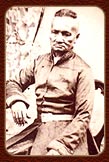
Somdet Chao Phraya Borom Maha Sri Suriwong (Chuang Bunnag), photographed by John Thomson in 1865, wore the Mahatthai hairstyle.
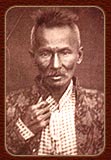
Mom Rachotai (M.R.W. Kratai Isarangkun), author of Nirat Lon, photographed by John Thomson in 1865, wore the Mahatthai hairstyle (from the book Thai Costume: Evolution from Past to Present, Volume 1).
It was the Mahatthai hairstyle, in which the hair around the head was shaved, leaving hair about four centimeters long at the crown, combed and arranged as deemed proper.
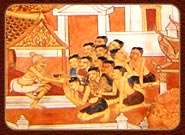
The Mahatthai hairstyle
(courtesy of Muang Boran)
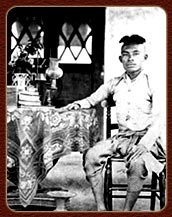
Male nobles wore the Mahatthai hairstyle or the Lak Chao style. Thai men had worn these styles since ancient times, until the reign of King Rama V when Western haircuts began to replace them. The photograph from the archives is undated (from the book Picture Book of Thailand).
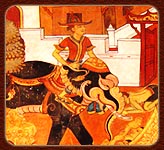
Side-parted royal headdress and upturned royal shoes
(courtesy of Muang Boran)
During military campaigns, he likely wore the side-parted royal headdress, as it was a headdress with minimal decoration, made of sturdy material suitable for practical use. The side-parted headdress was made of leather, shaped like a cut gourd, with a surrounding brim, lacquered black, covering the collar and ears. “It resembled Japanese armor” (Sanun Silakorn, 1988: 144).
Royal shoes
Normally, he wore upturned royal shoes, but during military campaigns they were made of leather. His attire varied according to different occasions, for example:
When traveling abroad to receive foreign envoys, he wore six primary regalia items: a ceremonial outer robe in Asawari stripes 1, an outer robe with borders in gold, silver, or green 1, primary headdress including the crown adorned with diamonds, rubies, and emeralds matching the robe 1, embroidered leg guards 1, jeweled sash 1, and a sword at the waist 1, totaling six items.
When attending a royal cremation at Wat Chaiwatthanaram, traveling by the King’s boat, he wore six items: a ceremonial outer robe in Thai style 1, an outer robe with silver-ground Thai pattern 1, primary headdress with crown matching the robe 1, embroidered leg guards 1, jeweled sash 1, and a sword at the waist 1, totaling six items.
When traveling to Phra Phutthabat, from the city up to Tha Chao Sanuk by the royal boat, he wore seven items: two-layered upturned leg guards 1, pleated sash 1, raised ceremonial outer robe 1, jeweled sash 1, five-pointed petal-style crown 1, sword at the waist 1, and he held a ceremonial light 1, totaling seven items.
When setting out the royal procession from Tha Chao Sanuk up to Phra Phutthabat, he wore four items: royal traveling attire 1, upturned leg guards 1, jeweled sash 1, and European-style crown with plume 1.
When traveling to Pak Pa Thung Ban Mai, he removed the traveling regalia, and the regalia were provided for the royal boat journey from the city. Upon reaching Than Kasem, he removed the regalia. In the afternoon, when proceeding to pay homage at Phra Phutthabat, he wore the following eight items if riding the golden Phutthala boat: two-layered upturned leg guards 1, pleated sash 1, jackfruit-thorned sash 1, ceremonial robe with small golden patterns 1, white outer robe 1, decorated sash 1, white crown with gold trim matching the robe 1, and sword at the waist 1, totaling eight items.
Upon reaching Phra Phutthabat and going on a forest excursion, he rode elephants in royal traveling attire and horses in foreign-style attire. Horses in traveling attire were allowed when visiting Wat Phra Si Sanphet and performing temple ceremonies, wearing a tall pointed crown with feathers 1, white patterned sash 1, Japanese-style ceremonial robe 1, palanquin with roof or empty palanquin allowed, two-layered leg guards decorated with gems and pearl chains, dragon embroidery adorned with gems 1, pleated sash in green, red, purple, and gold with gem embellishments, sash tassels in gold 1, raised circular ceremonial robe in ruby bronze with gold and pearl chains 1, Suwan Krom robe in green with gold leaf embellishments 1.
For the Maha Phichai royal carriage and the royal boat journey to present the Kathin robe, he wore: gold chest sash with red gems, six sandalwood flower plates 1, Maha Sangwan gem necklace with rubies and emeralds 1, skirt embellishments with various gems 1, decorative outer skirt with hanging gems 1, Maha Phichai crown 1, earrings with emeralds 1, rings 1, gold bracelets with enamel and gems 1, enameled royal shoes with gems 1, totaling thirteen items.
For war regalia for elephant combat, he wore: inner leg guards 1, indigo-dyed inner ceremonial robe 1, outer black silk leg guards 1, outer padded ceremonial robe 1, inner crown 1, outer side-parted headdress 1, black jeweled sash 1, totaling seven items.
For expeditions to capture animals in Lopburi, Sa Kaeo, Nam Jon, tiger enclosures, elephant hunts, and taming elephants in the fields, he wore traveling regalia, with pointed feathered crown… (from The Life of King Taksin the Great, Committee of the King Taksin the Great Foundation, 1980: 144-147; Thai Costume: Evolution from Past to Present, Volume 1, 2000: 202-204).
13.1.2 Attire of Officials: According to the records in the royal treatise on primary regalia, regarding the regulations on the duties and authority of officials, police, and royal pages, it is stated as follows.
- For officials attending full ceremonial royal events, the leaders of ten-thousand, attendants, and sergeants, as well as those covering silk or boarding the royal boat, wore patterned lower garments, draped ceremonial jackets, shoulder sashes, and waist sashes according to rank, with swords worn according to position.
- Ordinary royal pages wore patterned lower garments, draped ceremonial jackets, and sashes.
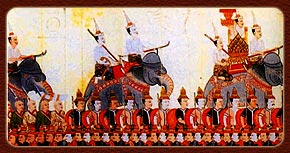
Color painting of the royal land procession in the Ayutthaya period, modeled from the mural of the ubosot at Wat Yom, Phra Nakhon Si Ayutthaya Province (from the book The Life of King Taksin the Great).
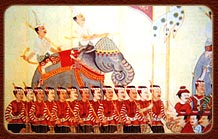
Color painting simulating the attire of ordinary royal pages (from the book The Life of King Taksin the Great).
For the “Chao Thi” of the Chao Thi Department, responsible for maintaining order in buildings and premises, the attire for royal ceremonies was as follows: for senior members, they wore patterned lower garments, draped ceremonial jackets, sashes, and wore swords.
For the police, divided into four departments—Outer Police (left 1, right 1) and Inner Police (left 1, right 1)—the regulations stated:
“When attending royal entertainments, the chief of the department wore patterned lower garments, draped ceremonial jacket; the department chief carried a sword, the assistant carried a sword; leaders of ten-thousand carried swords and spears; colored sashes around the waist; secretaries wore silk lower garments, long sash, waist sash, and carried swords following the procession.”
For less important events:
“Patterned lower garments, ceremonial jacket, sash.”
For hazardous events, such as observing tigers in the palace:
“Silk lower garments, waist sash.”
For processions outside the palace during such events:
“Silk-striped lower garments, overcoat, waist sash.”
For regular events inside the palace or minor events outside:
Regular events: “Patterned silk lower garments, ceremonial jacket, sash.”
Full ceremonial events: “Patterned lower garments, draped ceremonial jacket, sashes according to rank.”
Full ceremonial processions: “Patterned lower garments, overcoat, jeweled sash; department chief carried a sword, assistant wore a sash and sword; leaders of ten-thousand carried spears and swords; colored sashes around the waist; secretaries carried swords.”
Notes:
1. The overcoat refers to the garment called the inner coat.
2. Hats in the reign of King Narai, following military styles, included garland-brimmed hats, leather hats, Western-style hats, traveling hats, and hairstyles such as the Mahatthai hairstyle.
3. Generally, uniforms for warrior-nobles were sewn from silk and muslin. The sanob jacket or annual ceremonial cloth granted by the king was worn only for royal ceremonies or when accompanying the king on travels; it was not worn for ordinary occasions. When worn out, the official was to respectfully request a replacement from the king.
King Taksin granted Chao Phraya Mahakasatsuek a dark sanob jacket, patterned silk with large Nāga motifs, six-breadth lotus-patterned white sash, six-breadth window-patterned sash, and upturned leg guards.
Rewards for nobles who distinguished themselves in war were granted according to the Mandetianbal regulations:
“Any commander or subordinate who goes to battle and defeats the enemy, raising the standard in accordance with the law, shall receive rewards of gold, sanob jacket, and other garments; these are to be maintained and passed on to descendants as a reward.”
“If anyone engages in elephant combat, the reward shall be a golden hat, golden sanob jacket with raised sleeve ends, up to 10,000 rai; they shall also receive a golden carrying pole and gold staff.”
Additionally, the Mandetianbal regulations describe other noble attire, such as for nobles with a fief of 10,000 rai: the headgear is a gold topknot hat; for seated city nobles, a gold topknot hat; nobles with 10,000 rai holding city authority wear a golden turban.
Noble attire
Ceremonial jackets were made of hemp fabric (presumed to be lightweight cloth), thin and light, with hems reaching mid-calf.
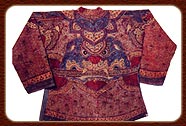
The Sena Kut jacket is a military uniform for both land and naval forces, dating back to the Ayutthaya period. It was made of patterned cotton fabric imported from India and sewn in the Chinese style, with buttons fastened along the right side. The front, back, and upper arms on both sides featured lion motifs holding armor. At present, only two pieces remain in the National Museum, Bangkok. This image is from the Royal Ontario Museum in Toronto, Canada (from the book Thai Costume: Evolution from Past to Present, Volume 1).
Outer jacket – made of silk from China or European fabrics, embroidered with gold thread in beautiful patterns, with a front opening fastened by buttons braided from silver or gold at intervals. The sleeves were wide. The fabric is presumed to be Indian or Persian brocade, such as Khemkhab, Atlat, or Yierbap.
Neck sash – made of Chinese silk, embroidered with silver or gold thread, or using the finest available fabric, possibly Indian or Persian brocade, such as Khemkhab, Atlat, or Yierbap, considered high-quality and valuable.
Leg guards – made of fine fabric, embroidered with gold and silver threads in patterns at the lower legs, extending well below the knees.
Lower garments – presumed from records that the wrap-around cloth worn over the leg guards followed the chong kraben style.
Shoes – wore slip-on shoes resembling Moorish sandals.
Lom Pok – a noble’s hat, also called Pok or Kiew, a garment accessory indicating rank. It was a pointed hat similar to a crown, with the brim trimmed in yellow or gold thread for decoration. Above the brim was a circular Kiew decorated with gold flowers and a pointed tip. Sharewes noted an interesting classification of noble ranks based on betel boxes and Lom Pok hats.
Okya – the highest-ranking noble. The brim of the Lom Pok hat was made of gold, and the pointed tip was decorated with a floral garland.
Okphra – second-rank noble. The brim of the Lom Pok was made of Chaiyapruek floral motifs.
Okluang – third-rank noble. The brim of the Lom Pok was only two inches wide and less finely crafted than that of an Okphra.
Okkhun – fourth-rank noble. The brim of the Lom Pok was made of gold or plain silver.
Okmuen – fifth-rank noble. The brim of the Lom Pok was made of gold or plain silver, similar to that of an Okkhun.
The “songpak” or “sompak” cloth was the most important lower garment for officials. The songpak was official cloth granted by the king, indicating rank and affiliation. It was worn when attending audiences or accompanying royal travels. Even when leaving home to enter the palace, another cloth was first worn, and the palace attendants carried the sompak cloth to be worn within the royal precincts. Mural evidence shows this practice near the inner walls of the palace hall.
The songpak or sompak was narrow silk, joined to create width using two pieces called a “ploa,” resulting in a width of approximately 160 cm, wider than ordinary lower garments by one-fourth. The length was also one-half longer than ordinary lower garments. For full ceremonial dress, sompak with various patterns was used; for normal audiences, silk sompak in different colors was worn. The most prestigious sompak was the “sompak puem,” woven with floral motifs; the simplest type was striped sompak.
The method of wearing the sompak differed from the chong kraben style because the fabric was longer and wider. When worn, the cloth was divided into short and long sides. The short side was made equal to a normal chong kraben, with the end tucked in first. The long side was folded to match the short side against the body. Any remaining upper fabric was tucked under the original tuck and pulled up to form a front flap called a “chak phok.” The edges to be rolled were uneven in thickness: the right side was a single fold, the left side double-folded. Both sides were layered, then rolled into a tube similar to a normal chong kraben, but somewhat thicker, passed between the legs, and secured at the waist like a normal chong kraben.
Wrapping the cloth – In Ayutthaya-period documents, the term “kiew” frequently appears in regulations related to officials’ attire. Somdet Chao Fa Krom Phraya Naritsaranuwat defined it as a cloth worn around the waist, while “kiew lai” referred specifically to a waist cloth with a pattern.
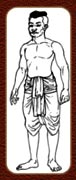
Wrapping the Yan Phat cloth
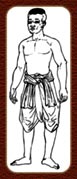
Wrapping the Krawat Cham cloth
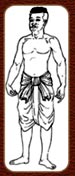
Wrapping the face cloth
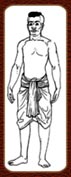
Wrapping the Kelay cloth
(from the book Thai Costume: Evolution from Past to Present, Volume 1)
There was a style of wearing cloth called the “kiew-kelay” style, which required two patterned pieces of fabric. Somdet Chao Fa Krom Phraya Naritsaranuwat defined it as follows:
“One piece was worn as a chong kraben over the leg guards, and the other piece was worn as a waist cloth. At the back, it was spread downward to cover the buttocks; at the front, it was gathered and tied in a knot. One side of the cloth was aligned with the knot, while the other side was spread downward like a trailing vine and then folded back up and tucked into the waist, resembling a pouch hanging at the front of the legs. It is understood that the piece worn as the lower garment was called the chong kraben, and the piece worn around the waist was called the kiew. It is believed that originally the lower garment and the kiew were different types of cloth—the chong kraben wide, the kiew narrow. Later, this distinction was less observed; when there was no separate waist cloth, the chong kraben itself was used as the kiew, creating the messy style sometimes called patterned chong kraben or patterned kiew, in this manner.”
The term “kiew” also applies when worn over a shirt with an additional cloth tied over it. If a belt is used, it is called “kiew pan neng” with silver or gold cords. If a decorated cord is used, it is called “kiew rad prakot.” If embroidered cloth called “jearabat” is used, it is called “kiew jearabat” (Thai Costume: Evolution from Past to Present, Volume 1, 2000: 208, 214-216).
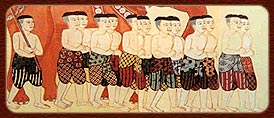
Attire of Common Men
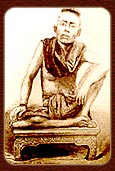
Attire of Ordinary Men
(from the book The Life of King Taksin the Great)
13.1.3 Attire of Common Men – They wore chong kraben, raised Khmer-style lower garments, loose-style garments, or sarongs with a waist cloth. Most men kept their hair short and therefore often wore hats when going to battle, presumably for protection against weapons.
- Attire of Women
- Female court officials
For the jackets of female court officials or women, silk was layered according to rank. The types of silk varied by pattern, such as Dara Khor Leaw silk, Jamruat silk, Khaorop silk, gold-patterned silk, and Dara Khor silk. One could determine a female official’s rank by the type of garment and silk, as follows:
The chief queen wore gold-patterned silk, a jacket, and gold foot coverings.
Royal consorts wore gold-patterned silk, a jacket, and gold foot coverings.
Royal princesses wore Dara Khor silk, a jacket, and velvet foot coverings.
Grandchildren of the king wore gold-patterned Phok jackets (without foot coverings).
Lesser grandchildren wore Dara Khor Leaw silk jackets.
Royal concubines wore silk of various colors.
Wives of high-ranking officials above ministers wore Khaorop silk.
Wives of ministerial officials wore a jacket and Jamruat silk.
Court ladies wore pleated skirts with a draped sash.
These garments were designated for royal ceremonies only; at other times, all women wore the same simple cloth.
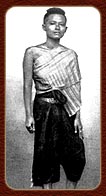
Ladies in the reign of King Rama IV (approximately 1801–1868) wore chong kraben, fastened with a gold belt with a gem-encrusted buckle, and draped a pleated sash made of Chinese silk.
(from the book Thai Costume: Evolution from Past to Present, Volume 1; Album of Thailand)
2. Common women wore chong kraben, usually in black or dark green, draped a diagonal sash, and secured it with a clasp. Their accessories included bracelets, pendants, necklaces, rings, and belts. Hairstyles were generally cut short into winged styles, although some evidence shows that shoulder-length wings were still occasionally worn (The Life of King Taksin the Great, undated: 135–138; Siam Araya 1(4), October 1, 2002: 87–88 by Abhisit Lai Sattruklai; Foundation for the Preservation of Ancient Monuments in the Former Palace, 2000: 116–120).
Note: In late Ayutthaya, there were four common hairstyles for women:
a. Bun in the center of the head
b. Winged style
c. Hair raised with decorative pins
d. Shoulder-length hair
Women often combined the winged style and shoulder-length hair in a single hairstyle: the top of the head combed into wings, with the hair left to fall to the shoulders on both sides. Additionally, the winged style was sometimes incorporated into the bun hairstyle.
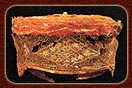
Tiaras
(from the book King Naresuan the Great)
It is also noted that the winged hairstyle may have been worn with a head ornament, such as a tiara or crown.
The shoulder-length winged hairstyle for women is believed to have originated in the royal court and gradually spread until the fall of Ayutthaya. At that time, hair was cut short, leaving only the wings, to facilitate combat and disguise as men, with little concern for beauty, as the more masculine the appearance, the safer it was. In later periods, the winged style consisted of hair cut short around the crown following the hairline, forming wings, while the remaining hair was shaved, leaving only the roots. The winged hairstyle alone is occasionally observed, for example, in depictions of the Vessantara procession, which is believed to have been painted in late Ayutthaya.
For children, it was common to wear hair in a topknot. When they grew older and the topknot was removed, the area where the hair had been tied remained as a circular mark around the other hair, called the “hairline.” This hairline marks where hair had been plucked or shaved, such as the frontal hairline and the topknot hairline. The frontal hairline helped define the face clearly, creating a smooth, rounded shape like the moon. The topknot hairline, remaining on the head, indicated youth. Women who wished to preserve their youthful appearance often plucked the hair along this line in a circular pattern around the crown, as reflected in expressions such as “applying oil to protect the hairline” and “smooth hairline decorated neatly.”
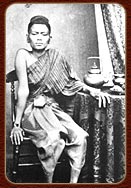
Royal women wore the winged hairstyle, a style that Thai women had traditionally worn. Unlike men, women shaped the hairline above the forehead for beauty and often left side locks by the ears, sometimes called “tat hair.” The winged hairstyle persisted until the reign of King Rama V, when long hair became fashionable according to royal preference, and later evolved into the “dok kratum” hairstyle (see Thai Costume in the Rattanakosin Era for reference).
(from the National Archives, photographer and year unknown; from the book Album of Thailand)
The term “winged hair” refers to a style of wearing hair in which small tufts were left around the head. The hair was combed to create a clear border, sometimes parted in the middle or brushed back as desired for appearance. It is called “winged hair” because the hairline forms a distinctly visible edge.
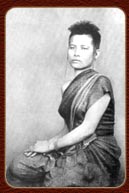
Siamese nobility during the reign of King Rama IV, from the book Siam by Karl Dohring, page 28, provide a good example showing the traditional winged hairstyle with tufts on both sides.
(from the book Album of Thailand)
“Jon hair” refers to the winged hairstyle with a tuft left by the ears, extending downward and tucked behind the ear, hence called “ear tuft” or “jon hair.” Those wearing ear tufts had to keep the rest of the hair short to match.
The beauty practices of women, as recorded in the natural and political historical accounts during the reign of King Narai, and the tattooing of the human body, as documented in the La Loubere memoirs.
The beauty practices for women here included dyeing the teeth black and growing the nails, as well as coloring the nails and fingers red. It also reflects the cultural preference for tattooing on men’s bodies.
Dyeing the teeth black: Nicolas Cheruel recorded the customs and beliefs of the Siamese in the Natural and Political History during the reign of King Narai the Great, noting the practice of blackening the teeth as follows.
“What Siamese women could not bear to see in us was that we had white teeth, for they believed that only spirits and demons had white teeth, and it was considered shameful for humans to have white teeth, just like certain animals. Therefore, when boys and girls reached the age of 10–15, they would begin to blacken and polish their teeth using the following method.
Once a person was chosen to undergo this ritual, they would be laid on their back on the ground and remain in that position for three days while the ceremony proceeded. First, the teeth were cleaned with lime juice and then rubbed with a certain solution until they turned red. Afterward, they were polished with charred coconut shell until black. However, the women undergoing the process became very weak due to the strength of the solution, to the point that if a tooth were pulled out, it would cause no pain. Sometimes, teeth would even fall out when tested with something hard to chew. During these three days, they consumed only lukewarm rice gruel, which was poured slowly down the throat without touching the teeth. Even a slight breeze could compromise the ritual’s outcome. Those enduring this procedure had to lie fully covered until the pain from the teeth subsided and the swollen gums or mouth returned to normal.”
The above account reflects a Western worldview, offering one observation among many hypotheses for why Siamese people had blackened teeth. It is noteworthy that Sherves described the procedure in detailed step-by-step fashion, providing a clear picture. This suggests that the author likely traveled to several places, framing his observations based on experiences elsewhere, which may limit the accuracy of his view of the Siamese. In reality, it does not have to be entirely correct.
For the Siamese themselves, historical evidence dating back to the Sukhothai period shows that both men and women chewed betel, which naturally reddened the lips and blackened the teeth. This is one plausible reason for the blackened teeth of late Ayutthaya Siamese.
Sherves recorded that the Siamese also dyeing the nails and fingers red and growing long nails, stating that “…The same solution used to color the teeth red was applied to the nails and little fingers. Only high-ranking individuals were allowed to have long nails and red-dyed little fingers, while laborers had to keep their nails short, marking a clear distinction between the elite and commoners…”
The process of dyeing the nails and fingers red is not clearly documented, nor are the materials used. It is assumed that natural plant-based dyes were employed, such as the orange pigment from the stems of the ixora flower, for example (Thai Dress: Evolution from Past to Present, Vol. 1, 2000: 220-221).
13.2 Royal Duties in the Arts: What was the artistic style during the Thonburi period?
Since the second fall of Ayutthaya, many Thai artisans were scattered, killed, or lost, and a significant number were taken captive by the Burmese. Therefore, by the Thonburi period, only a small number of skilled Thai craftsmen remained. King Taksin of Thonburi had to rely on newly trained and revived artisans for the construction of permanent structures and other artistic objects, both for religious purposes and royal administration. These tasks were carried out by his military and civilian officials, indicating that these officials also possessed craftsmanship knowledge. It is assumed that the king gathered artisans of all trades in Thonburi to train and teach the new generation. The craftsmen of this period passed on their skills and contributed significantly to early Rattanakosin art.
However, the artisans of the Thonburi period were newly trained, and time for craftsmanship was extremely limited due to continuous warfare. The creation of artistic works had to be done hastily to meet urgent needs. Moreover, King Taksin’s reign lasted only 15 years, making finely crafted works from the Thonburi period rare. Thonburi-era arts can be categorized into four types as follows:
13.2.1 Ships – During the Thonburi period, shipbuilding flourished, including warships, trading ships, and fleet vessels for royal service. In King Taksin’s reign, the name of a royal vessel recorded was…
- Barang Kaew Chakraphat (The Glass Throne Barge)
- Si Sawat Ching Chai (The Victory and Prosperity Barge)
- Butsak Phiman Throne Barge
- Phiman Mueang In Barge
- Samphao Thong Tai Rot Barge (Golden Stern Junk Barge)
- Si Samut Chai Barge
After King Taksin of Thonburi restored independence, he ordered the construction of new royal ceremonial barges as follows:
- The royal barges Suwannaphichai Nawa Tai Rot
- Si Saklat and
- Khomya Pip Thong Thuep were constructed (Office for National Identity Promotion, 1996: 112).
13.2.2 Painting During the Thonburi period, although the era was dominated by intense warfare almost continuously, there still existed finely crafted paintings left as significant legacies. Among the most important, and still preserved at the National Library of Illustrations, Tha Wasukri, Bangkok, is the “Tri-Pun Burān Illustrated Manuscript of the Thonburi Period,” commissioned in 1776 B.E. (A.D. 2319). The “Tri-Pun Illustrated Manuscript” is a pictorial book written according to Buddhist principles. Such books have been created since ancient times, and several versions are preserved as national cultural treasures, including the Ayutthaya-era Tri-Pun Illustrated Manuscript and the Thonburi-era version. Creating a “Tri-Pun Illustrated Manuscript” was a difficult task, as it required not only accurate textual content drawn from Buddhist scriptures but also skilled painters to illustrate the entire volume, depicting hells, heavens, and various realms correctly and beautifully.
In this type of book, the illustrations are central, forming the core of the entire work. Only a monarch or a person of high authority, who genuinely valued art and had a sincere devotion to Buddhism, could undertake the creation of such a manuscript.
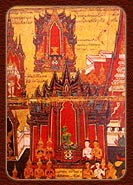
Depicts the Tavatimsa Heaven (Deva realm). Those who honor and respect their parents and the elders of their family, possessing generosity (not miserly) and great patience, are destined to be reborn in this realm.
(Image from the book King Taksin and the Role of the Chinese in Siam)
In the illustrated manuscript Traiphum Burana of the Thonburi period, the provenance is recorded as follows:
“In the Buddhist year 2319, 4 months and 26 days into the remaining intercalary period, on Tuesday, the 13th day of the waxing moon of the 11th month, Chula Sakarat 1138, the Year of the Monkey, King Taksin departed from the Thep Palace, Thonburi, with many royal attendants. Upon reviewing the stories in the Traiphum Burana manuscript, His Majesty wished that commoners and the fourfold clergy might understand the Three Realms and the Five Precepts, which are the origins of gods, humans, hells, asuras, pretas, and animals. He therefore commanded Chao Phraya Si Thammarat, the Grand Prime Minister, to prepare fine-quality manuscripts and deliver them to painters for illustrating the Traiphum. The work was to be done at the office of the Supreme Patriarch (Somdej Phra Sangharaja Si, the first Supreme Patriarch of Rattanakosin) at Wat Bang Wa Yai (present-day Wat Rakhang), who was to supervise and instruct the painters to depict the stories accurately according to the Pali texts and include Pali inscriptions wherever necessary, so that the teachings could be faithfully transmitted.” Thus, the Supreme Patriarch oversaw the process to ensure that both the illustrations and accompanying texts were accurate, orderly, and fully aligned with the canonical texts.
This manuscript can therefore be regarded as a true standard edition: exquisite in illustration, precise in content, and comprehensive in all aspects.
The four principal painters who executed this work with meticulous skill, fulfilling the royal commission, were:
1. Luang Phetchakam
2. Nai Nam
3. Nai Boonsa
4. Nai Ruang
Additionally, four scribes assisted in writing the explanatory captions:
1. Nai Boonchan
2. Nai Ched
3. Nai Son
4. Nai Thongkham
When creating the Traiphum manuscript, King Taksin of Thonburi gave special orders for the work to be carried out with meticulous care and strict supervision. In summary, His Majesty’s intention in commissioning this Traiphum Burana manuscript was to ensure that the general populace could correctly understand the realms of hell and heaven according to the Pali texts, and thereby be guided to diligently perform good deeds and refrain from evil, in accordance with the teachings of Buddhism for generations to come.
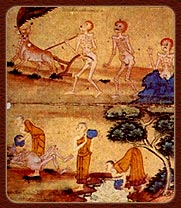
Depicted are two kinds of pretas:
1. Those who incurred sin for speaking carelessly to the Buddha Kassapa
2. Those who incurred sin for begrudging drinking water to humans and animals
(From the book “Somdet Phra Chao Taksin Maharaj and the Role of the Chinese in Siam”)
The pictorial Traiphum manuscript of the Thonburi period is regarded as one of the largest Traiphum pictorial manuscripts in Thailand. When fully unfolded, it extends to a length of 34.72 meters, with exquisitely executed color paintings applied on both sides of the folio pages.
The many dozens of illustrations contained in this Traiphum manuscript are remarkably beautiful and highly admirable, and it is difficult to find any other Traiphum pictorial manuscript that surpasses it in excellence.
Two manuscripts of this kind were commissioned during His Majesty’s reign. The other copy is now preserved in the National Museum in Berlin, West Germany, which acquired it from Thailand in 1893.
These two Traiphum pictorial manuscripts clearly demonstrate that His Majesty the King of Thonburi, in addition to restoring the nation and reclaiming its independence, also revived the arts and craftsmanship, and upheld the religion and moral conduct of the people in the nation (Sethuean Suphasopon, 1984: 6-7, 93-94).
Apart from the Traiphum pictorial manuscript, there are also mural paintings in the Phutthaisawan Throne Hall.
13.3.3 Fine Arts The Thonburi period possessed craftsmen skilled in this field, including lacquer artisans, decorative artisans, carvers, modelers, and painters. The important fine art objects of this era include the four gilt-lacquer Tripitaka cabinets in the Wachirayan Library of the National Library at Thawasukri in Bangkok, together with several other gilt-lacquer cabinets whose forms and craftsmanship closely resemble those of the aforementioned pieces, indicating that they were likely produced in the same period. These gilt-lacquer cabinets came from Wat Ratchaburana, Wat Chantararam, and Wat Rakhang Kositaram, showing that the craft of gold-on-lacquer decoration was another artistic tradition revived during the Thonburi period. In addition, there are mother-of-pearl inlaid Tripitaka cabinets in the mondop and in the Ho Phra Monthian Tham of Wat Phra Sri Rattana Satsadaram.
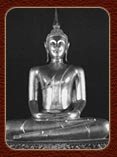
The royal Buddha image of His Majesty King Taksin the Great (with a simple robe)
(From the book “Analysis of the History of Buddhist Devotion and Buddha Images in Asia”)
In terms of casting, Luang Wichit Narumon was commissioned to model the Buddha images according to the Buddhist characteristics prescribed for examination, and a standing bronze Buddha and a meditating Buddha were cast, such as the principal Buddha image in the ubosot of Wat Mahathat.
Carving works include the royal bed platform and the platform for practicing Vipassana meditation.
1. The royal bed platform of His Majesty King of Thonburi, enshrined within the small vihara of Wat Intaram near Talat Phlu on the Thonburi side, is made of two wooden boards joined together, measuring 1.76 meters wide, 2.48 meters long, and 5 cm thick. It features a railing made of ivory, with carved ivory panels in elaborate phutthan flowers decorating the area beneath the railing. Posts for a canopy (mosquito net) are also fully assembled.
2. The platform for practicing Vipassana meditation, enshrined within the small ordination hall in front of the prang of Wat Arun Ratchawararam on the Thonburi side, near the former royal palace, is part of the original temple built since the Ayutthaya period, paired with the original prang (the current prang was constructed during the reign of King Rama III). This platform was made from a single wooden board, 7 feet wide and 20 feet long. Both platforms were crafted in a simple, plain manner without any particular beauty. Archaeologists consider the workmanship to be rather rough, indicating that it was produced by artisans whom His Majesty King of Thonburi had revived and trained, but who had not yet attained the skill level of master craftsmen.
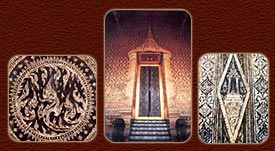
The doors of the ordination hall porch and the doors of the top vihara porch of Wat Phra Sri Rattana Satsadaram
(From the book The Grand Palace)
In addition, there is a bench from Klaeng District, Rayong Province, which is preserved at the National Museum in Bangkok, as well as mother-of-pearl doors at the ubosot of Wat Phra Sri Rattana Satsadaram and the northern mondop.
13.3.4 Ceramics in the Thonburi Period (corresponding to 1768–1782)
When His Majesty King Taksin ascended the throne at Thonburi, trade with China began to expand. During this period, Siam continued to import porcelain from China for use, mostly five-colored Benjarong bowls with Thep Nop and Narasingh designs, with interiors coated in white glaze rather than the green glaze typical of the Ayutthaya period.
Benjarong Porcelain
During the Ayutthaya period, after the fall of the city for the second time in 1767, Chinese ceramics painted with overglaze using five colors—white, black, red, yellow, and green or blue—known as Benjarong, began to play a significant role in Siam.
Benjarong is a type of painted ceramic on glaze, commissioned by the Siamese court from China, specifically produced for Thailand. The designs painted on Benjarong followed Thai patterns, sent by the Siamese court to China for replication. Later, Benjarong became widely popular among Thai nobility.
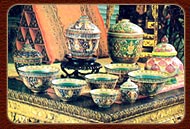
Benjarong Porcelain
(From the book Somdet Phra Chao Taksin Chom Bodin Maharaj)
Benjarong porcelain is entirely covered with painted designs, leaving no empty space. During the Ayutthaya period, Thep Nop and Narasingh designs were popular, often accompanied by flame-patterned motifs, with interiors coated in green glaze. Later, the designs commonly featured royal lion, garuda, lion, Narasingh, kinnari, and hanuman figures, combined with flame-pattern motifs and scroll stems, among others. In addition, there were Benjarong ceramics painted with Thep Nop, floral, and leaf designs, which were designed and painted by Phra Ajarn Daeng of Wat Hong Rattanaram and sent to China to produce glazed tiles, later used to decorate Wat Ratchabophit Sathitmahasimaram. (Phusadee Thapthas, Encyclopedia of Thai Culture – Central Region, Vol. 3, 1999: 1131, 1141)
13.3 Architecture What types of construction comprised architectural works during the Thonburi period?
During the reign of His Majesty King Taksin, it was an era of establishing and reorganizing settlements, leading to extensive construction works, including palaces, fortresses, city walls, and various temples. The architectural style of this period largely inherited elements from late Ayutthaya architecture. Building bases were gently curved like the hull of a ship, while the structures rose vertically. Other architectural components were not much different from those of Ayutthaya. Unfortunately, Thonburi-period architecture has often undergone restoration and renovation in later reigns. As a result, present-day appearances mostly reflect the style of the latest restorations. Structures that still retain some Thonburi architectural features include Wichaiprasit Fort, the walls of the former royal palace, the Thong Phra Rong and twin pavilions of the former palace, and temples in both the capital and provincial towns that were restored during this reign. Surviving Thonburi-era stylistic features can be observed in the ubosot and small vihara of Wat Arun Ratchawararam, the original ubosot and vihara of Wat Ratchakarah, the original ubosot of Wat Intaram, the Red Pavilion of Wat Rakhang Kositaram, and the ubosot of Wat Hong Rattanaram.
Note
1. Wat Arun Ratchawararam is located on the west bank of the Chao Phraya River and the east side of Arun Amarin Road, at the mouth of the Mon Canal, opposite Tha Tian Market. It is one of the most beautiful temples, showcasing Thai craftsmanship from the late Ayutthaya period to the Rattanakosin period.
History of the Temple
Wat Arun originally existed during the Ayutthaya period and was called Wat Makok, later renamed Wat Makok Nok, and eventually Wat Chaeng. It was elevated to a first-class royal temple during the reign of King Taksin because, when Ayutthaya fell to the Burmese, King Taksin, then Phraya Taksin, escaped by boat and arrived at the site of the temple at dawn, naming it Wat Chaeng. After securing independence in 1768, he established Thonburi as the capital, placing the royal palace within the walls of Wichaiprasit Fort on the west bank of the Chao Phraya River. The temple fell within the palace grounds, and monks were no longer permitted to reside there. During King Taksin’s 15-year reign, he restored the original ubosot and vihara of Wat Chaeng as much as possible (Fine Arts Department, 1978: 5-6).
Later, during the reign of King Rama II, further restorations and constructions were made, renaming the temple Wat Arun Ratchatharam. During King Rama IV’s reign, it was restored and renamed Wat Arun Ratchawararam, the official name used to this day.
Important Historical Structures at the Temple
Significant structures include the ubosot, showcasing Rattanakosin craftsmanship of King Rama IV’s era. In front of the ubosot entrance stand two guardian giants holding clubs, called Kumpan, believed to protect the temple from evil spirits. These figures demonstrate masterful craftsmanship, originally created by Phraya Hattakarn Bancha (currently restored inaccurately). The entrance doors feature crown-shaped arches, and the ubosot is surrounded by a cloister housing Buddha images in the Mara-victory posture. The principal Buddha image, named Phra Buddha Thammisara Ratchaloknathadilok, is gilded stucco, crafted during King Rama II’s reign, with a three-sok-wide lap. Notably, the Buddha’s face was modeled by the king himself. On either side sit two principal disciples in anjali posture. The interior walls feature murals depicting the Buddha’s life, and door panels are decorated with trompe-l’oeil patterns.
Another important structure is the vihara, housing the principal Buddha image, Champhunut Mahaburusalakkhana Asityanubhapitar, and in front, a smaller Buddha image called Phra Arun or Phra Chaeng, with a lap width of 50 cm, brought from Vientiane by King Rama IV. On the south side of the temple stand the original ubosot and small vihara, which are also of interest. The ubosot houses the platform used by King Taksin, made from a single wooden board, 1.67 meters wide. The small vihara enshrines the Phra That Chulamanee.
Another important historical structure is the prang of Wat Arun. King Rama II planned to rebuild the original prang, which was only 16 meters high, to be taller and more beautiful. Work began but King Rama II passed away before completion. King Rama III continued construction, completing the prang and installing the spire crown. The design and later decorative tiles were the work of Phraya Ratchasongkram (Kat Hongsakul) and his son, Phraya Ratchasongkram (Thad Hongsakul). Because construction spanned three reigns, the base and form of the prang were repeatedly restored up to the present (Natthaphat Navikcheewin, 1976: 57-58).
2. Wat Intharam, or Wat Bang Yi Ruea Nok
is a temple where King Taksin the Great performed royal merit-making activities. It houses several antiquities associated with him, such as the reclining royal bed platform, which served as the royal seat where he observed precepts and practiced meditation.
In addition, it is the burial site of King Taksin the Great. His cremation was conducted here, and his relics were enshrined at this temple as well. Today, Wat Intharam is classified as a third-class royal temple of the Worawihan type. It is located on Thoet Thai Road, Bang Yi Ruea Subdistrict, Thonburi District, Bangkok, covering an area of approximately 25 rai. The founder of the temple is unknown, but it is generally believed to be an ancient temple dating back to the Ayutthaya period.
According to local accounts, the area along Khlong Bangkok Yai, which was Bang Yi Ruea at that time during the Ayutthaya period, was a dense mangrove forest. The opposite bank was a lowland with grasses and reeds growing in shallow water, resembling a marsh. Boats navigating this canal had to make wide turns, allowing the forested area to be seen from a distance. This riverside forest became a strategic location for Thai soldiers to ambush enemy boats. The ambush tactic was called Bang Ying Ruea, which eventually gave the area its name, later becoming Bang Yi Ruea.
Wat Intharam was originally called Wat Bang Yi Ruea Nok, paired with Wat Ratchakaraha (Bang Yi Ruea Nai). When King Taksin established Thonburi as the capital, he was greatly pleased with this temple. He ordered extensive renovations and expansions, elevating it to a special first-class royal temple and using it for major royal merit-making ceremonies multiple times.
King Taksin granted a large area of land as sacred temple grounds. He built 120 monk’s quarters, restored statues, the ordination hall, pagodas, and assembly halls, and donated the Buddhist scriptures. He also renovated the entire temple complex and came to observe precepts and practice meditation in the royal residence here on five occasions. He used Wat Intharam as the site for royal cremation ceremonies and for enshrining the relics of Somdet Phanpi Luang, Princess Thepamat (Nok Yiang), the king’s mother. He ordered the construction of a crematorium, which took two months to complete, and had her body brought to Wat Intharam on Tuesday, the 2nd waning day of the 6th lunar month, in the year of the Ram, 2318 BE. The cremation took place two days later, on Thursday, the 4th waning day, and lasted three days and three nights. The ceremony included about twenty ceremonial pavilions, and around 6,000 monks and Brahmins were invited to make merit. At the same time, Burmese troops advanced close to Phitsanulok, which motivated the king to perform another merit-making ceremony for his mother.
In 2319 BE, King Taksin held another major royal merit-making ceremony for his mother. This grand event involved soldiers from other provinces, including Lopburi, Nakhon Sawan, Phichit, Phitsanulok, Kamphaeng Phet, Sukhothai, Chai Nat, Singburi, Ang Thong, Chachoengsao, Ratchaburi, Phetchaburi, and Suphanburi, who assisted in the temple ceremonies.
According to the schedule, on Tuesday, the 15th day of the waxing moon of the first lunar month in the Year of the Monkey, B.E. 2319, after the crematorium and the ceremonial site were completed, and after the royal relics were paraded from the Royal Palace past Wat Moli Lok (Wat Tai Talat) to Bang Yi Khan and then returned to be enshrined at the pavilion of Wat Intharam, the king ordered the Central Department to distribute money as great alms to all officials attending the ceremony. Men were granted salueng each, and women one fueang each. The king also instructed Phra Ya Maha Senakum to take 10 chang of money to distribute to beggars throughout both the capital and the provinces. The king further commanded the Sangha to invite 10,000 monks for the ceremonial meal. Among them, there were 2,230 monks and 1,738 novices (according to the account in the Thonburi Chronicles, Panjanumart edition, by Jerm, the monks did not differentiate by sect or temple). In King Rama V’s commentary, it was explained that “10,000 monks for the ceremonial meal” meant offering two bundles of rice to each monk, not money, which was the method used in the old capital.
Antiquities associated with King Taksin the Great
The Chedi Ku Chat is the stupa that contains the royal relics of King Taksin the Great. Its lotus finial stands paired with the stupa containing the royal relics of the queen. Both are enshrined in front of the old ordination hall.
The Buddha image in royal attire of King Taksin the Great is in the posture of enlightenment. It is the principal image in the old ordination hall and also houses the king’s cremated remains.
The bronze Buddha image in Mara-vijaya posture from the Ayutthaya period is enshrined in the small vihara next to the old ordination hall, also known as the Vihara of King Taksin the Great.
The old ordination hall, renovated by King Taksin the Great, originally had no windows. Later, when Phra Thaksin Kanishorn became the abbot, he opened windows in the walls.
The vihara houses the royal bed platform of King Taksin the Great and a model statue depicting him in meditation practice.
The new ordination hall was built over the area where King Taksin the Great’s royal relics are enshrined.
In addition, there are numerous prangs, stupas, and vihara structures that were constructed or restored after King Taksin’s reign. Some are now in ruins, while others are under renovation or newly built (Sanan Silakorn, 1988: 123–125)
13.4 Literature
In the late Ayutthaya period, after the reign of King Boromkotr, literature that had once flourished fell into decline once more. After the fall of Ayutthaya to the Burmese in 1767, the city was devastated and burned, which likely led to the destruction of many old books. Later, when King Taksin restored the unity of the nation, literature began to revive. However, the Thonburi period lasted only 15 years and was a time of rebuilding, so literary works were few. Those that did survive are almost all of significant value.
It is generally accepted that literature thrives during peaceful times, while in times of turmoil and war, literary activity declines. During King Taksin’s reign, the country faced numerous difficulties, yet he did not allow literature to decline accordingly. He actively resisted this deterioration, making the Thonburi period remarkably productive in literary creation.
Thonburi-era literature was directly influenced by the Ayutthaya period, using existing works as models for composition. Consequently, Thonburi literature closely resembled that of Ayutthaya. The characteristics of Thonburi-era literature are as follows:
1. All literary works were composed entirely in verse, employing all forms of poetic composition, including khlong, chan, kap, klon, and rai.
2. The content focused heavily on religion, moral teachings, glorifying the king, and entertainment.
3. Compositions often began with a prelude of praise or homage to show respect for revered subjects, followed by descriptive passages conveying emotions and sentiments. The emphasis was on beauty rather than content or philosophical ideas.
4. Thai values were clearly embedded, including respect, loyalty to the king, adherence to Buddhism, and the customs and traditions of Thailand (Uthai Chaiyanon, 2002: 8-9).
13.4.1 Who were the poets in the Thonburi period?
Poets in the Thonburi period, apart from King Taksin himself, were all government officials and senior monks whose names are recorded as follows:
1. Phra Wanarat (Thongyu), who later became the royal preceptor of King Buddha Loetla Nabhalai and left the monkhood to serve as Phraya Pojanapimon.
2. Phra Phimoltham of Wat Photaram (Wat Phra Chetuphon), who later became the royal preceptor of Prince Paramanujita Jinorasa and was afterwards elevated to Somdet Phra Wanarat.
3. Phra Rattanamuni (Kaew), who later left the monkhood to serve as Phraya Thammapreecha, founder of the Raktaprajit family.
4. Nai Suan Mahat Lek, who composed Khlong Yo Phra Kiat in praise of King Taksin in 1771.
5. Luang Sorawichit (Hon), a border officer in Uthai Thani, who later became Chaophraya Phraklang (Hon), Minister of the Port Department during the reign of King Rama I. He composed Phet Mongkut, using the tale Vetala Pakornnam as the narrative framework (the episode in which the Vetala tells a riddle tale of Prince Phet Mongkut), as well as Inao Khamchan. He passed away in 1805.
6. Phraya Mahanupap (On), who composed Nirat Kwangtung during his journey to China in 1781, a work of significant historical value as it records the events and experiences of the voyage; he also wrote three lyrical poems.
7. Phra Phikku In of Nakhon Si Thammarat, who composed Krissana Son Nong in collaboration with Phraya Ratchasuphavadi (Veena Rotjanaratha, 1997: 99).
8. Phraya Ratchasuphavadi, formerly the head of the Suratsawadi Department in Ayutthaya, who had been appointed by King Ekkathat as governor of Nakhon Si Thammarat, though the exact year of his appointment is unknown. He was said to be one of the great poets under King Borommakot and lived on into the Thonburi period. While serving as governor of Nakhon Si Thammarat, he was charged with wrongdoing and summoned back to Ayutthaya to stand trial, eventually losing the case and thus being removed from office in 1765. Later, he served as a minister and royal commissioner of Nakhon Si Thammarat (from 1769–1776, a total of seven years). During the tenure of Chao Nara Suriyawong as governor of Nakhon Si Thammarat, he served in a supporting administrative role; when Chao Nara Suriyawong passed away, he was recalled to Ayutthaya to resume government service (http://www.navy.mi.th/navy88/files/Nakorn.doc, 31/03/2004) (Royal Biography and Royal Activities of King Taksin of Thonburi: Cremation Ceremony for Miss Phan Na Nakhon, 20 September 1981: 8).
13.4.2 What literary works did King Taksin the Great compose?
The Royal Compositions of King Taksin the Great
King Taksin was more a warrior and a savior of the nation than a poet, for his reign was filled with warfare. However, he was a farsighted ruler who recognized the value of literature, and thus devoted his spare time to composing an important literary work, the Ramakien. The surviving portions of his royal compositions include episodes of the Ramakien: Hanuman entering the chamber of Lady Vanarin, the fall of Virunchambang, King Maliwarat adjudicating the case, Tosakan performing the ritual of burning the divine effigy, the casting of the Kabinphat spear, Hanuman tying the hair of Tosakan and Lady Mandodari together, and the releasing of the horse Uppakara. In addition, there are official documents from his reign that he corrected or composed, such as royal letters, formal correspondence, decrees, various regulations, the Treatise on Military Strategy, manuals on weapon making, didactic verses, administrative customs, and civic traditions.
The Ramakien was written in black Thai folding books, with the script executed in gold lines, crafted with exceptional refinement. According to the title folios, the date of composition is recorded at the beginning of every volume: Sunday, the first waxing day of the sixth lunar month, Chula Sakarat 1132, the Year of the Tiger, the second cyclical year, which corresponds to 1770, the third year of his reign. Later, scribes recopied the original royal manuscript according to his revisions, but retained the original title folios, resulting in the phrase “tram phodi yu” appearing in the extant Thai manuscripts. The time when the gold lines were applied is recorded as “Sunday, the eighth waning day of the twelfth lunar month, Chula Sakarat 1142 (1780),” near the end of his reign. The names of the four scribes who applied the gold are given as Nai Thi for volume 1, Nai Sang for volume 2, Nai Son for volume 3, and Nai Bunchan for volume 4. The names of the two donors, identical in every volume, are Khun Saraprasoet and Khun Mahasitthi. Unfortunately, the original manuscript written by the King himself has not been found (Uthai Chaiyanon, 2002: 15).
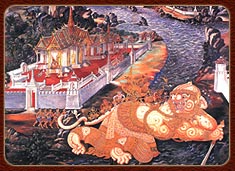
A depiction of the Ramakien, showing the episode in which Hanuman stretches himself into a bridge for Prince Phra Phrot’s army to cross the ocean and return to Ayutthaya, 1930
Powder pigments, mural painting, Room 154, Gallery of Wat Phra Si Rattana Satsadaram, Grand Palace, Bangkok
By the artist Suang Thimudom (image from Rattanakosin Art, Reigns I–VIII, Volume 1)
The origin of this royal composition derives from the King’s march south to suppress the faction of the Lord of Nakhon Si Thammarat in 1769. On that occasion, the Lord of Nakhon and his important associates and relatives fled to Thepha (now in Songkhla Province). The royal army pursued them.
The Memoirs of Krom Luang Narintorn Devi recount this episode as follows:
“When Phrarit Deva, the ruler of the city, learned that the royal army was in pursuit, he feared the royal authority and sent the Lord of Nakhon together with his relatives and followers, as well as the female performers, silver ornaments, royal treasures, and various possessions, to be presented immediately.”
This means that, apart from capturing the Lord of Nakhon, the most significant figure, they also gained female performers as an additional result.
While the Thonburi army was stranded by the monsoon in Nakhon Si Thammarat and unable to return to the capital for several months, in the twelfth month of that year, King Taksin performed royal merit-making ceremonies to celebrate the sacred relics of Nakhon Si Thammarat, and also commanded the female performers of the Lord of Nakhon to participate in the celebration. This pleased the King greatly and sparked his strong interest in theater from that time onward, leading him to train and revive it in Thonburi, as reflected directly in the fields of dance and music.
Just one month after returning from Nakhon Si Thammarat, he diligently composed the Ramakien play, having only two months for this work, because thereafter he had to lead a campaign to suppress the faction of Chao Phraya Fang in Uttaradit in the sixth month of early 1770.
He used very little time for composing such a high literary work, so it is natural that there would be some imperfections, lack of conciseness, and occasional lapses in elegance. This Ramakien play was directly composed by King Taksin himself, not mediated through any other poet (as in the Ramakien of King Rama I). Therefore, this royal composition reflects his character and wisdom very clearly (Sethuen Supasopon, 1984: 76). In the sixth month of 1770, he also received a report from the Uthai Thani provincial office regarding the misconduct of Chao Phraya Fang’s followers. By the eighth month of the same year, he led the royal army to suppress them. Thus, King Taksin likely completed all four episodes of the composition during this period, though he may have made later corrections, as indicated by inserted phrases in some sections such as “yang (tram, phodi) yu” or “inserted by the King.” If the composition had been completed before attacking Chao Phraya Fang, it might have been used in the celebratory performances when Sawangkhaburi was conquered (according to the Memoirs of Krom Luang Narintorn Devi: “Let the female performers be brought to celebrate Phraya Fang for seven days, then proceed to tread Phitsanulok
The celebration of Phra Chinarat and Phra Chinsri for seven days, with female performers,” may have used the Ramakien play staged according to the royal composition of King Taksin.
That a monarch devoted himself to poetry, even composing works while scarcely able to take time away from military duties, served as inspiration for other talented poets of the era to create works, even though the country had not yet fully returned to peace and normalcy.
Purpose of Composition
The purposes of composing the Ramakien may be outlined as follows:
1. To continue the royal tradition of promoting literature, with the monarch himself as the author.
2. To provide entertainment and enjoyment for the people.
3. To revive and preserve the Ramakien, an important literary work dating back to the Ayutthaya period.
4. To select episodes containing moral lessons suitable for guiding and comforting the people at that time, and additionally, to incorporate elements of meditation, in which the King had great interest, thus encouraging the people to practice for inner peace.
5. To compose a royal play for court performances, which customarily featured the Ramakien. According to the historical chronicle Phan Chanumas (Jerm), when King Taksin led the army to conquer Nakhon Si Thammarat in 1769, he brought back the Lord of Nakhon along with female performers to establish a royal theater, necessitating the composition of the play for performance (Kularb Mallikamas, Thai Literature: Ramkhamhaeng University, n.d.: 24–25).
The title folio of the original Thai folding book of this literary work states that King Taksin composed it in Chula Sakarat 1132 (1770). It is a verse drama with the names of the songs and dance sequences fully indicated, comprising four episodes (four volumes of Thai folding books) as follows:
Episode 1: Phra Mongkut – This is the final episode of the Ramakien and was composed as the first royal manuscript. The story concerns Phra Mongkut and Phra Lop, the sons of Rama and Sita, who are in the forest with the sage Valmiki because Sita has been exiled. The sage gives magical arrows to the two princes. The princes test the thunderous arrows by sending them to Ayutthaya. Rama releases the horse Uppakara to demonstrate his power. Phra Mongkut and Phra Lop ride the horse for fun. Phra Phrot captures Phra Mongkut to present to Rama, and Phra Lop follows to rescue him, and they escape together. The episode ends with Rama leading the army to pursue the two princes.
Episodes 2–4 are continuous in content as follows:
Episode 2 concerns Hanuman wooing Lady Vanarin. The beginning of the text is missing, so the episode starts with Hanuman meeting Lady Vanarin in the water (Lady Vanarin is a fairy who was cursed and must guide Hanuman to kill Virunchambang to break the curse). Hanuman wins her as his wife, then kills Virunchambang successfully, and returns to take her to the city of Fa. Tosakan orders her to summon King Maliwarat to Lanka to assist him. Episode 2 ends with King Maliwarat arriving at the battlefield but refusing to enter Lanka.
Example:
Hanuman woos Lady Vanarin
“This lady, foremost among maidens, a celestial of unmatched grace,
Do not doubt; I shall make it clear, only a little patience, O maiden.”
Episode 3 concerns King Maliwarat adjudicating with impartiality, bringing the plaintiff, the defendant, and Lady Sita to the battlefield, ruling that Tosakan must return Lady Sita. Tosakan refuses, and King Maliwarat curses him.
Episode 4 concerns Tosakan performing the sand ritual and consecrating the spear Kabinphat. Lady Mandodari incites Tosakan to kill Phiphek, who has been secretly informing Rama’s side. Phiphek hides and protects Phra Lak, who then uses the spear Mokkhasak. Hanuman flies to fetch the antidote, while Mae Hin grinds the medicine in Naga city and Luk Hin remains in Lanka. Tosakan lies down to sleep; Hanuman subdues him, breaks the top of the palace to seize Luk Hin, and then mischievously ties Tosakan’s hair to Lady Mandodari’s. Tosakan cannot untie it and must summon the sage Kobut to undo it.
Example:
Hanuman ties Tosakan’s hair to Lady Mandodari
“Having performed the final acts of renunciation, the diamond wisdom is of no use,
With power and mental skill, together with spiritual insight, recalling past and future lives,
Upon reaching that point, all will perish; not a single thing remains intact…”
Episode: The Battle of Pali and Tosakan
Pali recited incantations and summoned the forces of the demons,
According to the blessing of the Lord of the Three Worlds, contending in the demon war (2 words).
Tosakan lost half his strength, resisting in the battle of glory,
Hungry and exhausted, the demons flew back to the city of Lanka (2 words).
General Characteristics of the Ramakien Drama
The royal composition of the Ramakien is a verse drama in the old Ayutthaya poetic style, with complete songs and dance sequences for each episode. Its general characteristics are as follows:
- It uses simple, common words throughout the story, suitable for performance as a play for the general audience, for example, in the verse:
คิดแล้วให้สืบเทวา ตามตำรามาแถลงไข
เทวาจะว่าประการใด จงเร่งให้การมา
ฝ่ายทศกัณฐ์โจทก์ค้าน พยานเหล่านี้ชังข้างข้า
ไม่รู้ว่าได้ษีดา มาเป็นพยานมิเต็มใจ
ฝ่ายเทพรับสมอ้างค้าน สบถสาบานแถลงไข
แม้นมุสาให้ข้าบรรลัย มิได้เอาเท็จมาเจรจา
ชังจริงด้วยเธออาธรรม ถึงกระนั้นก็ไม่มุสา
ไม่แจ้งว่าได้ษีดา ข้ามิได้เอาเท็จมาพาที
เดิมข้าได้ยินเขาลือเลื่อง ในเมืองพระชนกฤาษี
เธอกลับเข้าครองบุรี ทำการพิธีมงคล
ให้ตั้งธนูยกศิลป์ชัย ชวนกันลงไปทุกแห่งหน
ใครยกไหวจะได้เนียรมล ผู้คนเต็มไปทั้งพารา
The verse style in the royal composition predominantly uses ordinary, common language, so that in some parts it resembles folk drama of earlier times, such as the episode of King Maliwarat listening to Tosakan’s distorted explanation about abducting Lady Sita from Rama.
เมื่อนั้น พระบรมลักษมณ์ศักดิ์สิทธิ์
ได้ฟังพ่ออ้ายอินทรชิต บิดผันเศกแสร้งเจรจา
เป็นสิ่งของหรือตกหล่น นี่มาเก็บคนได้กลางป่า
ผิดที่มิเคยพบเห็นมา หรือว่าผู้อื่นลักนาง
พอพบพระยาอสุรี ถ้าฉะนี้จะเห็นด้วยบ้าง
เกรงกลัวคิดว่าผัวนาง ขว้างเสียทิ้งไว้หนีไป
อันกระนั้นมั่นแม่นผิดที่ ถ้าฉะนี้พอจะเห็นด้วยได้
นี่สิว่านางตกกลางไพร จนใจไม่รู้ที่เจรจา ฯลฯ
These royal compositions reveal a quick, energetic temperament, fearless of anyone, straightforward in speech, disliking circumlocution, yet enjoying playful use of language at times.
In many passages, the wording is forceful and direct, blunt like an axe, using plain, folk-style language that expresses emotions openly and sincerely, especially in scolding or admonishing scenes, such as at the end when King Maliwarat berates Tosakan for giving false testimony regarding the abduction of Lady Sita from Rama.
เมื่อนั้น พระทรงทศธรรมรังษี
เดือดด่าพญาอสุรี อ้ายนี่มันช่างเจรจา
ฝ่ายมึงลักเมียเขาพรากผัว จะช่วยชั่วกระไรอ้ายบ้า
เมื่อเอ็งเล็ดลอดลักมา จะเห็นหน้าตามึงกลใด
มาดแม้นถ้าพบเจ้าผัว โดยชั่วไม่ละเมียให้
เช่นนี้หรือนางตกกลางไพร จะพิพากษาให้มึงมา ฯลฯ
In another episode, when King Maliwarat counsels and comforts Tosakan, he not only uses strong, plain, everyday language to admonish and instruct, but also interjects playful humor involving women shooting arrows at boats.
จงฟังคำกูผู้ปู่สอน ให้ถาวรยศยิ่งภายหน้า
จะทำไมกับอีษีดา ยักษาเจ้าอย่าใยดี
มาดแม้นถึงทิพสุวรรณ สามัญรองบทศรี
ดั่งฤาจะสอดสวมโมลี ยักษีอย่าผูกพันอาลัย
หนึ่งนวลนางราชอสุรี ดิบดีดั่งดวงแขไข
ประโลมเลิศละลานฤทัย อำไพยศยิ่งกัญญา
ว่านี้แต่ที่เยาว์ๆ ยังอีเฒ่ามณโฑกนิษฐา
เป็นยิ่งยอดเอกอิศรา รจนาล้วนเล่ห์ระเริงใจ
แม้นเจ้ามิฟังคำกู จะไปสู่นรกหมกไหม้
ล้วนสาหัสฉกรรจ์บรรลัย จะใยดีอะไรกับษีดา ฯลฯ
The composition does not favor vowel rhyming, retaining ordinary spelling in accordance with the convention of the Ayutthaya period.
เมื่อนั้น ท้าวทรงจตุศีลยักษา
ครั้นเห็นนวลนางษีดา เสน่หาปลาบปลื้มหฤทัย
อั้นอัดกำหนัดในนาง พลางกำเริบราคร้อนพิสมัย
พิศเพ่งเล็งแลทรามวัย มิได้ที่จะขาดวางตา
ชิชะ โอ้ว่าษีดาเอ๋ย มางามกระไรเลยเลิศเลขา
ถึงนางสิบหกห้องฟ้า จะเปรียบษีดาได้ก็ไม่มี
แต่กูผู้รู้ทศธรรม์ ยังหมาย มั่นมุ่งมารศรี
สาอะไรกับอ้ายอสุรี จะมิพาโคติกาตาย..
- It incorporates knowledge and ideas of Vipassana meditation, indicating that while composing, the King was studying or had begun practicing Vipassana, as in the episode where the sage Kobut speaks to Tosakan:
พระมุนีจึงว่าเวรกรรม มันทำท่านท้าวยักษี
อันจะแก้ไขไปให้ดี ต่อกิจพิธีว่องไว
จึงจะสิ้นมลทิลบาปหยาบหยาม พยายามอนุโลมลามไหม้
ล้างลนอกุศลสถุลใจ เข้าไปในเชาวน์วิญญาณ
เป็นศีลสุทธิ์วุฑฒิ หิริโดยตะทังคะประหาร
คือบทแห่งโคตระภูญาณ ประหารโทษเป็นที่หนึ่งไป
A special characteristic, considered unique and rarely found in other versions of the Ramakien, is that King Taksin’s royal composition contains many passages emphasizing morality and miraculous powers, reflecting his wisdom and royal disposition, with a strong dedication to Dhamma as well as the practice of Samatha and Vipassana meditation.
When describing the episodes of King Maliwarat, he often uses phrases such as “the righteous king of virtue,” “the king who performs virtuous deeds,” “the king radiant with the ten virtues,” “the king radiant with moral virtue,” or “the king endowed with the four precepts,” etc. Some passages seem to incorporate the King’s personal routines, for example, in the episode describing Lord Shiva sitting to discuss Dhamma with the sage:
One day he sat, still upon the radiant throne,
Discussing profound Dhamma with the sage Narot.
This royal composition reflects King Taksin’s disposition, devoted to the study of moral and philosophical teachings. In his leisure time, he took pleasure in discussing Dhamma with the Sangha or even with clerics of other religious traditions, such as French missionaries or Islamic teachers, as recorded in various chronicles and royal annals.
In the episode where Lady Mandodari comforts Tosakan, disappointed that King Maliwarat refused to side with him, the composition skillfully incorporates moral teachings.
พระจอมเกศแก้วของเมีย ปละอาสวะเสียอย่าหม่นไหม้
แม้จิตไม่พิทราลัย ถีนะมิทธะภัยมีมา
อันซึ่งความทุกข์ความร้อน ตัวนิวรณ์วิจิกิจฉา
อกุศลปนปลอมเข้ามา พาอุธัจจะให้เป็นไป
ประการหนึ่งแม้นมีเหตุ เวทนาพาลงหมกไหม้
ฝ่ายซึ่งการแพ้ชนะไสร้ สุดแต่ได้สร้างสมมา
ถึงกระนั้นก็อันประเวณี ให้มีความเพียรจงหนักหนา
กอปมนตร์ดลทั้งอวิญญาณ์ สัจจะสัจจาปลงไป
ล้างอาสวะจิตมลทิน ให้ภิญญโญสิ้นปัถมัย
เมียเขาเอามันมาใย ไม่ควรคือกาลกินี ฯลฯ
Especially in the episode where the sage Phra Kobut teaches Tosakan, it clearly reflects the King’s profound wisdom in advanced Dhamma, containing extensive terminology related to high-level teachings. In addition, it also demonstrates miraculous powers arising from the practice of Dhamma.
พระมุนีจึงว่าเวรกรรม มันทำท่านท้าวยักษี
อันจะแก้ไขไปให้ดี ต่อกิจพิธีว่องไว
จึงจะสิ้นมลทินบาปหยาบหยาม พยายามอนุโลมลามไหม้
ล้างลนอกุศลสถุลใจ เข้าไปในเชาว์วิญญาณ
เป็นศีลสุทธิ์วุฑฒิ หิริโดยตะทังคะประหาร
คือบทแห่งโคตระภูญาณ ประหารโทษเป็นที่หนึ่งไป
แล้วจึงทำขึ้นที่สอง โดยเนกขัมคลองแถลงไข
ก็เป็นศิลาทับระงับไป อำไพพิลึกโอฬาร์
อย่าว่าแต่พาลโภยภัย ปืนไฟไม่กินนะยักษา
ทั้งหกสวรรค์ชั้นฟ้า จะฆ่าอย่างไรไม่รู้ตาย
อย่าคณนาไปถึงผู้เข่นฆ่า แต่วิญญาณ์คิดก็ฉิบหาย
จะทำอย่างใดไม่รู้ตาย อุบายถอยต่ำลงมา
อันได้เนกขัมประหารแล้ว คือแก้ววิเชียรไม่มีค่า
ทั้งฤทธิ์และจิตตวิชชา อีกกุพนามโนมัย
กอปไปด้วยโสตประสาทญาณ การชาติหน้าหลังระลึกได้
ถึงนั่นแล้วอันจะบรรลัย ไม่มีกะตัวถ่ายเดียว
อย่าประมาณแต่การเพียงนี้ สามภพธาตรีไม่คาบเกี่ยว
สาบไปแต่ในนาทีเดียว มิทันเหลียวเนตรอสุรา
จะสาอะไรกับรามลักษณ์ ถึงไตรจักรทั่วทศทิศา
ไม่ครั่นครือฤทธิ์วิทยา ถ้าปรารถนาเจ้าเรียนเอา ฯ
In this royal composition, King Chulalongkorn (Rama V) commented:
“The text arranged here clearly reveals the mind of King Taksin, showing great courage in his knowledge and delight in the practice of Dhamma meditation; such is the form of his thinking.”
In another comment, he noted:
“…the parts corrected by King Taksin mostly appear in the battle episodes and in matters of miraculous powers within Dhamma practice.”
It is a play with a tightly structured plot, keeping pace with the actors’ movements, as in the episode where Hanuman battles Virunchambang.
ฝ่ายวิรุณจำบังตกใจ ก็รู้ว่าภัยมาตามผลาญ
จึงอ่านพระเวทวิชาการ บันดาลแทรกตัวออกมา
พ้นจากวงหางขุนกระบี่ อสุรีอายใจยักษา
ก็ผาดโผนแผลงฤทธา กลับเข้าเข่นฆ่าหนุมาน
หนุมานเผ่นโผนโจนจับ จับกุมกันตามกำลังหาญ
วิรุณจำบังตีหนุมาน พลังทานมิได้จมไป
หนุมานผุดขึ้นอ่านมนต์ เข้าผจญชิงเอากระบองได้
วิรุณจำบังจมไป ผุดเมื่อไรซ้ำตีอสุรา
The book “Collection of Examples of Royal Composed Verses” by the Vajirayan Library explains at the end of King Taksin’s royal composition: “It is said that composing plays was very difficult for King Taksin. It is told how he composed so that it could be sung and danced exactly as in his royal composition. Sometimes the original verses could not be sung, which made him angry. King Chulalongkorn once mentioned in his book of royal commentary that ‘King Taksin’s composition differed greatly from this. It is said that many parts were so forceful and boisterous that he was almost furious. The verses that had to be whipped and struck were many, such as in the scene presenting the monkeys:
“Used by day, used by night, sitting by the lamp watch, striking armor, knocking wood, unable to stay, so they fled.”
5. The content is relatively short and concise because the King focused primarily on the story, avoiding lengthy, drawn-out embellishments, unlike the Ramakien royal composition of Rama I, which is widely known. For example, one episode in King Taksin’s version contains only 146 words, while in Rama I’s composition, it contains 400 words. Comparing printed pages, King Taksin’s version occupies only 11 pages, whereas Rama I’s version fills 50 pages.
This demonstrates the King’s brisk temperament, disliking delays, taking pleasure in speaking directly, focusing on delivering the matter efficiently, and thus prioritizing content and narrative above all.
The expansion in Rama I’s version, using elaborate rhetorical flourishes, has led some scholars to suggest that poets assigned to compose certain episodes may have used King Taksin’s version as a base, merely enlarging the content.
For this reason, the story is essentially the same, but the number of verses is multiplied many times over.
6. In several episodes, King Taksin also expresses poetic emotion and aesthetic sensibility. For example, in the episode where King Maliwarat admires Lady Sita’s beauty, he can use descriptive rhetoric in a strikingly vivid manner. This royal composition is relatively long, as illustrated in the following example:
เมื่อนั้น พระทรงจตุศีลยักษา
ครั้นเห็นนวลนางษีดา เสน่หาปลาบปลิ้มหฤทัย
อั้นอัดกำหนัดในนาง พลางกำเริบราคร้อนพิสมัย
พิศเพ่งเล็งแลทรามวัย มิได้ที่จะขาดวางตา
ชิชะโอ้ว่าษีดาเอ๋ย มางามกระไรเลยเลิศเลขา
ถึงนางสิบหกห้องฟ้า จะเปรียบษีดาได้ก็ไม่มี
แต่กูผู้รู้ทศธรรม์ ยังหมายมั่นมุ่งมารศรี
สาอะไรกับอ้ายอสุรี จะมิพาโคติกาตาย
โออนิจจาทศกัณฐ์ สู้เสียพงศ์พันธุ์ฉิบหาย
ม้ารถคชพลวอดวาย ฉิบหายเพราะนางษีดา
ตัวกูผู้หลีกลัดตัดใจ ยังให้หุนเหี้ยนเสน่หา
ที่ไหนมันจะได้สติมา แต่วิญญาณ์กูแดยัน
ขวยเขินสะเทินวิญญาณ์ กว่านั้นไม่เหลือแลแปรผัน
ไม่ดูษีดาดวงจันทร์ พระทรงธรรม์เธอคิดละอายใจ
บิดเบือนพักตร์ผินไม่นำพา ขืนข่มอารมณ์ปราไส
อัดอั้นอดยิ้มไม่ได้ เยื้อนแย้มว่า ไปแก่ษีดา
เจ้าผู้จำเริญสิริภาพ ปลาบปลื้มเยาวยอดเสน่หา
เจ้าเป็นเอกอรรคกัญญา หน่อนามกษัตราบุรีใด
ทำไมจึ่งมาอยู่นี่ สุริวงศ์พงศ์พีร์อยู่ไหน
ลูกผัวเจ้ามีหรือไม่ บอกไปให้แจ้งบัดนี้
In some episodes, he skillfully incorporates humor, such as when Tosakan converses with Lady Mandodari, his consort, about burning the celestial image. The royal composition is as follows:
ฝ่ายพี่จะปั้นรูปเทวา บูชาเสียให้มันม้วยไหม้
ครั้นถ้วนคำรบสามวันไซร้ เทวัญจะบรรลัยด้วยฤทธา
ไม่ยากลำบากที่จะปราบ ราบรื่นมิพักไปเข่นฆ่า
พี่ไม่ให้ม้วยแต่นางฟ้า จะพามาไว้ในธานี
What has been mentioned so far represents only a portion of the insights. There remain many passages worthy of study and admiration, reflecting the royal diligence with which He composed this drama amidst the chaos of war and the manifold disturbances of the kingdom. Nevertheless, His compositions retain remarkable literary value.
Thanit Yu Pho, former Director-General of the Fine Arts Department and an expert in performing arts and drama, provided valuable insights regarding King Taksin’s Ramakien compositions in his 1941 article “Telling the Story of the Ramakien.” One significant passage reads:
“In summary, the wording, verse style, literary techniques, and the portrayal of characters in this Ramakien are like a clear mirror, reflecting the King’s disposition and temperament in composing it. He appears to have been open, straightforward, and decisive, favoring swiftness and clarity, as can be seen even in the structuring of the scenes. He was bold, courageous, and willing to take risks calmly in critical situations. At the same time, he could create enjoyment alongside serious endeavors, showing a disposition that delighted in contemplating high moral and philosophical truths, unwilling to settle for mediocrity—either fully attaining what he sought or rejecting it completely, rather than accepting only partially.
This can be seen even from the form of the verses and the brevity of the acts, suggesting that His disposition was truly suited to the qualities required of a leader at that time… etc.
From the Ramakien drama as discussed here, it is evident that King Taksin was not only a skilled warrior but also a learned sovereign poet, possessing remarkable intellect and literary ability. (Setuean Supasopon, 1984: 76-80; Somphan Lekhapan, 1987: 24-26)
Value
1. Linguistic value: Uses simple, easy-to-understand words; the verse structure is concise, straightforward, fast-paced, and serious. It may not sound very gentle, but in love passages, it uses tender expressions.
2. Religious and moral value: Provides useful moral lessons for daily life, such as appreciating ordination and practicing Dharma to achieve spiritual results (Uthai Chaiyanon, 2002: 8).
13.4.3 What type of verse and length did Nai Suan Mahadlek use in composing “Khlong Yo Phra Kiat Somdet Phra Chao Krung Thonburi,” and what was its subject?
Nai Suan Mahadlek was a royal court official during the Thonburi period, though his full biography is unknown. From the literary work “Khlong Yo Phra Kiat Somdet Phra Chao Krung Thonburi,” it is evident that he served closely with the king even before the founding of the capital, being well-informed about important events and fully understanding the king’s character and behavior. He composed a valuable literary work as a tribute: “Khlong Yo Phra Kiat Somdet Phra Chao Krung Thonburi.” It is written entirely in four-line khlong (khlong si supap), consisting of 85 stanzas. The content of each khlong demonstrates the author’s clear recognition of King Taksin’s brilliance and is filled with loyalty.
This collection of khlong is praised as one of the most beautiful, suitable for a royal tribute. Reading it not only provides literary enjoyment but also offers historical knowledge and insights, serving as an important source for investigating events in early Thonburi. Nai Suan praises Thonburi as follows:
ดูดุจเทพแท้ นฤมิต
ฤาวิษณุกรรมปลิด จากฟ้า
ถ่อมถวายมอบสิทธิ์ ทรงเดช
เลอวิไลงามหล้า เลิศล้ำบุญสนอง
Nai Suan Mahadlek composed this royal tribute khlong in B.E. 2314, the 4th year of King Taksin’s reign, during the period when the king had just successfully reunified the Thai kingdom and was preparing to expand his military power and extend the royal territories, aiming to bring the formerly tributary states back under Thonburi’s rule.
The content narrates the founding of Thonburi, which was originally a deserted area. King Taksin established it into a complete city with a royal palace comprising various buildings, such as the armory, elephant stables, judicial halls, royal pharmacy, audience halls, and forts. Regarding people, it mentions the right and left queens of royal beauty, skillful ministers including the defense chief, chancellor, the council of four, royal guards, police, and palace servants. Within the palace, music, singing, and dance performances took place. The text also refers to a white elephant and fine horses. The suppression of various uprisings was successfully accomplished through the king’s prowess, establishing 104 cities under his authority.
Nai Suan Mahadlek began the khlong by recording the king’s reputation, listing names, and noting the date and year he started composing:
นายสวน มหาดเล็กเจ้า จอมกษัตริย์
แถลงเรื่องราชศรีสวัสดิ์ กราบเกล้า
ถวายต่างบุษปรัตน์ มาลย์มาศ
ภุมวารเดือนเก้า สิบขึ้นเถาะตรี
The date on which this immortal literary work was begun was Tuesday, the 10th day of the waxing moon of the 9th month, Year of the Rabbit, Chulasakarat 1133, Tri-sak, corresponding to B.E. 2314, which was shortly before King Taksin of Thonburi was to depart to subdue the city of Phutthaimat and the country of Cambodia for a period of two months.
Following that, it served as a tribute to honor and glorify King Taksin of Thonburi, expressed in carefully chosen and exquisitely appropriate words.
บังคมบทรัชไท้ ทรงทศ ธรรมนา
พระปิ่นอยุธยายศ ยอดฟ้า
ขอแถลงนิพนธ์พจน์ เฉลิมบาท พระเอย
ไว้พระเกียรติท่วมหล้า โลกเหลื้องลือบุญ
บุญพระภูวนาถเจ้า จักรพาฬ
ทรงฤทธิเดโชชาญ เชี่ยวพ้น
พระสติวิทยาญาณ ขยันยอด ชนแฮ
ทรงสมาธิปัญญาล้น แหล่งหล้าหรือเสมอ
If one observes the later verses, it can be seen that this poet highly praised His Majesty’s practice of Dhamma: “He possesses abundant concentration and wisdom, unparalleled in the world.”
In verses 5–7, it describes His Majesty’s march with the naval forces from Chanthaburi to reclaim the nation as follows:
พระตรีญาณประเวศด้วย นรชน
เห็นทุกข์เมทนีดล แด่ขว้ำ
ยลสาสน์พระพุทธพล โรยร่อย ไปนา
หวังช่วยเชิดชูปล้ำ ปลุกให้คงเกษม
จึงยกพยุหยาตรข้าม กันดาร ชเลนา
จรจากจันทบูรสถาน ท่านไท้
สถิตธน นครินราญ อริราช
หวังสาสน์สมบูรณ์ให้ เทพซร้องสดุดี
ฝูงทวยราษฏรทั้ง พสุธา
มาพึ่งบารมี มา มากพร้อม
ภักดีอยู่ถนอมบา ทุการาช
บาทพระเป็นมกุฎย้อม โลกให้คืนเกษม
The episode of establishing Thonburi as the capital.
จึ่งแต่งฐานที่ตั้ง ภูมิไชย
ให้สถิตถาวรไป ตราบเท้า
กัลปาวสานใน ธรณิต
ธนบุรินปิ่นเกล้า ตริสร้างเวียงสถาน
เมืองเก่าดูระดะด้วย ระนามวัน
พงพ่านผักโหมหัน แหกขึ้น
กอบกองอศุภสรรพ์ เนียรชีพ
ครั้นพระมาสถิตฟื้น กลับแผ้วผ่องไสว
In this set of khlongs, stanza 33 also praises His Majesty’s glory very beautifully and appropriately.
พระเดชานุภาพพ้น พงศ์กษัตริย์
ควรแก่เศวตฉัตรรัตน์ เรื่อฟ้า
เป็นหลักโลกุดมดัด ใจโลก
ด้วยบุรพาบารมีกล้า กว่ากล้ากลับแข็ง
Khlong stanzas 47–51 describe the conferment of rewards to members of the royal family and trusted military officers, appointing them as governors of various cities after the suppression of the uprisings, with the uprising of Chao Phraya Fang being the last, in B.E. 2313.
This section serves as an important historical record for investigating events during that reign.
ทหารเอกพระมอบหมั้น เมืองเอก
ตามที่ตรี โท เษก ส่งให้
ขนานนามย่อมดิเรก ดำแหน่ง มีนา
ทั้งราชนิกูลไท้ เษกสร้างตามขบวร
เจ้านรานเรศร์เรื้อง รวิวงศ์
ทรงพระกรุณาปลง โปรดให้
ครองปาตลิบุตรทรง ธรณิศ
ต่างพระฤทัยไท้ ท่านตั้งตามสถาน
เจ้าพระยาอนุชิตเชื้อ อาษา
ครองพิษณุโลกา เพริศแพร้ว
เจ้าพระยาพิชัยรา- ชาชื่อ ฦาแฮ
ครองสวรรคโลกแผ้ว ผ่องน้ำใจถวิล
เจ้าพระยาอนุรักษ์เรื้อง ณรงค์รุทร์
ครองนครสวรรค์ผุด ผาดแผ้ว
ฤทธิ์จะประมาณสุด คำร่ำ ถึงฤา
เจ้าพระยาสรรค์ทะแกล้ว โปรดให้เมืองสรรค์
บำเหน็จดำแหน่งน้อย พอประมาณ ก็ดี
พระโปรดประทานสถาน ที่ได้
เป็นพระยาพระหลวงหาญ ในนอก
เมืองเอก โท ตรี ให้ ครอบเลี้ยงประชาชน
“Chao Nara Naret Rueang Rawiwong” here refers to Chao Nara Suriyawong, the royal grandson who was assigned to govern Nakhon Si Thammarat (in this khlong, consistently called “Muang Patalibut”) at that time.
“Chao Phraya Anuchit Chuea Asa” refers to Chao Phraya Anuchit Asa, who in the Royal Chronicles is named Phraya Anuchit Racha, serving as Chao Phraya Surasi Phitsanulok, the chief city of the northern provinces, later becoming Somdet Krom Phraratchawang Bowon Mahasurasinghanat in the reign of King Rama I.
Chao Phraya Phichai Racha, another chief military officer, became Chao Phraya Sawankhalok, governing Sawankhalok (he is a different person from “Luang Phichai Asa” or “Phraya Phichai Dap Hak” of the Wichai Khattaka lineage, who at that time held the rank of “Phraya Siharat Decho” and was later promoted to Phraya Phichai—governing Phichai—at the same time).
“Chao Phraya Anurak” refers to Chao Phraya Anurak Phuthon, who governed Nakhon Sawan, later called “Chao Phraya Nakhon Sawan.” He was a trusted chief military officer, courageous in battle, favored even before Chao Phraya Chakri (King Rama I).
Chao Phraya San (said to be an ancestor of the Paengsapha family) governed Sangkhaburi.
Another section mentions the vassal cities in the early Thonburi period (2313 BE), totaling 104 cities, and records the submission of some tributary states, such as Tani (Patani) and Krung Si Sattanakhanut (Vientiane–Laos), serving as important historical evidence.
ประมวญนัคเรศแคว้น อยุธยา
หนใต้ฝ่ายเหนือมา ท่วนทั้ง
ร้อยสี่บุรีสถา- พรทั่ว สถานแฮ
พระมอบมาตย์ไปตั้ง แต่งไว้เป็นเฉลิม
นานาประเทศขึ้น ยังหลาย
เป็นที่ทูลทางถวาย ดอกไม้
หิรัญรัตน์ทองพราย สรรพส่ง มานา
ทั้งพระยาไทรไซร้ มอบเกล้าสดุดี
ตานีนัคเรศเจ้า นครา
ส่งสุวรรณบุษป์มา กราบเกล้า
น้อมถวายปิ่นอยุธยา ภูวนาถ
กลัวรักภักดีเข้า สู่เงื้อมบทมูล
กรุงศรีสัตนาคเจ้า กรุงกษัตริย์
ทรงพระสุพรรณบัตร บอกร้อน
ถ่อมถวายบุษปรัต- นามาศ มานา
มาพึ่งบารมีต้อน ตัดร้ายรอนเข็ญ
ท้าวทั่วนัคเรศน้อม ผะนมกร
ส่งสุวรรณมาลย์จร จรดเกล้า
มาถวายบทบวร วรราช
ถ้วนอัษฎาทิศเข้า นอบน้อมสดุดี
In chapters 57–58, the text praises the merits of King Taksin of Thonburi in a way that is deeply moving, especially when recalling the events in which He purchased clothing and food to distribute as alms to the common people, who were numerous throughout the city at that time.
พระเดียวบุญลาภเลี้ยง ประชากร
เป็นบิตุรมารดร ทั่วหล้า
เป็นเจ้าและครูสอน สั่งโลก
เป็นศักดิ์ศุภผลอ้า โอบให้เป็นคุณ
เป็นที่พำนักถ้วน นรชน
เป็นที่กรุณาคน ยากไร้
เป็นที่ส่งสัตว์ดล เมืองโมกข์
เป็นทรัพย์ปจุบันให้ ทั่วหน้าเนืองเขษม
The closing benediction of this series of honorific khlongs also mentions traits that are uniquely characteristic of King Taksin of Thonburi, unlike any other monarch. Here are two example verses.
ขอพรพระพุทธเรื้อง สัพพัญญู
ให้เดชเดชาชู ปิ่นเกล้า
ตราบเสร็จโพธิญาณตรู ตราโลก
ดับเด็จปัญจขันธ์เข้า สู่ห้องนฤพาน
ขอพระธรรมเจ้าช่วย ผะชุมธรรม์
แปดหมื่นสี่ธรรมขันธ์ ช่องชี้
พระไตรปิฎกพลัน สิงสู่ พระนา
ให้พระปัญญานี้ ตรัสรู้ถ่องถวิล
Before concluding the complete series, Nai Suan, the royal page-poet of King Taksin of Thonburi, expressed his intention and diligence in composing this series of khlongs in verse 84 (this series consists of 85 verses in total) as follows.
หวังให้กุลบุตรเบื้อง อนาคต
ปรากฏเกียรติศักดิ์ยศ ปิ่นเกล้า
ไป่ยลแต่สดับพจน์ ราวเรื่อง สนองนา
ก็จะสาธุการเช้า ค่ำชี้ชมผล
The “Khlong in Praise of King Taksin of Thonburi” by Nai Suan, the royal page-poet, is thus considered a precious literary work of the Thonburi period (Setuean Supasopon, 1984: 80–82).
General characteristics of the praise khlongs:
1. Uses simple, easily understood words that convey clear meaning, though some words are repeatedly used, which can be seen as a minor flaw.
2. Strives to select words following good khlong composition practices, such as rhyming within lines and across lines.
3. Describes in detail and praises extensively, especially when referring to buildings and structures. The following khlong example speaks of King Taksin’s royal grace as being warm and deeply moving to his subjects.
พระเดียวบุญลาภเลี้ยง ประชากร
เป็นบิตุรมารดร ทั่วหล้า
เป็นเจ้าและครูสอน สั่งโลก
เป็นศักดิ์ศุภผลอ้า โอบให้เป็นคุณ
เป็นที่พำนักถ้วน นรชน
เป็นที่กรุณาคน ยากไร้
เป็นที่ส่งสัตว์ดล เมืองโมกข์
เป็นทรัพย์ปจุบันให้ ทั่วหน้าเนืองเขษม
(สมพันธุ์ เลขะพันธุ์, 2530 : 27)
Value:
1. Linguistic value: Uses simple vocabulary, making it easy to read and understand; provides detailed and precise descriptions; considered one of the good literary works with straightforward style.
2. Historical value: Accurately and thoroughly recounts historical events during King Taksin’s reign, providing a clear view of that period and information about various locations in the Thonburi era (Uthai Chaiyanon, 2002: 55).
13.4.4 Luang Sorawichit (Hon) – prose and verse compositions, and works composed in the Thonburi period
Luang Sorawichit (Hon) was the son of Chaophraya Bodin Surin Ratchai (Bunmi) and Lady Charoen. His ancestors were high-ranking military officers with a notable record since the Ayutthaya period. He later became Chaophraya Phra Khlang in the reign of Rama I and was a prominent poet of early Rattanakosin Thailand. Historical records show that during the Thonburi period, he held the title Luang Sorawichit, serving as the governor of Uthai Thani. He played a key role in suppressing uprisings at the end of the Thonburi era. According to the royal chronicles and letters, he helped safeguard the capital until Somdet Chaophraya Maha Kasat Suek returned from the campaign against Cambodia. Luang Sorawichit went to meet the army at Thung Saen Saep, reported on governmental affairs, and escorted them back to the capital, earning special merit. In the reign of Rama I, he was promoted to Phra Phiphat Kongsa and eventually Chaophraya Phra Khlang. He is an ancestor of the Boon-Lhong family and passed away in 1805 (Somporn Lekhapun, 1987: 30–31).
Chaophraya Phra Khlang (Hon) had literary talents in both prose and verse. He was a poet whose compositions were elegant and deeply pleasing. His literary works totaled 11 pieces:
1. Lilit Siwichai Chada
2. Lilit Phet Mongkut
3. Lilit Phayu Yatra Phet Phuang
4. I-nae Kam Chan
5. Raw Yao Mahachat (Kandh Kumarn and Matree)
6. Bot Mohoree Kakee
7. Director of translating the Three Kingdoms
8. Co-authored Ratchathiraj with three other poets
9. Verses and inscriptions for the construction of Phu Khao Thong at Wat Ratchakhrue
10. Sambat Amarin Kam Klon
11. Proverbs and miscellaneous long songs
During the Thonburi period, his literary works included:
1. Lilit Phet Mongkut – composed between 1767–1779 (B.E. 2310–2322) to dedicate to the royal sons of King Taksin.
2. I-nae Kam Chan – composed in 1779 (B.E. 2322), the 12th year of King Taksin’s reign.
1. Lilit Phet Mongkut was written in lilit suphap style, combining ray suphap and four-line klon suphap. The story is a tale narrated by a Vetala to King Vikramaditya (based on the Sanskrit Vetala Panchavimshati by Sivatas, India).
The content: King Vikramaditya went into the forest and captured a Vetala to use as a mount. The Vetala requested to tell tales with the agreement that if the king could answer the riddles, the Vetala would serve him; if not, the Vetala would claim the king’s head. Thus, the Vetala told tales to the king.
Starting from Prince Phetmangkut asking his father’s permission to go hunting with his caretaker, they got lost and reached Krann city. There he met the princess of Krann and they became fond of each other. The caretaker then devised a plan for the princess to become Prince Phetmangkut’s consort. The princess, fearing that the caretaker would take Prince Phetmangkut back to the city, tried to poison the caretaker to kill him. However, the caretaker was clever and managed to bring Prince Phetmangkut back safely.
Later, the caretaker advised Prince Phetmangkut to bring the princess along. Using a ruse, they caused the king of Krann to misunderstand and expel the princess from the city. Prince Phetmangkut then took her to his own city and sent a letter requesting friendship. The king of Krann, realizing he had been deceived, grieved until he passed away. The vetala (spirit) teased King Vikramaditya by asking whose fault it was. The king inadvertently answered that it was the fault of the king of Krann. The vetala thus seized the opportunity to remind King Vikramaditya of his broken promise not to speak along the journey, floating back to the forest as before. In the end, the vetala had to become a servant of King Vikramaditya. (Uthai Chaiyanont, 2002: 56-57)
Example of descriptive verse:
The ruler went on an excursion, through various quarters of the land, leading the animals along from their homes. They wandered across the fields, grazing in the open, some leaping vigorously, deer pairing in motion, bears, porcupines, and wild pigs mingled, young ones peeking beside them. Elephants intermingled among the others, calves playfully testing each other. Bulls chased the deer across the sand, antelopes leapt across cliffs, buffaloes crouched hidden, rhinos gnawed on thorns, hares hopped in pursuit. Many kinds of animals appeared, countless in number, watching monkeys in the wide forest, delighting the heart of the elephant lord exceedingly.
ปางเพชรมงกุฎไท้ ทอดตา
ยลมฤคหนึ่งอาภา เผือกผู้
สีสังข์เศวตมุกดา งามแง่
หมู่มฤคร้ายรอบรู้ ยศเบื้องบริวารฯ
พี่เลี้ยงทูลเพชรมงกุฎให้ระงับราคะ
พระเอยยามยากกลั้น กระหาย
เสพย์สิ่งใดอย่าหมาย อิ่มท้อง
รสใดจะหลงหลาย ดุจรส ราคนา
พ่ออย่าหลงเลศต้อง วุ่นว้ายภายหลัง
Value:
1. Literary value: Lilit Phetmongkut is a literary work over two centuries old, a poetic composition of considerable beauty. It uses smooth, simple diction with a rhythm similar to Lilit Phra Lo, yet retains its own distinctive style.
2. Moral and ethical value: It demonstrates the love between parents and children, reflecting the traditional Thai family relationship very well (Uthai Chaiyanont, 2002: 61).
2. I-nae Kamchan was composed in 2322 BE, based on the plot of the drama I-nae, originally authored by Prince Mongkut (late Ayutthaya period). The poetic form combines chan (classical Thai verse) and kap. The story begins with I-nae scheming to burn Dāhā city and abduct Busaba, hiding her in a cave. Chorka pursues and finds I-nae, but I-nae cleverly conceals the truth, deceiving Chorka into believing he had not abducted her.
It is understood that Chaophraya Khlang (Hon) composed this story without any particular agenda, merely expressing the poet’s natural inclination to showcase his skill in chan. This is the only known work of his composed in chan.
General characteristics of I-nae Kamchan:
1. The chan style clearly reflects Chaophraya Khlang (Hon)’s distinctive diction, comparable to his other poetic works, with intricate consonance patterns throughout, for example:
“ สอดชงฆสอดชา ณ สองกรสอดกร
สองโอษฐเอมอร ตฤบรสรสาสรรพ์
พร่างพักตรพรายเนตร บยลเดือนตะวันจันทร์
พยุโพยมครร ชิตวิชุลดาพราย ”
In some places, words are repeated in a manner similar to alliteration, more unusual than elsewhere, for example:
“Chaem-chuen chuen chee, ru rosadee, saneh saneh ha, lai long long kam, klap phans hannsa, hat leum leum tha, ni ratcha ratchathan.”
2. Chorka laments for Busaba, praising almost every part of her body, comparing each to various objects according to the conventions of earlier poets, from face, eyebrows, hair, eyes, ears, cheeks, lips, neck, arms, up to the chest, fully preserving the old stylistic and comparative traditions.
3. The poet demonstrates knowledge of prosody and uses correct terminology.
Examples of stylistic passages:
อิเหนาปลอบบุษบาในถ้ำ
แม้จักนิวัตวรนิเวศน์ ทิศนี้ณะรัฐยา
ตัวพี่ก็จักจรทุรา อรัญเวศจวบวาย
อ้าแม่อย่าแหนงมนัสพี่ ว่าจะเมื้อหมันหยาหมาย
ใจเรียม บ สูญสัจจะมลาย ชีวม้วยวนาดอน
พระชี้ชมวิหคา จับพฤกษารายเรียง หงส์จับเหียงอยู่เหินห่าง
ยูงไต่ยางสุดยอด กะต้อพลอดกิ่งพลับ จิงโจ้จับจิกแจง
ไก่ฟ้าแฝงพุ่มแฟบ รังนานแนบขานาง ฝูงนกลางจับเลียบ
เค้าโมงเซียบซองแมว ฝูงนกแก้วจับเกด มุโนเรศจับรัง
ขุนแผนพังจับฝาก ดอกบัวบากหารัง กะกรุมตรังบ้างบินร่อน
ดุเหว่าว่อนกินหว้า คณาคล้าจับคลาย ขมิ้นหมายกระทุ่มหมู่
นกเค้าคูคาบแค ซังแซวแซ่จับซาก จากพรากไต่พฤกษ์
หัวขวานตึกเจาะจวิด… (สมพันธุ์ เลขะพันธุ์ , 2530 : 22-23)
Value
1. In literary style: The work is elegant, clever, and emotionally profound, with skilled use of alliteration. Its literary value serves as evidence of the enduring popularity and admiration of the story of I-nae dating back to the Ayutthaya period.
2. In social perspective: It reflects the daily life and living conditions of ordinary Thai people. (Uthai Chaiyanon, 2002: 52)
13.4.5 What is the value of Nirat Mueang Guangzhou?
Phraya Mahanuparap authored this nirat (travel poem), though there is no clear record of the poet’s biography. It is assumed that he was the head of the diplomatic mission sent by King Taksin to establish friendly relations with China in 1781 (B.E. 2324) during the reign of Emperor Qianlong in Beijing. On this occasion, the king’s grandson, Prince Krom Luang Narenthornrares (Thongchin), who held the rank of Luang Ritthinaiwero Mahadlek, also traveled as a deputy envoy.
The journey to China occurred near the end of King Taksin’s reign, when the country was unstable. The diplomatic achievements were not widely recognized at the time, and chronicles do not clearly mention this mission.
The poet received the noble title Phraya Mahanuparap during the reign of King Rama I and also collaborated with other poets such as Chaophraya Phra Khlang (Hon) and Luang Songphon in composing long poems (phleng yao) included in the Prachum Phleng Yao collection of the National Library.
The Nirat Phraya Mahanuparap to China
Commonly known as Nirat Mueang Guangzhou, is a nirat poem composed during the Thonburi period. It is historically significant as the only record documenting King Taksin’s sending of envoys to establish royal diplomatic relations in Beijing. This literary work is valuable for its poetic artistry, historical content, and diplomatic record, providing a firsthand poetic account of sea travel. The poem consists of 372 verses.
Another important point is that this “Nirat” is the only one composed about the journey of the Thai diplomatic mission to China over 200 years ago, as far as what remains in the world’s collections up to the present.
Thus, “Nirat of Phraya Maha Nuphab to China” holds great value in illustrating the relationship between China and Thailand in ancient times and is a document that is exceedingly rare to find.
The purpose of composing this Nirat seems to have been to record impressive events during the sea voyage, the reception, and the unusual sights encountered abroad, as well as to honor and dedicate it to King Taksin of Thonburi. As stated at the beginning:
“Sent as a letter of loyalty, according to what was originally heard.”
The content begins with the purpose of composing the Nirat, describing the Thai diplomatic mission departing on 11 ships, including praise for the mission’s convoy, the tribute, royal letters, concern and care for the country, and a description of the journey passing important locations from the mouth of the Chao Phraya River in the morning, Khao Sam Roi Yot, Phutthaisong, Pa Sak, the city of Yuan, all the way to Macau. It includes praise of the city of Guangzhou, descriptions of Chinese customs, the return journey, and concludes with eulogizing King Taksin of Thonburi (Uthai Chaiyanon, 2002: 62).
General characteristics of the Nirat to Guangzhou:
1. The poetic style closely resembles the traditional Phleng Yao (long song) style, also favoring alliteration and consonance like classical Ayutthaya-era poetry:
“Responded through the royal canals, the royal friendship remained unharmonized,
The goodwill ceased for so long, approximately twenty-four years at the end.”
2. The descriptions are highly detailed, such as observing the market, watching the women of Guangzhou, and specifying the exact dates and times of travel:
“Upon the day of Phumchet Month, thirteenth waning day,
At the second hour of morning, just as the shadows dimmed, eleven ships set sail and departed.”
Note: The names of the days in Pali are as follows: Atijja, Ravi (Sunday); Canda, Soma (Monday); Pummma (Tuesday); Budha, Vudha (Wednesday); Vihapati, Kruvara (Thursday); Sukra (Friday); Sora (Saturday).
3. The language used is mostly simple, mixed with colloquial terms, and words are often repeated, as can be clearly observed:
“Then after two and a half days, reached the mountain”
“Then after three days, reached the hill”
“Then after two days, reached Khaenun”
“Then after that, in two days, saw the mountain”
4. Comparisons and descriptions follow the old style. The poet adheres strongly to the “teacher’s model,” for example lamenting:
“If at night, one can only admire the moonlight; by day, one can only behold the sun’s rays.”
The meditation practice of King Taksin is described metaphorically, similar to classical literature:
“His meditation surpasses the five treasures,
Wearing the Three Marks as a crown, most beautiful in heaven,
Righteous precepts in deeds, like a golden, eternal jewel,
Liberation as an umbrella, truth as an extensive canopy,
All shining instruments of virtue, equanimity as a flowing stream.”
5. In the Nirat to Guangzhou, lamentations about a beloved woman are very minimal compared to other Nirat poems. Instead, the poem constantly praises the majesty of King Taksin, invoking his protection in times of danger, and ends with a description of seated meditation and a dedication of blessings.
It can be said that the Nirat to Guangzhou is well-composed and comparable to other classical Nirat poems. It is notable that poets of the Thonburi period expressed deep loyalty and pride in King Taksin’s wisdom and merit, which is clearly reflected in the literature (Somphan Lekhapun, 1987: 28–29).
This Nirat opens with paying homage to the sovereign, describing King Taksin’s royal intention to develop the nation so that it would prosper like a heavenly city, and the reason for dispatching an embassy to China (which in ancient times Thailand referred to as “Rajgir,” as mentioned in this Nirat). The poem states:
สรวมชีพบังคมบรมนารถ
ด้วยภักดีชุลีลาบาท อภิวาทขอเบื้องพระบารมี
เป็นร่วมโพธิ์สุวรรณกั้นเกศ ไปประเทศกวางตุ้งกรุงศรี
เป็นจดหมายมาถวายด้วยภักดี ตามที่ได้สดับเดิมความ
แรกราชดำริตริตรองถวิล จะเหยียบพื้นปัถพินให้งามสนาน
จะสร้างสรรค์ดังสวรรค์ที่เรืองราม จึงจะงามมงกุฎอยุธยา
เมื่อไอศูรย์สมบูรณ์ด้วยสมบัติ กับกษัตริย์ราชคฤคฤาหา
เคยร่วมพื้นยืนแผ่นสุวรรณมา แต่นิราเสื่อมเศร้ามาเนานาน
เสื่อมสนองโดยครองกษัตริย์ชาติ เสื่อมราชไมตรีไม่มีสมาน
เสื่อมสวาทขาดมาก็ช้านาน จะประมาณยี่สิบสี่ปีปลาย
One passage describes King Taksin drafting the royal letter on a golden plate to be sent to the Emperor of China, along with royal tribute items to Guangzhou (“Jim Gong”), serving as historical evidence of ancient royal traditions:
“Thus His Majesty composed the message, a bridge of virtues to be preserved,
Inscribing the message on golden plates, arranging the tribute in dazzling array.
Moreover, besides Jiim Gong as the main gift, many items were lavishly bestowed,
Including merchants and officials of the city, all marked with the precious lotus seal.”
The “Tra Bua Kaeo” is the official seal of the ministerial position at the Royal Treasury, overseeing foreign affairs and the treasury department (image from the book Phra Ratcha Lanchakon).
The “lotus seal” marked the royal tribute and gifts for the Chinese officials and merchants. This seal belonged to the Maritime Department, or the Royal Treasury Department at that time, which handled diplomacy and trade with foreign countries. Today, it serves as the official seal of the Ministry of Foreign Affairs.
The next passage describes the eleven junks that carried the tribute goods and the royal embassy, including the date and time of departure from the pier in Thonburi:
อนึ่งนอกจิ้มก้องเป็นของถวาย รับสั่งยกให้หกนายข้าหลวงว่า
บรรทุกเสร็จทั้งสิบเอ็ดเภตรา มาทอดท่าคอยฤกษ์เรียงลำ
ครั้นถึงวันภุมเชษฐมาสี กาฬปักษ์ดิถีสิบสามค่ำ
เมื่อโมงสองบาทเช้าพอเงาง้ำ สิบเอ็ดลำบังคมลาแล้วคลาไคล
The departure date of the envoys’ ships from the pier at Thonburi, the capital, was Tuesday, 7th month, waning moon 13th day, Year of the Ox, Tri-Sak, Chula Sakarat 1143, corresponding to B.E. 2324. Although this Nirat mainly recounts the diplomatic mission to China, several passages interweave the poet’s emotions in the traditional Nirat style, reflecting the longing caused by parting from a loved one.
ครั้นเรือล่องคล้อยคลองตลาดเลี้ยว ตลึงเหลียวแล้วชลนัยน์ไหล
จะจากเรือนจากเพื่อนภิรมย์ไกล ดังสายใจนี้จะขาดจากอาตมา
โอ้ความปรีดิ์เปรมเกษมสันต์ ตั้งแต่จะนับวันคอยหา
จะนับเดือนเคลื่อนสังวัจฉรา จะก้มหน้านั่งช้ำระกำไป
ชะรอยพรากเนื้อนกวิหคขัง บำราศรังริบลูกเขาเป็นไฉน
มาตามทันบั่นร้างไว้กลางใจ ให้จำไกลจากราชธานี
In some passages, the ships are depicted facing terrifying storms, requiring the invocation of the protective grace of King Taksin. These verses are particularly skillful in praising His Majesty’s meditation practice to attain enlightenment.
สุดคิดจึงอุทิศถึงพระบาท แล้วยอกรอภิวาทเหนือเกศี
ขอเดชะตบะบุญพระบารมี จะแทนที่วรพุทธโพธิญาณ
กับอนึ่งซึ่งพระองค์ได้ทรงศีล อันผ่อนภิญโญยอดพระกรรมฐาน
มาช่วยป้องลมขัดอย่าพัดตราน ขอบันดาลลมส่งให้ตรงไป
อนึ่งเขาในชลามัจฉาชาติ ทั้งปีศาจพวกพรายอย่ากรายใกล้
ให้ปลอดเหตุสารพัดกำจัดภัย จำเริญชัยชมชื่นจนคืนมา
ครั้นสิ้นคำบรรยายพระพายพัด พอคำสัตย์ส่งท้ายก็ย้ายหา
ให้เห็นเหตุในพระเดชเดชา ก็แล่นไปได้ทวาทสวัน ฯลฯ
The poet also recounts traditional rituals for river and sea spirits, as well as mountain and sea deities, to ensure a safe voyage according to the beliefs of that era.
ครั้นถึงกึ่งกลางมหาสมุทรไท จึงบูชาตรงหน้าพุทไธมาศ
เซ่นสาดลงท้องทะเลใหญ่ กระดาษเผารินเหล้าแล้วลอยไป
เขาว่าไหว้ผีน้ำในท่ามกลาง ฯลฯ
ถึงสลุปกำปั่นไปค้าขาย จะแล่นนอกนั้นไม่ได้ใกล้เกาะทราย
จำเพาะบ่ายเข้าหว่างเป็นทางจร เขาล้มไก่ลงไหว้เทเวศร
ตามเพศที่สถิตอยู่สิงขร บรรดาพวกเรือค้าเภตราจร
ถวายกรตามตำแหน่งทุกแห่งไป ฯลฯ
The practice of offering to whales, when they approach and threaten the ships, is also vividly described by the poet.
จะโดยทิศใดก็ใจหวาด วิปลาสเห็นวาฬขึ้นข้างขวา
ประมาณยาวราวสามสิบห้าวา ที่ท่อนหน้าไม่ตระหนักประจักษ์ใจ
เห็นคล้ายกุ้งที่กระพุ้งแพนหาง ประมาณกว้างนั้นสิบห้าวาได้
แต่โดยลมอมชลที่พ่นไป ก็สูงได้โดยหมายกับปลายตาล
เขาก็กลับใบบากออกจากที่ คะเนหนีจะให้พ้นแถวสถาน
เอาธูปเทียนบวงบนขึ้นลนลาน วันทนาปลาวาฬวุ่นวาย ฯลฯ
It shows that sailors at that time feared whales so much that they had to light incense and candles to pray for protection. Traveling to China during that period was therefore extremely perilous. Phra Ya Maha Nupap briefly lamented: at night one could enjoy only the moonlight, by day only the sunlight, and when observing the fish in the waters, danger was everywhere. The distance from Thailand to China—from Thonburi to Guangzhou—and the travel time are recorded in Nirat Guangdong as follows:
ขอประมาณแต่นิราธานี ถ้านับวันก็ได้สามสิบสามวัน
ถ้าสำคัญว่าเท่าไรในวิถี ก็ได้สามร้อยโยชน์เศษสังเกตมี
The reception in China upon first arrival can be illustrated by the following excerpt:
ฝ่ายจีนจงเอี้ยซึ่งเป็นใหญ่ ได้คุมไพร่สิบหมื่นรักษาสถาน
ก็ลงเรือรีบพลันมิทันนาน มาถามการข่าวข้อคดีดี
ฝ่ายทูตตอบว่าพระราชสาร พระผู้ผ่านอยุธยาวดีศรี
มาจิ้มก้องโดยคลองประเพณี จำเริญราชไมตรีตามโบราณ
ฝ่ายจีนจดหมายเอารายชื่อ แล้วก็รื้อดูทรงส่งสัญฐาน
แต่จำกดจดไปจนไฝปาน แล้วเกณฑ์เจ้าพนักงานลงคุมไป
กับทหารสามสิบใส่เรือรบ เครื่องครบอาวุธสรรพไสว
พนักงานป้องกันให้ครรไล ก็แล่นไปตามเรื่องรัถยา
(อธิบายศัพท์บางคำ-จงเอี้ย ก็คือจ๋งเอี้ย ในภาษาจีน แปลว่า นายค่าย หรือนายทัพ)
The poet also vividly described the conditions within the Chinese city at that time: even in the water there were no fish, in the forests no trees, and in the air no birds; wherever one looked, there were only people.
เห็นวารีนั้นไม่มีมัจฉาชาติ อรัญวาสเล่าก็ไร้รุกขา
บนอากาศขาดหมู่สกุณา พสุธาดาดาษด้วยคนไป
เป็นชาวคามนิคมวาสี ช่างทำที่นั้นอุตส่าห์น่าอาศัย
ล้วนตึกก่อต่อเนื่องเป็นเรื่องไป ทุกวุ้งเวิ้งเชิงไศลละลานตา
ที่พ้นน้ำนั้นก็ทำเป็นเรือกสวน บ้างเพาะพรวนปลูกผักก็หนักหนา
ที่ลุ่มลาดหาดน้ำก็ทำนา ไม่มีป่าปลูกไม้ไว้มากมี ฯลฯ
The image of the Chinese soldiers and the crowds that gathered to surround and observe the Thai diplomatic mission is described at one point as follows.
เหล่าทหารประจำการกินเบี้ยหวัด ก็เปลี่ยนผลัดกันพิทักษ์รักษา
ล้วนเกาทัณฑ์สันทัดอยู่อัตรา ถือตำราที่โบราณท่านชิงชัย
ฝ่ายฝูงประชาชนชาติ ก็เกลื่อนกราดกลุ้มมาไม่นับได้
สะพรั่งพร้อมล้อมพรูมาดูไทย ทั้งชายหญิงวิ่งไขว่กันไปมา
บ้างลงเรือน้อยๆ มาพลอยทัก ยิ้มพยักด้วยไม่รู้ภาษา
บ้างลอยล้อมตอมรอบทั้งเภตรา เอาผักปลามาจำหน่ายขายไทย
อันนารีเรือลากสำหรับจ้าง นั้นรูปร่างหมดจดสดใส
นวลนิ่มจิ้มลิ้มละไมใจ เมื่อดูไกลเอกเอี่ยมลออตา ฯลฯ
The formal reception of the diplomatic mission, as well as the scenes along the route—through markets and Chinese community neighborhoods—are vividly described by the poet, giving us a clear picture of China as it was 200 years ago.
ครั้นถึงวันรวิวารเวลา ภัทรบทกำหนดปีอุศุภศก
ข้างหมูอี้จงตกเขาปรึกษา แล้วมารับคำนับราชสารา
กับทูตาข้าหลวงทั้งปวงไป ขึ้นขี่เกวียนจรดลด้วยคนหาม
ดำเนินตามที่ทางถนนใหญ่ ศิลาลาดดาดปูที่ดูไป
นั้นอำไพเรียบริมรัถยา อันร้านรายขายของทั้งสองฟาก
ประหลาดหลากล้วนทำด้วยฉำฉา ประจงเจียนเขียนวาดแล้วชาดทา
ที่ตั้งหน้าตรงร้านกระดานทอง เป็นวิสัยลูกค้าบรรดาขาย
จารึกรายไว้ให้ดูรู้ของ ที่กระถางธูปเทียนนั้นเขียนทอง
ทั้งเตียงรองหลั่นลดนั้นรจนา อันเครื่องร้านที่สำหรับประดับของ
ล้วนแก้วแหวนเงินทองนั้นนักหนา แพรพรรณสรรพสิ่งละลานตา
ทั้งเสื้อผ้ามุ้งม่านตระการใจ ทั้งถ้วยโถโอจานแลจันอับ
จะคณนานามนับเป็นไหนๆ บ้างหาบคอนร่อนขายอุบายไป
บ้างเคาะไม้แทนปากก็มากมาย อันหมูแพะแกะกะทิงมหิงห์ห่าน
วันละพันก็ไม่พานพอขาย เต็มตลาดดาษดูไม่รู้วาย
บ้างซื้อจ่ายวุ่นไขว่กันไปมา ฯลฯ
(อธิบายศัพท์บางคำ-หมูอี้จงตก หรือจงตกหมูอี้ นั้นก็คือผู้สำเร็จราชการมณฑล)
ที่หน้ากว้านร้านตลาดนั้นกวาดเลี่ยน ตะลิบเตียนมิให้มีสิ่งใดได้
อันหญิงชายประชาข้าเวียงชัย ก็วิ่งไขว่ซ้อนหน้ามาอลวน
บ้างอุ้มลูกจูงยายตะพายหลาน ก็ลนลานวิ่งเบียดกันเสียดสน
ที่ชรามายากลำบากตน ก็ขี่คนรีบเร่งมาเล็งแล
เอาแว่นตาติดเนตรเข้าเพ่งพิศ หวังจิตให้รู้จักตระหนักแน่
ทั้งสาวหนุ่มกลุ้มกลัดมาอัดแอ ซ้อแซ้เพ่งพิศพินิจไทย ฯลฯ
In the passages describing the beauty of young Chinese women of that time, the poet depicts them in a way that is truly enchanting and captivating.
อันหมู่สาวสุดามัชฌิมาหม้าย นั้นแต่งกายแซมมวยด้วยไม้ไหว
ที่เยี่ยมยลอยู่บนตึกใน นั้นอำไพพิศพริ้งพรายตา
ดูยืนแต่ละอย่างกับนางเขียน ทั้งจีบเจียนยั่วยวนเสนหา
ผัดพักตร์ผิวพรรณดังจันทรา นัยนากวัดแกว่งดังแสงนิล
นาสิกเสื้องทรงดังวงขอ งามคองามคิ้วควรถวิล
งามเกศดำเพศภุมริน ปักปิ่นมวยห้อยสร้อยสุวรรณ
ปากแดงนั้นด้วยแสงลินจี่แต้ม เมื่อยิ้มแย้มน่าชมภิรมย์ขวัญ
ใส่เสื้องามสามสีสลับกัน พื้นสุวรรณแวววาบวิไลใจ
แม้นองค์พระธิดาดวงสมร จะเอกเอี่ยมอรชรสักเพียงไหน
แต่ได้ดูหมู่ข้ายังอาลัย ดังสายใจนี้จะยืดไปหยิบชม ฯลฯ
(อธิบายศัพท์บางคำ – เสื้องทรง หมายถึงรูปร่างสูงแหลม)
The image of ancient Chinese women who practiced foot-binding to make their feet small also appears in this travel poem.
อันชมสาวที่ชาวสถลมาศ ไม่อุจาดเหมือนจีนประจำท่า
อันรูปทรงสรรเสริญจำเริญตา ครั้งพิศเบื้องบาทาก็เสียดาย
เอาผ้าคาดขึงเหนี่ยวจนเรียวรัด พาวิบัติอินทรีย์ให้มีสลาย
จะดำเนินมิใคร่ตรงพอทรงกาย ย่อมใช้ชายขายค้ามาให้กิน ฯลฯ
The image of beggars in China from around 200 years ago.
อันยาจกวรรณิพกที่ไปมา เที่ยวภิกขาจารขอไม่พอกิน
ก็อุบายทำกายนั้นต่างๆ จะร่ำปางโดยดูไม่รู้สิ้น
บ้างอุจานทานทำทั้งกายิน บ้างนั่งวอนนอนดิ้นลงโดยจน
บ้างก็เอามีดสับจับอิฐต่อย จนโลหิตแดงย้อยไปเต็มถนน
มิได้ของแล้วก็ร้องไม่จรดล ไปเห็นจนก็ได้คิดอนิจจา ฯลฯ
(อธิบายศัพท์บางคำ-อุจาน ในที่นี้หมายถึง อุจาด นั่นเอง)
Regarding official matters that the Thai envoys attended to in China at that time, the poet also depicted them vividly. Here is an excerpt presented as a brief illustration.
อันเหล่าเจียงทหารใหญ่ในกรุงศรี นั้นใส่หมวกจามรีถ้วนหน้า
แวดล้อมเหล่าไทยให้ไคลคลา ใครผ่านหน้าตีต้อนตะบึงไป
ก็ลุดลตำบลกงกวนเก่า สถานทูตเคยเข้าอยู่อาศัย
เป็นตึกตรอกอยู่นอกเวียงชัย ก็เชิญราชสารไว้ที่ควรการ
แล้วส่งของที่คุมไปขึ้นไว้ห้าง ตามร่างเรื่องตราโกษาสาร
ทั้งสองห้างตามอย่างธรรมเนียมนาน แล้วแจ้งของที่ประทานนั้นออกไป
ข้างจงตกหมูอี๋ผู้มีสติ เขาดำริแล้วไม่รับประทานได้
ว่ากฎห้ามกวดขันถึงบรรลัย ประนมไหว้ควรขอบพระคุณมา
แล้วให้คนเร็วรีบยังนัคเรศ ถวายเหตุราชคฤคฤาหา
แต่กำหนดนับไว้ทั้งไปมา นี่ทางม้ายี่สิบเจ็ดราตรี
ผู้ถือสารจึงเอาสารรับสั่งส่ง ให้กับจงตกดูหมูอี๋
แล้วคัดข้อสารามาพาที ว่าพระเจ้าหมื่นปีนั้นโปรดปราน
ให้ส่งทูตไปถวายอภิวาท ตามราชตำราบุราณสาร
กับสิ่งของในคลองบรรณาการ ที่นอกอย่างบุราณมีมา
นั้นไม่รับครั้นจะกลับให้คืนของ ระวางคลองเหมือนไม่แสนเสนหา
เสียดายราชไมตรีที่มีมา ทางทะเลก็เป็นท่ากันดารนาน
ก็ควรขายจำหน่ายเอาทุนทรัพย์ ให้คืนกลับอยุธยามหาสถาน ฯลฯ
The attire of the Thai royal envoys, as they prepared to pay homage to the Emperor of China, was also vividly described.
ครั้งถึงวันที่จะทำโดยกำหนด เดือนสิบเอ็ดขึ้นทศมาสา
จึงจงตกหมูอี๋ให้ลีลา มาเชิญทูตกับข้าหลวงจร
ไปอภิวันท์ปั้นสื้อในนัคเรศ ตามเพศขุนนางแต่ปางก่อน
ข้างทูตไทยผู้จะไปถวายกร ก็ผันผ่อนแต่งแง่ให้งามทรง
เป็นคนเจนชัดเช่นในเชิงเก่า ถึงแก่เถ้าก็จริตยังหยิบหย่ง
นุ่งยกช่องกระจกโจงผจง ฉลององค์อัตลัดประทานงาม
เอาเสนากุฎใส่วิไลเกศ ดังชัยเชษฐบุราณชาญสนาม
พระพี่เลี้ยงข้าหลวงทั้งปวงตาม ทหารหามคันเกี้ยวด้วยกันไป ฯลฯ
The decoration of the reception area in China was also vividly described, providing a clear visual impression.
ครั้นไปถึงที่ประตูเห็นหมู่ทหาร ริมทวารขัด ดาบดูไสว
ทั้งสองแถวรัถยาดาไป ที่ชั้นในไว้เหล่าที่เกาทัณฑ์
ทั้งง้าวปืนยืนงามไปตามถนน ที่ว่างคนลดเลี้ยวเป็นหลายหลั่น
ถึงสถานที่จะได้ไปอภิวันท์ พิศพรรณเพียงจะแลละลานตา
ล้วนปิดทองธรรมชาติแล้ววาดเขียน ธงเทียนพื้นสุวรรณเลขา
ที่ถิ่นฐานสะอ้านโอฬาร์ รจนาโคมเคียงเรียงกัน
อันโรงรีซึ่งเป็นที่สำหรับรับ นั้นประดับแพรแดงแกล้งสรรค์
ใส่พู่รายข่ายรอบเป็นขอบคัน เอาพื้นพรรณแพรลาดเป็นหลังคา
แล้วก็แซมดอกไม้กับใบสน เป็นที่ยลนับถือกันหนักหนา ฯลฯ
The manner of paying respects and kowtowing differed between the Thai and Chinese practices. In China, one had to prostrate the head to the ground three times in the Chinese style, but the Thai envoys found it awkward and had to stifle their laughter.
เขาขุยขลุกลุกพร้อมแล้วกรอมกราบ ข้างเหล่าไทยมิใคร่ราบแต่โรยหา
ก็กลั้นสรวลอยู่จนถ้วนทั้งสามครา แล้วกลับมาสถิตโรงเมื่อแรกไป
The Thai envoys who went to China at that time probably could not avoid “womanizing”; they likely flirted mischievously with local women, and “contracted illnesses” one after another, as lamented in one passage.
อีดอกทองราวทองธรรมชาติ พิศวาสมิได้เว้นวันสม
จนโรคันปันทบข้างอุปทม เสนหาส่าลมขึ้นเต็มตัว
At the conclusion of the “Nirat Guangzhou,” the poet elegantly extols the glory of King Taksin of Thonburi, in a manner unlike that of any other monarch.
In particular, the verses praise His Majesty’s practice of meditation and his conduct as if he were a bodhisattva, with the poet skillfully employing figurative language and vivid comparisons.
ชะรอยอรรคบุรุษอุดมวงศ์ ในสิบองค์โพธิสัตว์ดุสิตสวรรค์
ได้ลัทธยาเทศทายทำนายธรรม์ ในอนันต์สำนักชิเนนทร์นาน
จึงดลใจให้พระองค์ทรงนั่ง บัลลังก์รักรสพระธรรมกรรมฐาน
ให้ทรงเครื่องนพรัตน์ชัชวาล พระชมฌาน แทนเบญจกกุธภัณฑ์
เอาพระไตรลักษณ์ทรงเป็นมงกุฎ ก็งามสุดยอดฟ้าสุธาสวรรค์
เอาพระศีลสุจริตในกิจธรรม์ เป็นสุวรรณเนาวรัตน์สังวาล
เอาพระวิมุติธรรม์เป็นคันฉัตร เอาพระสัจเป็นระไบไพศาล
ล้วนเครื่องศีลวัตรอันชัชวาล พระอุเบกขาญาณเป็นธารกร
เอาพระไวปัญญาเป็นอาวุธ ตัดวิมุติสงสัยแล้วสั่งสอน
สว่างแจ้งกว่าแสงทินกร สถาวรทั่วโลกแลงาม
จะดูโดยโลกีย์เป็นที่รัก ก็งามนักสุดโลกเหลือถาม
จะดูฤทธิ์เล่าก็คล้ายนารายณ์ราม จะชูงามไปทั่วกัลปา
ขอพรพระศรีรัตนตรัย อันเป็นใจจอมพุทธศาสนา
ช่วยบำบัดตัดบาปธรรมา ให้ลุโดยเจตนาโพธิญาณ ฯลฯ
In conclusion, he offered blessings according to tradition, invoking the grace of the great deities of heaven—namely Shiva, Vishnu, and Brahma—to bestow their protection upon the king and grant him ever-increasing prosperity. Then the poet ended with a heartfelt verse of blessing.
อันสมบัติในจังหวัดทวีปนี้ ให้อยู่ในพระบารมีทุกแห่งหน
ให้พระเกียรติก้องฟ้าสุธาดล ขอพระชนม์ได้ร้อยพระวษา เอยฯ
From certain passages of “Nirat Kwangtung,” or “Nirat Phraya Mahanuphab’s Journey to China,” one of the most important literary works of the Thonburi period, even the portion presented here is enough to show that it is a work of great significance to Thai society.
Beyond serving as historical evidence from the reign of King Taksin of Thonburi, reflecting diplomatic traditions—especially the ancient relations between Thailand and China—and beyond offering literary appreciation in accordance with the conventions of the nirat genre, it is also the only book written more than 200 years ago that recounts a journey to China at that time, a journey filled with hardship and countless dangers, including storms, reefs, whales, and more.
Most importantly, it enables us to understand the conditions in China more than 200 years ago with considerable clarity, something absent from all other literary works composed in ancient times.
Therefore, “Nirat Phraya Mahanuphab’s Journey to China” is one of the most important literary works, having originated from King Taksin’s command to send a Thai diplomatic mission to strengthen relations with the emperor of China on that occasion (Sethuen Suppasopon, 1984: 84–87).
Value:
1. Literary value: The wording is simple, the style plain, and the descriptions are detailed and refined, possessing considerable beauty, even if not equal to the nirats of Sunthorn Phu.
2. Historical value: It helps record the events of the journey to strengthen relations with China and the customs of diplomacy, and is considered the first literary work set in a foreign country.
3. Social value: It provides knowledge of the conditions of the towns, the way of life of the Chinese people, and the practices of seafarers (Uthai Chayanan, 2002:79).
13.4.6 Krisana Son Nong: What type of literature is it, and who composed it?
The work has two authors, Phraya Ratchasuphavadi and Phra Phikkhu In (or In), whose biographies are unknown; it is only known from what is stated at the end of the text that—
Phraya Ratchasuphavadi was a government official appointed by King Taksin the Great to assist in administering Nakhon Si Thammarat. When Chao Nara Suriyawong, His Majesty’s nephew who had been sent to govern the city, passed away, King Taksin appointed Phraya Ratchasuphavadi to be the new governor of Nakhon Si Thammarat. Later, he was ordered to take up duty in Thonburi.
Phra Phikkhu In was a monk from Nakhon Si Thammarat who resided there during the rainy-season retreat, but the specific temple is unknown. He was one of the most skilled poets of his time (Uthai Chayanan, 2002:24).
The two jointly composed Krisana Son Nong Khamchan, with Phraya Ratchasuphavadi writing the beginning and Phra Phikkhu In being invited to continue the work to its completion. It is also stated that an original version once existed but has since been lost.
The purpose of its composition, like that of other poets who wrote Krisana Son Nong, was to serve as moral instruction for women regarding household life. It is a work composed by adapting the storyline from the Indian epic Mahabharata, taking the episode in which Lady Krisana, the wife of the five Pandava kings, teaches the conduct of women as wives and household keepers, instructing how they should behave toward their husbands.
It is written primarily in kap chabang and kap surangkhanang, with some indra wichian chan and wasandilok chan appearing in the final section.
Its content recounts that King Brahmadat, ruler of Varanasi, had two daughters, Krisana and Jiraprapha. When the king arranged a suitor-selection ceremony, Krisana chose five men while Jiraprapha chose only one. Krisana, being clever and skilled in service, lived in great happiness with her husbands, whereas Jiraprapha, deficient in her duties, was not happy. Jiraprapha thus asked Krisana to teach her what to do. Krisana then instructed her younger sister that, in order for a husband to love his wife and for both to live happily together, a woman must be wise in managing the household, know the duties of a wife, skillfully care for her husband, and conduct herself according to his counsel. Jiraprapha then applied her sister’s teachings in her life with her husband (Uthai Chayanan, 2002:25).
General characteristics
1. It is clearly evident that the style at the beginning is weaker than at the end, showing that Phraya Ratchasuphavadi possessed less poetic skill than Phra Phikkhu In. Moreover, Phraya Ratchasuphavadi was likely more adept at composing kap than chan, so the beginning consists entirely of kap. It is understood that Phra Phikkhu In was a renowned poet of Nakhon Si Thammarat, whose sharp poetic talent appears in his confident closing in the manner of a master poet:
เสร็จสารสฤษดิ์อนุสนธิ์ วงจรประจงฉันท์
ลำนำพฤทธิคณอัน นุประกอบยุบลกลอน
แต่งตามวโตไทยวรา ก็เสนาะสถาวร
เอก โท ครุ ลหุ สอน กุลบุตรพึงยล
2. It employs many altered and shortened words, especially in the earlier sections.
3. Its content corresponds for the most part with other versions of Krisana Son Nong, and its comparisons match those in the version of Krom Somdet Phra Paramanujitanoron, for example:
ดวงจันทรกระจ่างแสงพราย มลเมฆกลับกลาย
รัศมีก็มัวมลทิน
กระษัตรีเฉกโฉมกินริน แปมปนมลทิน
เทียรย่อมจะเศร้าอัปรา
คชสารแม้ม้วยมีงา โคกระบือมรณา
เขาหนังก็เป็นสำคัญ
บุคคลถึงการอาสัญ สูญสิ้นสารพัน
คงแต่ความชั่วกับดี
ปรากฏในพื้นปัถพี กฤษดิศัพท์จักมี
ติดปากสรรเสริญนินทา
(Sompan Lekhaphan, 1987: 29–30)
The ways in which a woman should conduct herself toward a man
Kap Surangkhanang 28
พี่จักสอนนาถ เป็นวรโอวาท จำไว้เยาวมาลย์
เจ้าจักรักชาย ชมชื่นหึงนาน มิให้รำคาญ วิโยคเจียนไกล
สุดแต่ความสัตย์ กับทางปรนนิบัติ ให้ชอบน้ำใจ ฯลฯ
เมื่อสบายบันเทิงหฤทัย ทุกข์โศกสิ่งใด
คอยได้โอกาสจึ่งทูล
ได้ถ้อยทางความทั้งมูล เห็นจักบริบูรณ์
มโนรสาสมสาร
อย่าเสียจารีตโบราณ พระนุชเยาวมาลย์
ทรงพระดำริจงดี
หนึ่งจงบริรักษ์ราชี พระชนกชนนี
พระญาติวงศ์ทรงชรา
โดยชอบธรรมแท้สัตยา ตอบแทนคุณา
ทุกเทพท้าวสรรเสริญ
พระยศยิ่งจักจำเจริญ ศรีสวัสดิเจริญ
ในมุขมงคลทั้งหลาย
มาตรว่าทวยทาสหญิงชาย นอกในหมวดหมาย
ทุพพลภาพพิกลแก่ชรา
ควรคิดสังเวชอนิจจา ยำเกรงกรุณา
ผิดพลั้งอดออมเอาใจ
อย่าเกรี้ยวโกรธาฟุนไฟ ทำเป็นปากไว
ด่าด้วยถ้อยคำหยาบหยาม
มักขึ้งมักเคียดคุมความ เสียศรีซึ่งงาม
จะหมองน้ำนวลพักตรา
หนึ่งโสดคุณบิตุมารดา เกิดเกล้าเรามา
ประเสริฐยิ่งภพไตร
คุ้มครองป้องกันโพยภัย แต่เยาว์เท่าใหญ่
พระคุณก็สุดแสนทวี
ครั้นเรามีคู่สมศรี พระคุณสวามี
เป็นมิ่งมงคลคุ้มตัว
นามชื่อกษัตรีมีผัว ดุจแหวนมีหัว
เห็นงามแก่ตาโลกทั้งหลาย
เป็นที่สงวนรักกับกาย อย่าทำให้สลาย
แสงแก้วจะอับเงางาม
แม้ทองเนื้อแท้สุกอร่าม ปราศจากพลอยพลาม
สุวรรณจะเศร้าหมองมัว
ดุจหญิงพลัดพรากจากผัว ปากคนย่อมหัว
เยาะเย้ากระซิบครหา
จะกันกลความนินทา เห็นสุดปัญญา
ยากนักในอกกษัตรี
ทำชอบชอบใจสวามี ทำผิดทุบตี
วิโยคร้างแรมตาย
ดวงจันทร์กระจ่างแสงพราย มลเมฆกลับกลาย
รัศมีก็มัวมลทิน
กษัตรีเฉกโฉมกินริน แปมปนมลทิน
เทียรย่อมจะเศร้าอัปรา
คชสารแม้ม้วยมีงา โคกระบือมรณา
เขาหนังก็เป็นสำคัญ
แม้นยิ้มยิ้มพอพริ้มพราย ยิ้มนักมักสลาย
เงาฟันจะเศร้าศรีแสง
แม้นจามค่อยจามตามแรง แม้นมีกิจแถลง
อย่าน้อยอย่ามากพอการ
แม้นนอนอย่าได้นอนนาน คิดถึงการงาน
การมือการปากจงดี
กินน้อยซูบเนื้อเสียศรี กินมากมักพี
แต่พอประมาณดูงาม
จะเดินนอนนั่งทั้งสาม อุตส่าห์พยายาม
อิริยาจงพร้อมเสมอสมาน
จะสบายเอ็นสายสำราญ ดับโรครำคาญ
จะพูนความสุขทุกอัน
ความรู้แม้นเรียนรู้ขยัน ทุกสิ่งสารพัน
ครั้นเศร้าก็เสียแรงเรียน
มาตรว่าเก็บปักขบวนเขียน ถ้ามีความเพียร
จะภิญโญยิ่งวิชา
รู้กานท์รู้กลเจรจา รู้กันนินทา
รู้กินรู้รักษาตัว
เท่านี้ชอบน้ำใจผัว รักเราเมามัว
ยิ่งกว่าทำเสน่ห์เล่ห์กล
รักตัวอุตสาห์เสงี่ยมตน ฝ่ายในกุศล
ถือศีลศรัทธาทำบุญ
มุจลินทร์จุลาการ ก็บังเกิดมหัศจรรย์
คลุ้มคลื่นตรังคัน อุโฆษศัพทเครงโครม
บุษบันก็ทรงดวง สะเทือนดอกวิลาสโดม
มัตสยาก็ล่องโลม ระรื่นเชยกระแสสินธุ์
เอิบอาบ บ เอื้ออิ่ม สโรชสร้อยสวาริน
ตรลบกลิ่นผกาตฤณ แสยงเศียรสบายกาย
ส่องแสงสุริโย พยอนโยกกระแสสาย
ชลทิตประพรายพราย ปทุมเมศกระจ่างบาน
ภุมราภมรมัว ฤดีร่วมผสานสาร
เกลือกเคล้าสุคนธาร ทวีราคนิรารมย์
สององคอ่าองค์ สบายองค์เกษมสม
แสนสนุกนิอุดม ถวัลย์เวียงวิเจษฎา
ยศศักดิสมบูรณ์ อุกฤษฏ์เกียรติลือชา
ทั่วเทพเทวา นราราษฎร์ก็ชมบุญ
สองทรงศิลาทาน สถิตรัตนาคุณ
คุ้งชันษาสุญ ชราภาพชีวา
Value:
1. Its literary value lies in the use of simple wording, making it easy to read and understand, while also helping preserve important literature from being lost. It has additionally influenced later literary works, such as the version of Krisana Son Nong Khamchan composed by Somdet Phra Maha Samana Chao Krom Phra Paramanujitanoron in the Rattanakosin period.
2. Its social value appears in its presentation of women’s duties, enabling women to understand the correct conduct expected of them as wives, which brings about happiness in the family—the fundamental unit of society. When each family practices these principles, every household becomes happy, and when families are happy, society naturally becomes happy as well (Uthai Chayanan, 2002: 36–45).
13.4.7 Which work was composed by an anonymous poet?
An anonymous poet composed
Nithan Rueang Pachit Kumar Klon An.
It is a widely told folk tale, an ancient story from Phimai, and one of the jataka stories from the Pannasajataka. The original manuscript consists of five Thai folding-book volumes. Upon examination, it can be divided into two versions:
Version 1 consists of four volumes. They are white-paper folding books written in ink using Thai script, all in the handwriting of a single person throughout the four volumes, possibly the handwriting of the author himself. This version is a Thonburi-period literary work, with clear evidence at the end stating the date: “Completed in the ninth month, full moon day, Year of the Tiger. Written in the fifth month, waning 14th day, Year of the Tiger, Chosok, Era 2316, Vasa Piriya-boon Nanithita.” The author’s name does not appear in this version.
Version 2 consists of one volume, composed during the reign of King Mongkut (Rama IV) of Rattanakosin.
Purpose: To accurately record the story and for the benefit of future generations.
Form: Written in klon an (readable verse).
Content is divided into five parts:
1. Pachit Kumar Klon An, Volume 1, No. 1, Cabinet 115, Shelf 6/5, Bundle 28, original library record 16/5/56 (composed by Luang Bamrungsuwan). The text contains condemnatory expressions and begins with the story of Pachit Kumar up to Prince Pachit bidding farewell to Lady Oraphim as she returns to Nakhon Thom, preparing for the bridal procession.
2. Pachit Kumar Klon An, Volume 2, No. 2, Cabinet 115, Shelf 6/5, Bundle 28, original library record (Thonburi-period version). The story begins with Prince Pachit dreaming a vision, consulting the astrologer, and sending a messenger to investigate Lady Oraphim’s household, continuing until the hunter kills Prince Pachit and takes Lady Oraphim. This volume does not continue from Volume 1, as it is a different version, so missing content cannot be compared.
3. Pachit Kumar Klon An, Volume 3, No. 3, Cabinet 115, Shelf 6/5, Bundle 28, original library record (Thonburi-period version). The narrative continues from Volume 2, beginning with Lady Oraphim being taken by the hunter, devising a plan to kill him, then hurrying back to Prince Pachit’s body to administer the elixir instructed by Indra to restore her husband’s life, continuing to when Lady Amara sends the maid Nam Phesat and letters to present to the Supreme Patriarch.
4. Pachit Kumar Klon An, Volume 4, No. 4, Cabinet 115, Shelf 6/5, Bundle 28, original library record (Thonburi-period version). The narrative continues from Volume 3, beginning with the Supreme Patriarch reading the letter and responding to Lady Amara’s message, up to Prince Pachit escorting Lady Oraphim out of Nakhon Champak.
5. Pachit Kumar Klon An, Volume 5, No. 5, Cabinet 115, Shelf 6/5, Bundle 28, original library record (Thonburi-period version). The story covers from Prince Pachit’s troops constructing a cremation pyre for King Brahmadat in Varanasi, until the jataka tales conclude, including the date of completion and the author’s dedication (Uthai Chayanan, 2002:84–85).
2. Moral Tale of Bodhisattva Kosamkin
This is another verse-based moral tale. It is assumed to have been composed by the same poet, as the original manuscript appears at the end of the Thai folding-book version of Pachit Kumar (Foundation for the Preservation of Ancient Monuments in the Old Palace, King Taksin the Great, 2000:124).
13.5 Performing Arts, Entertainment, and Spectacles
How were classical dance, khon, drama, and performances during the Thonburi period?
The second fall of Ayutthaya in 1767 (B.E. 2310) had a profound impact on royal characters and court dramas, especially women’s plays, which were significant cultural templates of the time. Many of these were lost during the war, as the Burmese captured royal performers from the court as prisoners and sent them to Burma, while numerous play scripts were destroyed along with the city. Consequently, classical dance, khon, and drama—unique hallmarks of Thai artistic culture—suffered great devastation.
After King Taksin of Thonburi successfully restored the nation’s independence and the country gradually returned to normalcy, he devoted great attention and effort to reviving the nation’s arts and culture in this field. It is recorded that he brought the women’s drama troupe from Nakhon Si Thammarat, captured when he suppressed the Nakhon princes’ rebellion in 1769 (B.E. 2312), to serve as instructors, combining them with other troupes he had gathered from elsewhere to retrain and reorganize a new royal drama troupe in Thonburi. The style followed the Ayutthaya tradition, serving as a model for training. Consequently, Thai classical dance, khon, and drama began to recover from that time onward. However, the performances from Nakhon differed somewhat from those of the old capital. The Ayutthaya troupe followed the strict model exemplified by Princess Pinthavadi, daughter of King Boromakot, while the Nakhon troupe, not being from the capital, allowed some flexibility according to general audience preferences.
This women’s drama was extremely important, being a true cultural hallmark of the kingdom. In the past, it was strictly prohibited for anyone outside the royal court to possess it. It existed solely for royal use in court ceremonies and palace events and was considered a form of royal regalia. Even high-ranking nobles, including the viceroy or the Krom Phra Ratchawang Bowon, were not permitted to have a women’s drama troupe. This restriction was only lifted during the reign of King Mongkut (Rama IV) of Rattanakosin. The fact that Nakhon was able—or daring enough—to maintain a women’s troupe at that time was due to the devastation of Ayutthaya and the disintegration of royal authority, which allowed Nakhon to establish itself as an independent realm and create a women’s drama troupe as a symbol of prestige. It is said that Nakhon received instructors from the Ayutthaya royal troupe, as some performers had escaped the Burmese invasion and settled safely in other towns, particularly in Nakhon Si Thammarat. This enabled Nakhon to successfully establish its own women’s troupe.
After returning from Nakhon Si Thammarat, King Taksin took a keen interest in performing arts and drama, even composing the Ramakien drama himself in four acts, only one month after his return. This was intended for the newly restored royal troupe to use for training and performance.
A few months after King Taksin of Thonburi returned from Nakhon Si Thammarat, he devoted himself to composing the Ramakien drama because he was about to lead a military campaign to suppress the rebellion of the Chao Phrabang in early 1770 (B.E. 2313). After successfully quelling the uprising, he ordered celebrations for the Phra That of Muang Fang, followed by ceremonies for Phra Si Rattana Mahathat in Sawankhalok, and for Phra Si Rattana Mahathat, Phra Buddha Chinnarat, and Phra Buddha Chinnasi in Phitsanulok, in succession.
During each of these northern city celebrations, beginning with the Phra That ceremony in Muang Fang, he even commanded the newly restored royal women’s drama troupe to perform at every event. It is understood that the freshly composed acts of the Ramakien, created only a month after his return from Nakhon Si Thammarat, were used in these performances. Evidence in the Thai folding-book manuscripts of these royal compositions shows notes such as “still raw,” “just right,” “revised,” and “inserted,” indicating that he continuously edited and adjusted the scripts to ensure they were fully suitable and harmonious for performance.
Regarding King Taksin and drama, King Chulalongkorn (Rama V) once remarked:
“Observe that he greatly enjoyed drama. Even after capturing Muang Fang, he brought the troupe to perform for the celebration. It seems that King Taksin himself enjoyed these festivities more than anyone else.”
In addition to composing the scripts himself, King Taksin personally supervised and directed the rehearsals.
It is said that toward the end of his reign, he continued to compose additional acts for the royal drama for performance. One particularly difficult scene involved Hanuman during the monkey homage episode, with the lines:
“By day it is used, by night it is used; sitting by the torch, striking armor and hitting wood; cannot endure, therefore must flee.”
The lead performer could not initially deliver the lines properly and was severely whipped until he finally managed to sing them correctly!
However, the manuscript of the royal composition for the monkey homage scene has not survived.
Another story, said to have occurred toward the end of King Taksin’s reign, relates that one day he was watching a performance of I-na, specifically the “Siang Thian” episode. When the scene reached the part where Lady Madewi instructs Lady Bussaba to recite her prayer lines, Bussaba hesitated out of shyness. Madewi insisted and guided her until she recited the lines properly.
At that moment, King Taksin, observing the performance, apparently was displeased with the performer or, perhaps because Madewi’s portrayal was exceptionally vivid—so much so that the king became engrossed as if it were real—he immediately ordered:
“This one is not of noble birth, yet dares to take charge—whip her!”
Consequently, on that day, Lady Madewi was punished by whipping for performing too well.
From such accounts, it is presumed that, besides the Ramakien, another drama performed at the Thonburi court was I-na.
There is no evidence that King Taksin composed it anew; it appears that he used the existing Ayutthaya script for performance.
Additionally, it is assumed that plays of Unarut may also have been performed in Thonburi using old Ayutthaya scripts.
During the Thonburi period, it seems that the royal drama troupes were extensively retrained, allowing them to perform simultaneously in multiple theaters. The troupes included both women’s and men’s dramas. Men’s dramas, understood to be “lakorn nok” (outside drama), emphasized comedy and farce, with only male performers. Graceful, refined dance and movement characteristic of “lakorn nai” (court drama) would have been impossible in such performances.
The most significant performance of the Thonburi period involved multiple competing troupes—royal, provincial, and private—both women’s and men’s dramas, along with various spectacles lining both banks of the Chao Phraya River, totaling several dozen theaters. This occurred during the reception and celebration of the Emerald Buddha at the end of 1779 (B.E. 2322) into early 1780 (B.E. 2323).
The chronicles of Krom Luang Narintaradevi describe the event:
“… The pavilion stood in the center, with women’s drama on one side and men’s drama on the other. The remuneration was ten chang for the women’s troupes, five chang for the men’s, lasting seven days… Women’s troupes competed with the Nakhon troupes at five chang per troupe, royal troupes competed among themselves at five chang per troupe for three additional days …”
King Chulalongkorn (Rama V) later commented:
“The pavilion appears to have been newly constructed, allowing viewing from both sides.”
This shows that King Taksin took a serious interest in observing the performances, which lasted seven days and seven nights, marking the grandest entertainment for the Thai people since the fall of Ayutthaya, twelve years earlier.
Based on the chronicles of the Emerald Buddha celebration in 1780, the performing arts and entertainment of the Thonburi period included khon, nang (shadow puppetry), puppetry, drama, dance (female dance, Ram-style, Javanese, and Vietnamese dances with lotus lanterns), mahori, piphat ensemble, rameng, Mong Kruem, six Vietnamese acrobats, and foot performers juggling six spears, single-staff feats, three-staff high tricks, tightrope acrobatics, small seesaws, dragon striking skill (tak wisai), buffalo puppet shows, Chinese monkey dances, boxing, wrestling, swordplay, spear combat, pole fighting, elephant jousting, horse racing, spear-back riding, sword-back riding, and horse-mounted martial performances.
The memoirs of Krom Luang Narintaradevi record several episodes of drama during the Thonburi period, for example:
“At the beginning of the Year of the Ox, he ordered the release of all prisoners in the jail to celebrate the young prince, then proceeded to attack Nakhon. He led the naval fleet on the royal vessel Sri Saklad, entering the mouth of Nakhon on the 10th month, waning 7th day, Chula Sakarat 1131, Year of the Ox, Ekkasak.”
“After the victory, he received offerings including the women’s drama troupe, royal treasures of silver and gold, and other items. He then attended the consecration of the stupa, with women’s drama performing, and arranged processions for three days. He remained until the Chinese shipmasters brought tribute, then assigned Chao Nara Suriwong to govern the city and returned to Thonburi.”
“He tracked elephants in the forest along the Maet River, received offerings, ordered celebrations for the queen, and had the women’s drama troupe perform at the Fang celebration for seven days, then proceeded to Phitsanulok to celebrate Phra Chinnarat and Phra Chinnasi for seven days, with the women’s drama performing…”
“During the procession of the Emerald Buddha to the Royal Pavilion at the field, the pavilion was in the center, with women’s drama on one side and men’s drama on the other. Payment was ten chang for the women’s troupe and five chang for the men’s, lasting seven days… For the full seven-day celebration, women’s troupes competed with the Nakhon troupe for one day, five chang per troupe; the royal troupe competed among themselves, five chang per troupe, for another three days…”
In addition to drama, music—mahori, piphat, and other ensembles—was promoted alongside performances. The memoirs record several instances of important musical performances.
Note
Large Piphat Ensemble (Image from Music in Thai Life)
The piphat ensemble is divided into two main types: piphat mai khreng (hardwood piphat) and piphat mai nuam (softwood piphat). A typical piphat ensemble consists of four primary types of instruments: ranat (xylophone), khong wong (gong circle), pi (oboe), and percussion instruments. The two types differ in the hardness of the mallets used for the ranat and khong wong, as well as in the instruments included in the ensemble. The piphat mai nuam replaces the pi with a flute and adds the saw u (fiddle), producing a softer, mellower sound and allowing for gentle, graceful performances, in contrast to the more vigorous style of the hardwood ensemble. Both types of piphat ensembles are classified into three sizes: piphat kruang ha (five-instrument ensemble), piphat kruang khua (paired-instrument ensemble), and piphat kruang yai (large ensemble).
String instruments of the small ensemble (image from Music in Thai Life).
The string ensemble is a type of musical group that primarily uses plucked and bowed instruments, with selected wind and percussion instruments added for complementary sound. It typically includes the saw duang and saw u (fiddles), klao (flute), and percussion instruments such as ching (small cymbals), chap (hand cymbals), thon (drum), ramana (frame drum), and hong (gong). String ensembles are classified according to size and instrument combination into four types: small string ensemble, paired-instrument string ensemble, Javanese-pi string ensemble, and mixed string ensemble.
Mahori ensemble (image from Music in Thai Life).
The mahori ensemble combines string and piphat instruments, but the three-stringed fiddle (saw sam sai) is essential, as it is the true symbol of mahori. An ensemble without the saw sam sai is considered incomplete. Therefore, a combination of piphat and string instruments is called a mahori ensemble. Some Thai scholars refer to it as a “string ensemble combined with softwood piphat,” but this term is cumbersome, so it is commonly shortened to “stringed piphat ensemble.” Mahori ensembles are classified into three sizes: small mahori, paired-instrument mahori, and large mahori (Panya Rungreung, 2002: 48-69).
For example, during the celebration of the birth of a royal child, Nai Suan, a palace attendant, described the mahori in the ceremonial curtains:
มโหรีเชิงม่านแม้น พิณอินทร์
เป็นที่นฤบดินทร์ยิน ยั่วล้ำ
ดั่งอัปสรเทวินทร์ ขับท่อ ถนอมนา
เหมือนจะส่อออกซ้ำ แซกซ้ำนำเกษม
Entertainment and ceremonial performances during the Thonburi period.
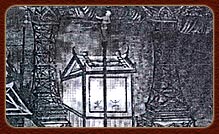
Various entertainments: firework displays, Thai theaters, Vietnamese six-person acrobatics (Yuan Hok). Note that every theater roof had beverage stalls, with ladders placed for access and water pots provided to extinguish any fires that might occur from lighting fireworks.
(Source: Prachum Mai Rap Sang, Volume 1, Thonburi Period. Bangkok: Printing House of the Secretariat of the Cabinet, 1980) (image from Sippasart Rangsang).
The term mahasop originally referred to ceremonies celebrating the royal or noble funerals of kings, princes, officials, or important persons (a meaning used before 1873 B.E.). Today, it generally refers to performances or entertainments for amusement (Kuea-kun Yuenyong-anun, 2003: 188).
Mahasop during the Thonburi period encompassed a wide variety of forms. According to Prachum Mai Rap Sang, Volume 1, Thonburi Period, the performances included khon, drama, puppetry, Chinese opera (ngiew), female dance, shadow play, Thep Thong, mahori, and piphat ensembles. Recreational activities included prap kai (cock clapping), Vietnamese six-person acrobatics (Yuan Hok), Mong Kruem, ra-beng, foot performers, hoop-ladder acrobatics, wrestling duels, sword and staff combats, six-staff high tricks, single-staff tricks, tightrope walking, and juggling. In summary, these mahasop events included theatrical performances, musical ensembles, folk games, and acrobatics. Moreover, each type of performance often had multiple troupes from different ethnic backgrounds, which will be discussed further.
The royal celebratory mahasop events discussed here include five occasions, chosen to study and compare the details of performances and recreational activities as follows.
Images of various entertainments: hoop-ladder acrobatics, firework displays, Chinese theater (puppetry), Vietnamese six-person acrobatics (Yuan Hok).
(Source: Prachum Mai Rap Sang, Volume 1, Thonburi Period. Bangkok: Printing House of the Secretariat of the Cabinet, 1980) (image from Sippasart Rangsang).
Event 1: The cremation ceremony of Somdet Phanpi Luang, Krom Phrathepamat, at Wat Bang Yi Ruea Nok (present-day Wat Intaram), Chula Sakarat 1138 (B.E. 2319 / 1776 CE). The royal orders specified the performances as follows:
“…During the day: 1 royal khon troupe of Intharaphet, 1 khon troupe of Khun Ratchaseni (total 2 troupes), 1 Chinese opera (ngiew) troupe of Phraya Ratcha Setthi, 1 Thep Thong troupe… 4 khon troupes, 4 female dance troupes, 2 shadow play troupes during the day, 1 Yuan puppet troupe, 2 ngiew troupes (total 17 troupes)… 2 Lao puppet troupes… total 18 troupes.
At night: 3 large Thai shadow play (nang thai) troupes… Thai shadow play in the middle hall… 2 Chinese shadow play troupes… (total 16 troupes).
(Total for day and night) 35 troupes…”
Event 2: The royal cremation ceremony of Krom Khun Inthraphithak and Chao Narasuriyawong, ruler of Nakhon Si Thammarat, in Chula Sakarat 1138 (B.E. 2319 / 1776 CE) at Wat Bang Yi Ruea Nok. The performances were specified as follows:
“…During the day: 2 large khon troupes, 2 khon troupes for the intermediate hall, 1 female dance troupe, 1 daytime Thai shadow play (nang thai) troupe, 1 Mon puppet troupe, 2 Lao puppet troupes (total 7 troupes), 1 large Chinese opera (ngiew) troupe, 1 Thep Thong troupe, Khmer drama, old Ramayana dance, new Ramayana dance, 2 large Thai shadow play troupes, 5 Thai shadow play troupes for the intermediate hall, 1 Chinese shadow play troupe. For acrobatics: Vietnamese six-person acrobatics (Yuan Hok), two foot performers…”
Images of various entertainments: Vietnamese six-person acrobatics (Yuan Hok), tightrope walking, firework displays, Thai shadow play (nang thai).
(Source: Prachum Mai Rap Sang, Volume 1, Thonburi Period. Bangkok: Printing House of the Secretariat of the Cabinet, 1980) (image from Sippasart Rangsang).
Event 3: The funeral of the mother of Somdet Phra Chao Luk Thoe, Chula Sakarat 1142 (B.E. 2323 / 1780 CE) at Wat Bang Yi Ruea Nok. The performances were specified as follows:
“…During the day: 2 large khon troupes, 2 Lao puppet troupes, 1 large Lao puppet troupe, 1 large drama troupe, 1 Khmer drama troupe, 1 Chinese ngiew troupe, 1 intermediate hall Thep Thong with khon troupe, 1 female dance troupe, 1 Mon puppet troupe. At night: 2 large Thai shadow play (nang thai) troupes, 7 Thai shadow play troupes for the intermediate hall, 1 Chinese shadow play troupe, old Ramayana dance, new Ramayana dance…”
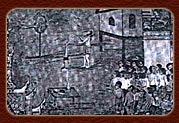
Images of various entertainments: hoop-ladder acrobatics, human pyramids, knife-throwing.
(Source: Prachum Mai Rap Sang, Volume 1, Thonburi Period. Bangkok: Printing House of the Secretariat of the Cabinet, 1980) (image from Sippasart Rangsang).
Event 4: The royal cremation ceremony of Mom Chao Saeng, Phraya Sukhothai, and Phraya Phichai Sawan at Wat Bang Yi Ruea Nok, Chula Sakarat 1139 (B.E. 2320 / 1777 CE). The performances were specified as follows:
“…During the day: 2 large khon troupes, 2 khon troupes for the intermediate hall, 1 female dance troupe, 1 daytime Thai shadow play (nang thai) troupe, 1 Mon puppet troupe, 2 Lao puppet troupes, 1 large Chinese opera (ngiew) troupe, 1 old Ramayana dance troupe, 1 new Ramayana dance troupe, 1 Thep Thong troupe, Vietnamese six-person acrobatics (Yuan Hok), and foot performers…”
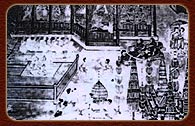
Images of various entertainments: boxing.
(Source: Prachum Mai Rap Sang, Volume 1, Thonburi Period. Bangkok: Printing House of the Secretariat of the Cabinet, 1980) (image from Sippasart Rangsang).
Event 5: The Celebration of the Emerald Buddha. This event included several stages. It began with the procession bringing the Emerald Buddha to Tha Chao Sanuk, Saraburi, where a three-day, three-night celebration was held. Then the royal barges were paraded down to Phra Tamnak Bang Khranei, where Somdet Phra Chao Luk Thoe Chao Fa Krom Khun Inthraphithak came to receive it. The grand procession included over two hundred barges. The performances paraded on the barges included:
“…Khon from Sam Pan Luang Raksasombat, Ngiew from Sam Pan Phraya Ratchasethi… Thai drama Muen Sanoh Phubaan, Muen Wohan Phirom, Khmer drama from Sam Pan Luang Phiphitthawathi, royal Chinese drum and gong, Vietnamese six-person acrobatics on Vietnamese barges, Lao puppets on Kulae barges, Javanese dance, Thai mohrree by Luang Anuchit Racha, Western mohrree by Luang Sriyos, Khmer mohrree by Phra Ong Kaew, etc.…”
When the Emerald Buddha procession reached Pom Ton Pho Bridge at Pak Khlong Nakhonban, the attendants carried it into the hall beside the ordination hall of Wat Chaeng (present-day Wat Arun). His Majesty graciously commanded Thai piphat, Ram piphat, Lao piphat, Indian-Western mohre, Chinese-Vietnamese mohre, and Mon-Khmer mohre to perform in rotation for 2 months and 12 days. The surrounding area of Wat Chaeng during that period must have been filled with a serene, musical atmosphere.
At the main celebration on Wednesday, the 13th day of the 6th lunar month of the Year of the Pig, numerous performances were held for 7 days and 7 nights, including:
Chinese opera theaters (โรงงิ้ว)
(Source: Prasum Mai Rap Sang, Volume 1, Thonburi period. Bangkok: Secretariat of the Cabinet Press, 2523)
(Image from Sippasat Rangsarn)
During the daytime, there were Lao puppets, Khmer drama, Chinese opera, Vietnamese opera, khon interludes, female dance, daytime shadow puppetry, and Thepthong; at night, there were Thai shadow puppetry, interlude shadow puppetry, Chinese shadow puppetry, and so on. The royal celebratory performances for the Emerald Buddha were a highly festive and joyous occasion for the people of Thonburi. Besides theatrical performances, there were also games and acrobatics to watch, such as high-pole acrobatics, single-pole acrobatics, low-wire acts, six-person Vietnamese acrobatics, two-person foot balancing acts, cock-clapping, Mong-Krum, firecrackers, front-line Siamese dances, and Vietnamese dances holding lotus-shaped lanterns. There were also wrestling, boxing, staff duels, sword duels, shield duels, long-spear duels, and Mon-Lao-Vietnamese spear duels. A celebratory performance would be incomplete without fire displays; therefore, this event also included the sounds and sights of firecrackers, Chinese fireworks, flares, sparklers, gold-thread fireworks, windmills, and pyrotechnic torches.
What do the theatrical performances at royal cremations, funerals, and the Emerald Buddha festivities reflect?
Reflections from the celebratory performances:
The five celebratory performances reflect the following:
1. Thonburi society was multicultural. This is evident from the diverse performances and games, each representing the arts of multiple ethnicities and languages. Examples include:
Puppet performances included Thai puppets, Mon puppets, Khmer puppets, Lao puppets, Chinese puppets, Vietnamese puppets, and Tavoy puppets (Tavoy puppets are wooden figures dressed like Tavoy people and operated with pulling strings, according to the Royal Institute Dictionary, 1982, 1995); operas included both Chinese and Vietnamese styles; dramas included Thai and Khmer plays; dances included female Thai dance, Ramanya dance, and Mon dance; shadow puppetry included both Thai and Chinese forms; musical performances included Thai Mohori, Indian-French Mohori, Chinese-Vietnamese Mohori, Mon-Khmer Mohori, Thai piphat, and Ramanya piphat; these performances reflect that Thonburi society was composed of people of many ethnicities, languages, and cultures living together, including Lao, Mon, Khmer, Tani Muslims, Chinese, Vietnamese, and Europeans, some of whom had long-standing residence while others had arrived as captives when the Thonburi army won wars.
Many groups were persuaded to relocate to Thonburi, where they established their own communities with leaders who were officials holding ranks and land. These senior nobles each maintained their own troupes for khon, shadow plays, dramas, folk music, and instrumental ensembles. These performance troupes participated in ceremonial events, making the entertainment lively, spectacular, and diverse. Senior nobles who organized troupes to join the celebrations included:
– Phraya Rachasetthi of Chiang Chun with a Vietnamese Mohori
– Phraya Rachasetthi of the Chinese community with a Chinese Mohori
– Phraya Ramanya Wong with a Mon Mohori.
2. The entertainment enjoyed by the people of Thonburi can be seen from the ceremonial performances; the five major events provided varied amusement, with the celebration of the Emerald Buddha in 2322 BE (1779 CE) being especially lively and festive compared to funerals. The Emerald Buddha celebration featured a variety of performances similar to other ceremonial occasions, but what added extra excitement were the numerous folk games and acrobatic acts. The celebration lasted a long time, beginning with a three-day, three-night ceremony upon the arrival of the Emerald Buddha at Tha Chao Sanuk, Saraburi, followed by a grand procession of 246 boats to Thonburi. Upon reaching Wat Arun, musical performances by Mohori and piphat ensembles were held in rotation for 2 months and 12 days. On the main celebration days, festivities continued for 7 days and 7 nights, filled with firework displays, torches, and the sounds of piphat and Mohori music, as well as shadow puppet performances. Such prolonged, entertaining, and culturally diverse celebrations suggest that the people of Thonburi at that time were able to relieve the hardships of war, famine, and internal and external threats, as well as the strain of rebuilding the city during the early reign—after more than ten years of enduring difficulties, they could finally enjoy some relaxation toward the end of the reign.
3. Observations on performances and entertainments: every ceremonial event featured both daytime and nighttime performances. Daytime performances were more numerous, while nighttime shows consisted primarily of shadow plays, which required illumination with fires in front of a white screen. Puppeteers and dancers performed in rhythm with the roles of the shadow characters, including kings, queens, giants, and monkeys, all in front of the screen. The repertoire included the Ramakien. Musical performances and fireworks were also part of the celebrations, including various kinds such as rockets, fire wheels, sparklers, and firecrackers.
For each event, the preparation and organization were distributed among various government departments, which oversaw the construction of performance halls, charitable pavilions, ceremonial pavilions, and bridges over canals. They also stationed musicians with piphat ensembles, drums, trumpets, conches, and ceremonial umbrellas. Labor was conscripted from provincial towns to assist with construction; for example, during the ceremony for the cremation of Somdet Phanpi Luang, Krom Phra Thepamart, officials from Nakhon Sawan, Phichit, Sangkhaburi, and Kamphaeng Phet were tasked with building enclosed pavilions, while officials from Chainat, Singburi, Inburi, and Phromburi built bridges. Foreign communities also participated, such as the Khmer constructing Khmer theatres and the Ramanya building Ramanya halls. These collaborative activities fostered unity, coordination, and enjoyment among all social groups. The expenses for these events were covered by the state, including wages for construction workers, participants in processions, and performers. The most costly event was the Emerald Buddha celebration, totaling 379 chang, 3 tamlueng, 1 baht, and 2 salung.
4. Significance of Wat Bang Yi Ruea Nok (Wat Intharam): This temple served as the venue for royal cremations and funerals of important nobles, as documented in royal decrees. Its location by the Bangkok Yai canal, near the royal palace and at the junction of Bangkok Yai, Dan, and Chak Phra canals, made it a hub for commerce, customs, and transportation, enhancing economic activity. Additionally, King Taksin renovated the temple’s Buddha images, chedis, and viharns, constructing numerous monks’ quarters and inviting Vipassana monks to reside there.
5. Performances, music, folk games, and acrobatics in Thonburi: These were a continuation of Thai cultural traditions from Ayutthaya into the Rattanakosin period. Although the fall of Ayutthaya in 2310 BE dispersed many experts in performance arts, artists from provincial towns were eventually gathered to revive the arts in Thonburi. This preserved and transmitted traditional cultural practices to the Rattanakosin era. In summary, public entertainment in Thonburi had been disrupted since the fall of Ayutthaya in 2310 BE. During the early Thonburi period, the kingdom faced challenges such as economic instability, famine, and crime, leaving little time to restore artistic traditions. Once the city stabilized, King Taksin endeavored to revive all art forms, recruiting artists from Nakhon Si Thammarat to train Thonburi residents in drama and other performances. He also organized a wide variety of performances and folk games for ceremonial events, including royal and noble funerals and the Emerald Buddha celebrations.
These ceremonial celebrations were organized by King Taksin to include all ethnic groups living in Thonburi in every stage of the activities, from preparation to performances, allowing people from all communities to unite in harmony, reviving their spirits and alleviating suffering, while also preserving Thai cultural traditions from being lost (Kuekul Yuenyong Anan, 2003: 188-194).
In summary, the royal initiatives of King Taksin regarding the promotion and preservation of arts and culture can be outlined as follows:
1. He possessed broad interests and recognized the importance of all branches of art and knowledge. He worked diligently on royal duties, making no idle use of his time for personal pleasure, and even with limited leisure due to warfare and maintaining public order, he devoted himself to the support and cultivation of the arts and sciences to the greatest extent.
2. He sought to collect and preserve ancient literature, particularly the valued works from the Ayutthaya period. Simply gathering surviving manuscripts after the fires was insufficient; it was necessary to recover and reconstruct works from original texts and from memory, tracing manuscripts from private homes, temples, and provincial towns. This collection effort was likely conducted with urgency under his direct encouragement, knowing that delay could result in the loss and decay of these literary treasures.
3. He recognized the necessity of restoring the morale of the populace. After the devastation of war, commoners and citizens had lost courage and the will to perform their duties, even though the king had restored freedom and rebuilt the country. Recovering public spirit took longer than rebuilding physical infrastructure. King Taksin therefore considered it a vital royal duty to uplift the people’s morale through the promotion of arts and literature, which served as a source of enjoyment and psychological relief. He encouraged the composition of literary works and the revival of theatre, bringing the flourishing drama traditions of Nakhon Si Thammarat to train the royal court, and restoring court theatre according to the Ayutthaya model. The production of literature and the revival of theatre functioned as a clever and subtle strategy to boost the spirits of his people.
4. He sought to perform the royal duties of a monarch fully according to traditional royal practice, meaning that the king must also promote literature. King Taksin demonstrated his resolve and determination to carry out these literary duties to the best of his ability, undeterred by obstacles and surrounding circumstances. Although literary works from his reign were not as outstanding as in more prosperous times, they revealed his remarkable wisdom and capability, which were difficult to achieve under such conditions.
5. He may have intended literature to serve as a guide for fostering thought, harmony, patriotism, and selflessness. He composed the Ramakien episode of Phra Mongkut, depicting a time when the realm of Rama was in turmoil due to misunderstandings, which, once resolved, brought peace throughout the land. The episodes of Hanuman courting Nang Wanarin until sending her to the city of Fa, and the episode of Thao Maleewarat adjudicating, all convey moral lessons relevant to the state of the nation. It is evident that the revival and promotion of literature during the Thonburi period was not only aimed at honoring and preserving the art of composition but was also closely connected to the necessities of governance and the well-being of the people.
Summary of the Distinctive Features of Thonburi-era Arts and Culture
The Thonburi period lasted only 15 years, so its distinctive cultural characteristics were not very prominent. They can be summarized as follows:
1. Almost all arts were influenced by the flourishing culture of Ayutthaya, including architecture, painting, performing arts, and literature.
2. Thonburi-era arts tended to be simple and unadorned. This is evident in the construction of important buildings such as palaces and temples. This simplicity likely reflected the country’s severely weakened economic situation at the time. In literature, even long epic works such as the Ramakien and the I-Lae were abridged into shorter episodes. Although Thonburi did not produce exceptionally distinctive arts as models, it preserved the cultural achievements of the previous era and laid the foundation for their revival and further development in the subsequent Rattanakosin period.