

King Taksin the Great
Chapter 11: Royal Duties in Governance, Law, and the Courts
11.1 Royal Duties in Governance
What was the system of governance during the Thonburi period?
During the reign of King Taksin the Great, the old system of governance inherited from the Ayutthaya period was likely still in use. In summary, it was as follows:
- 1. Central or Capital Administration
It was under the responsibility of two Grand Chancellors and four ministers of the Chatusadom, namely the Departments of the Capital, the Palace, the Treasury, and Agriculture. The administration was divided into two branches: the civilian branch, headed by the Samuhanayok, who supervised the work of the Chatusadom and oversaw the northern cities; and the military branch, headed by the Samuhaklahom, who oversaw national defense and managed the southern cities. The ministers of the Chatusadom performed duties similar to those in the Ayutthaya period, but the Department of the Palace had additional responsibility for coastal cities, including Samut Prakan, Samut Sakhon, Samut Songkhram, Nonthaburi, Chonburi, Bang Lamung, Rayong, Chanthaburi, and Trat (53 Thai Monarchs Who Won the Hearts of the Thai People, 2000: 240). - 2. Regional Administration
This involved governing the various cities within the kingdom, divided into two levels: the provincial cities under a Phraya Mahakhon and the tributary cities.
2.1 Administration of Provincial Cities under a Phraya Mahakhon
These were divided into two levels:
– Inner cities included smaller fourth-rank cities surrounding the capital, governed by a ruler under the supervision of the Samuhanayok, such as Phra Pradaeng and Sam Khok.
– Outer cities included cities located farther from the capital, categorized by size and importance into first-, second-, third-, and fourth-rank cities, each governed by a city lord with full authority on behalf of the king.

The mural paintings of golden and silver floral bouquets on the eastern and western walls of the Chakraphat Phimarn Hall
(Image from the book Architecture of the Grand Palace)
The Organization of Cities during the Thonburi Period
- First-rank cities included Phitsanulok.
- Second-rank cities included Sukhothai, Phetchabun, and Rayong.
- Third-rank cities included Nakhon Sawan and Phichit.
- Fourth-rank cities included Phra Pradaeng, Nonthaburi, Sam Khok, and others (53 Thai Monarchs Who Won the Hearts of the Thai People, 2000: 240). For small and remote towns, Thonburi did not administer them directly but assigned larger cities to oversee them as follows:
– Nakhon Ratchasima supervised the northeastern cities.
– Nakhon Si Thammarat supervised the southern cities.
– Phitsanulok supervised the northern cities.
– Chanthaburi supervised the eastern coastal cities (Sukhothai Thammathirat Open University, 2003: 350).
2.2 Administration of Tributary Cities
The capital granted the tributary states full authority in their internal administration, as well as the power to govern nearby smaller towns. Their duties included presenting tribute and the Trees of Silver and Gold to the capital once every three years, as well as providing troops and supplies as appropriate in times of war.
Note
Titles of Nobles
The two Grand Chancellors
– Chaophraya Mahasenabodi, holding the position of Samuhakalahom, sometimes referred to as the Department of Defense
– Chaophraya Chakri Si Ongkharak, holding the position of Samuhanayok, sometimes referred to as the Department of the Interior
The Chatusadom consisted of four positions, each holding the title of Phraya:
– Phraya Yommarat, head of the Department of the Capital or the Department of Metropolitan Affairs
– Phraya Thammathikon, head of the Department of the Palace
– Phraya Kosa Thibodi or Phraya Si Thammathirat, head of the Department of the Treasury
– Phraya Mahathep or Phraya Prachachip or Phraya Kasetathikan, head of the Department of Agriculture
3. The Eight Ministers
Phraya Aphaironarit, holding the position of Jangwang of the Left Royal Police Department
Phraya Anuchit Racha, holding the position of Jangwang of the Right Royal Police Department
Phraya Thibet Bodi, holding the position of Jangwang of the Left Royal Pages Department
Phraya Si Saowaratch, holding the position of Jangwang of the Right Royal Pages Department
Phraya Ratchaphakdi, holding the position of Jangwang of the Royal Treasury of Great Wealth, or serving in a high-ranking royal department
Phraya Phetphichai, holding the position of Jangwang of the Royal Palace Guards
Phraya Sunthonwohan, holding the position of Jangwang of the Royal Scribes Department
Phraya Sriphiphat, holding the position of Jangwang of the Royal Warehouse
(Jangwangwas a high-ranking official position within the Royal Pages Department, responsible for supervision and serving as the chief officer in attendance to the royal family.)
4. Governors of various cities held ranks ranging from Chaophraya Thetsarat, Chaophraya, Phraya, to Phra, depending on the importance of the city they governed. For example, Nakhon Si Thammarat was governed by Phra Chao Nakhon Si Thammarat; Phitsanulok was governed by Chaophraya Surasi; and Phichai was governed by Phraya Siharachadecho, and so forth (53 Thai Monarchs Who Won the Hearts of the Thai People, 2000: 241–242).
- 3. Administration of the Commoners
The control of manpower, or “control of the phrai,” was a crucial element of Thai governance. The phrai system had disintegrated after the fall of Ayutthaya, when various nobles seized the opportunity to take royal phrai as their own property. This caused the state to lose a large portion of its labor force and tax revenue. King Taksin therefore restored the phrai system by ordering the tattooing of marks on the wrists of phrai luang and phrai som, marking the first time such tattoos were required for all departments and divisions. A law was also established that anyone forging the tattooing iron would be punished by death, including their entire family line.
In addition, there was a royal decree from the reign of King Taksin, issued in 1774 (B.E. 2317), which set rules requiring every phrai to have tattoo marks indicating their master and province of residence. It also stated that “whoever forges tattooing needles or tattoos a phrai falsely as his own shall be punished by death.” The practice of tattooing the name of the master or province on a phrai’s wrist had never existed before King Taksin’s reign. The reason for enforcing this decree requiring every phrai to be tattooed (sak lek) was to facilitate the conscription of labor during both peacetime and wartime, and to prevent the loss of royal phrai (Sukhothai Thammathirat Open University, 2003: 362). The construction of the new capital and the continuation of warfare required a vast amount of labor (Foundation for the Preservation of Ancient Monuments in the Old Palace, 2000: 98–100).
Note
Phrai refers to commoners in the modern sense. Phrai were required to perform state labor service for the king. Adult male phrai were registered under a noble’s supervision for government service. Every adult male had to be officially affiliated with a noble in exchange for legal protection, since the law stated that an unaffiliated man had no legal rights or protection. Phrai were divided into two categories according to their affiliation:
(1) Phrai Luang — royal phrai directly under government departments and thus directly serving the king. Their duties varied according to their assigned department. There were two types of phrai luang: those conscripted to perform labor for the government, and those who paid goods or money in lieu of labor service, called phrai suai. Initially, they supplied goods instead of labor in what was called “rotation service,” but toward the end of the Ayutthaya period, especially during the reign of King Narai, monetary payment in place of labor became common. The money was called “government service payment.” Phrai luang served the king and were required to perform six months of labor per year—one month in service, one month at home, alternating continuously. This system was called “rotation in service” and “rotation out of service.” However, phrai could change their status in two directions: upward to noble rank, or downward to slavery. The labor of the phrai benefited their nobles as a source of manpower and production, and likewise benefited the state both militarily and economically.
(2) Phrai Som were phrai granted by the king to princes and nobles holding official positions for their benefit. Phrai Som remained under the control of the noble as long as the noble continued to hold office. Upon the death of the noble, the phrai som were transferred to become phrai luang, unless the children of the deceased noble petitioned to retain control of the phrai som.
Phrai luang were generally in a more difficult position compared to phrai som, because phrai som served only their noble master and therefore had more comfort, whereas phrai luang were conscripted for labor by the state and had to perform heavier work (Youth Parliament, The Kingdom of Thailand in the Past: Early Ayutthaya Period, B.E. 1893–1991, http://203.154.23.6/teen/knowledge/politics_ayutthaya1.asp, 31/03/2004).
4. In addition, regarding military administration, King Taksin strengthened the morale of Thai soldiers and established military units to suppress criminals as follows:
4.1 King Taksin consistently maintained the morale of Thai soldiers to ensure their well-being, but only for those who were truly qualified as soldiers. He regularly instructed them to practice weapon drills and combat maneuvers to develop proficiency in their respective formations, enabling them to perform military exercises skillfully. Even officers of high rank, such as colonels and commanders, were continually provided with additional instruction in military strategy. King Taksin personally took the effort to teach and train them. During rainy seasons without active military campaigns, he would convene the generals and commanders for intensive training to enhance their capabilities beyond those of the enemy, ensuring continued success in battle.
4.2 Accumulation of arms and war materiel — besides training the troops and rigorously instructing senior officers, the king also hurried to amass weapons and materiel so they were well supplied. He even procured European-style cast cannons whenever possible; any types of cannon that could be cast locally were produced without delay, since artillery was regarded as the essence of warfare. In using the cannons he ordered soldiers to practice volley firing, attempting to fire dozens of pieces simultaneously to demolish enemy units or strongholds suddenly, producing an effect comparable to the heaviest aerial bombardment. This was intended to prevent the enemy from learning the artillery beforehand and thus be destroyed utterly. The tangible result in battle was that such firepower shattered the enemy and secured victory each time.
4.3 Forts and camps at that time were also essential to the military. He ordered the rapid construction of additional forts at many important locations. As for the original Vichaiyent Fort built in the reign of King Narai the Great, during the reign of King Taksin the Great it was renovated and given a new name, Fort Vichaiyaprasit, in B.E. 2314 (Useful information about Thonburi, 2000: 33)
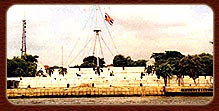
Wichaiprasit Fort (Image from the book King Taksin the Great)
5. Regarding the common people, he governed them like a father governs his children, and he preferred that both soldiers and citizens address him as “Father.” At that time, laws concerning cordoning off areas for public access had not yet been enacted, and he allowed the people to appear along the streets without armed guards or marksmen controlling them. Even foreigners admired this aspect of his character. For example, Monsieur Lebon described in a letter to the Director of Foreign Affairs: “The people call King Taksin the king of the land, yet King Taksin himself considers himself merely the protector of the capital. He does not behave like previous kings. In the customs of Eastern kings, they do not appear before their people for fear of diminishing their prestige. King Taksin does not agree with this. He is far more capable than ordinary men, and therefore does not fear that appearing before his subjects and speaking to them will weaken his royal authority. He wishes to observe all matters with his own eyes and hear all matters with his own ears” (Fine Arts Department, Compilation of Chronicles, Volume 39: 63–64; adapted in King Taksin the Conqueror King, Sanan Silakorn, 1988: 19).
11.2 Royal Duties in Law and the Courts
11.2.1 Law during the Reign of King Taksin
Throughout the reign of King Taksin the Great, the kingdom was frequently engaged in military campaigns, leaving little time to revise royal decrees or laws for legal cases. Therefore, the laws established during the Ayutthaya period were still in use. The Department of the Palace (Krom Wang) or Ministry of the Palace was responsible for determining which cases should be tried in which courts and for forwarding cases accordingly. Court work was divided into two main sections:
The reception of cases handled the drafting of complaints, assessed whether a case should proceed, and submitted it to the appropriate court. This section also had the duty of levying fines and punishing offenders.
The examination and adjudication section was originally composed of twelve Brahmin legal experts in various fields, called the “jury at the royal court.” Later, skilled Thai legal officials joined this section as well. However, this jury at the royal court did not have the authority to levy fines or impose punishments.
During King Taksin’s reign, the “military court” was predominantly used. Even when the king imposed the highest penalties, he often instructed that punishments be applied gradually, starting from the minimum. In many cases, offenders who committed serious crimes received royal clemency or had the severe punishment commuted, instead being assigned alternative duties to atone for their crimes (Foundation for the Preservation of Ancient Monuments in the Old Palace, 2000: 86–87).
For example, severe punishments were imposed for crimes such as defrauding the state. Counterfeiting currency resulted in the death penalty, while embezzling royal rice led to 100 lashes, repayment of ten times the value of the rice, demotion from Luang to Nai Muad to oversee phrai, and the detention of the offender’s spouse and children (53 Thai Monarchs Who Won the Hearts of the Thai People, 2000: 242).
11.2.2 Examples of Laws during the Reign of King Taksin
The book King Taksin the Conqueror (Sanan Silakorn, 1988: 27–34) provides examples of laws in effect during King Taksin’s reign as follows:
1. Law of Trial by Fire and Water
An important law used by King Taksin to resolve disputes involving monks whose moral purity was in question was the Law of Trial by Fire and Water, an old law dating back to the Ayutthaya period. This law stipulated that to determine which party in a dispute was truthful, seven methods could be applied: competing to reach lead, swearing an oath, passing through fire together, diving into water together, swimming against the current or across a river competitively, and carrying equal candles. The law prescribed detailed procedures, particularly for the trials by fire or water: the plaintiff and defendant would either dive or pass through fire together. In diving, the first to surface would lose, while in the fire trial, the first whose feet were burned would lose. King Taksin applied these methods on multiple occasions to settle disputes involving monks.
- 1.1 Investigation of the Supreme Patriarch
When he first ascended the throne, King Taksin reflected that “Buddhism will flourish through the practice of the fourfold assembly (monks, nuns, male devotees, and female devotees) following the teachings of the Buddha. However, monks today do not fully observe the fourfold purity precepts, because there is a lack of high-ranking monastic leaders capable of practicing Dhamma and meditation and teaching others.” Therefore, he issued a royal command to seek out knowledgeable monks, summon them, and organize them into senior and junior royal monastic ranks. He appointed a virtuous teacher at Wat Pradu as Supreme Patriarch. Later, a plaintiff accused the Supreme Patriarch, claiming that “while serving at the camp of the commander at Pho Sam Ton, he conspired with the commander to hasten the collection of wealth from the townspeople in the camp, implying that they were wealthy.” King Taksin then ordered Phraya Phrasat to interrogate the Supreme Patriarch, who refused to answer. The king therefore commanded a trial by fire to prove his innocence. The Supreme Patriarch failed the trial by fire, and King Taksin ordered him defrocked. Later, he invited Phra Ajahn Sri, who had fled from the Burmese army to Nakhon Si Thammarat, to become the new Supreme Patriarch.
- 1.2 Purification of Northern Monks
When Ayutthaya fell to the Burmese, the country fragmented into various factions. In the north, there was the faction led by Chao Phraya Fang, who was a monk but had assumed authority, gathering followers who were also monks to take up arms, engage in combat, kill, and commit various violations of monastic precepts. When King Taksin successfully suppressed Chao Phraya Fang’s faction, he proceeded to purify the northern monks, stating: “Summon all northern monks to their seats and gather high and low-ranking officials together. It is clear that these northern monks are all followers of Chao Phraya Fang, carrying weapons and firearms, fighting, killing, looting, drinking alcohol, and committing sexual misconduct. They have violated the four parajika offenses and other precepts, failing in their duties as monks. Such misconduct cannot be tolerated. Furthermore, northern and southern monks are mixed together, making it unclear who is virtuous and who is not, yet they are still venerated. Monks must testify truthfully; if found guilty of any of the four parajikas, they shall be defrocked and assigned to secular duties. Those who refuse must undergo a trial by water, and if they pass, they may be appointed abbots or senior monks of the northern region according to their merit. If they fail, they will be flogged and have their wrists tattooed, forbidden from ordination. If tied in the trial, they will receive robes and be re-ordained. Those who initially refuse and are found guilty after the trial will face execution.” At that time, monks of pure conduct passed the trial or tied, while those of corrupt conduct mostly failed. The officials carried out the punishments and appointments according to the king’s instructions.This demonstrates King Taksin’s deep concern for the affairs of Buddhism, aiming to ensure its prosperity, to have virtuous monks teaching and guiding the people. He admonished the monks: “May all of you diligently maintain the purity of the fourfold precepts without defilement. Should you lack any of the four requisites, the laypeople will provide support. Even if meat or blood is requested, the laypeople are capable of offering it as the highest act of merit.”
2. Court Code
The Court Code is a law that establishes regulations for conduct within the royal court and defines the relationship between the king and his officials. This law dates back to the reign of King Boromtrailokkanat of Ayutthaya. King Taksin the Great applied this law on numerous occasions to adjudicate and resolve various cases, such as:
- 2.1 Case of a foreigner having an affair with a royal consort
A passage in the royal chronicles records that on Monday, month seven, waning moon day 1, Chula Sakarat 1131, Year of the Ox, Mom Chao Ubon, daughter of Krom Muen Theppipit, and Mom Chao Chim, daughter of Prince Phichit, who were consorts of King Taksin the Great, together with four other court women, were intimate with two foreign valets. After the matter was duly investigated and the facts established, the men and women were punished by having their arms cut off, being beheaded, and their chests opened, so that no one would imitate them. Mom Chim and Mom Ubon were among the consorts the king favored, and after the executions he was deeply distressed, even saying he would die with Mom Chao Ubon. The execution of the consorts and their lovers was carried out under the Court Code, chapter 120, which states that anyone who has an affair with a royal consort shall be killed and that the woman shall be put to death three days later; however the law does not prescribe the exact method of execution, leaving that to the royal decision.
- 2.2 Disobeying the Royal Command
According to the Court Code, Chapter 101, it is prescribed that “From ten thousand fields to eight hundred fields, disobeying the royal command carries four types of punishment: disobeying a direct verbal order results in having the mouth spat upon, disobeying a written royal order results in execution, disobeying a command results in cutting of the mouth, and disobeying a royal petition results in punishment by the fourfold whip.” During the Thonburi period, an important incident related to disobeying the royal command occurred:
1. When the king proceeded to suppress the rebellion of Chaophraya Nakhon, a fire broke out in Nakhon city, in the district of Naykai. King Taksin the Great personally went to oversee the firefighting. He ordered his officials to bring elephants to demolish houses, but the elephant department did not arrive in time. As a result, he imposed corporal punishment by flogging thirty to fifty strokes on each official, according to their rank, and all royal relatives who could not keep up with the king’s progress were also punished.
2. When the army was sent to attack Phutthaimat, King Taksin ordered the Department of Instructors to deploy the most skilled soldiers. The city was captured, but Phaya Racha Setthi, the city’s ruler, escaped. The king asked the instructors which route the army had taken to enter the city, but the three instructors gave conflicting answers. Upon inspecting the route, the king found it was contrary to his plan and ordered the soldiers who had entered incorrectly to be flogged. Later, the first soldiers to successfully enter the city were rewarded with 325 chang of money.
3. On returning from the Chiang Mai campaign, he ordered reconnaissance boats to hasten the army. Anyone who stopped at a house along the way was to be executed. When Phra Thep Yot stopped his boat, the police reported it to the king. In anger, King Taksin had him tied to a palace post, drew his sword, and executed him, displaying the body at the front of Wichaiprasit Fort and disposing of the remains in the river.
There was one occasion when King Taksin chose to waive the application of the Khot Mon Thian Ban (Court Code). In the year 2318 BE (1775 CE), after successfully subduing the Burmese in Chiang Mai, he returned to the city of Tak. On Thursday, the 2nd day of the waxing moon of the 3rd month, he organized an army under Luang Maha Thep to immediately march against Burmese forces who had encroached via the Mae Lamao pass. After arranging the army, around the second watch of the night, he boarded his royal barge, accompanied by the Ministry of the Palace, while Luang Raksakosa attended at the stern. They were informed by officials that fires were seen along the river and that Burmese voices were heard. King Taksin confirmed the report and ordered Nai Khwan to lead him down to inspect. Upon seeing the fires, he anchored the royal barge and sent Muen Chong to scout, who reported that Burmese vessels from Chiang Mai were approaching. The commander Phra Phet Prani controlled the vessels and issued warning signals. After verification, the king proceeded. However, the royal barge struck a submerged tree and capsized, forcing him to wade ashore. He then continued his journey by land, arriving at the Mango Garden Residence at Ban Rahang at dawn. The king graciously consulted on rewards and punishments for the soldiers: those who performed well were rewarded. The accident of the capsized barge was regarded as an act of fate beyond human control, so no punishment was administered. Unlike previous monarchs, whose boatmen and crew would have faced execution, King Taksin swam ashore himself and did not take offense, despite being exhausted and deprived of rest throughout that day. Even in the early hours after the accident, he continued on foot like an ordinary soldier, without showing anger. This incident highlights King Taksin’s leniency and practical judgment, even in cases where the strict court code might have demanded harsh punishment.
3. Royal Criminal Code (Phra Ai-ya-kan Achaya Luang)
This law prescribed detailed provisions regarding offenses against the king and their corresponding punishments. King Taksin applied this law in two cases:
- 3.1 In the case of Phraya Ratchaphakdi’s army pursuing the Burmese toward the Uthai Thani checkpoint, heavy rains caused flooding in the forest, making it difficult to continue the pursuit. The army therefore retreated and reported to Thonburi that the Burmese had fled quickly, and they could not catch up. Upon learning this, the king became enraged at their laziness and failure to persevere in the military campaign, and ordered that all be executed. Phraya Ratchaphakdi acknowledged that he alone was at fault and requested to receive the royal punishment himself only. The king responded, “All generals and officers acted without objection, so if you spare one, it would set a precedent. Let all die together.” This action followed the Royal Criminal Code, Chapter 5, which states that whenever the king issues an order for military campaigns or other duties, those who fail to follow it shall be punished in eight specified ways.
- 3.2 In the case of Chao Phraya Phichai Racha, the Chao Phraya of Sukhothai, who came to serve in Thonburi, he sent elderly intermediaries to request the younger sister of Chao Chom Chim, the chief consort and daughter of the ruler of Nakhon Si Thammarat, to come and serve as his wife. When the king learned of this, he became enraged and declared that it was audacious for someone to treat himself as equal in rank to the king. He then ordered Chao Phraya Phichai Racha to be executed, beheading him and displaying his head at the side gate of the palace pavilion as a warning so that no one would imitate this behavior in the future. This followed the Royal Criminal Code, Chapter 1, which states: “Anyone who is excessively greedy and ambitious, acting beyond their rank and disregarding the king’s preference, shall be considered arrogant and punished in eight specified ways.”
4. Law Prohibiting Conversion to Christianity and Islam
Historical evidence shows that King Taksin paid attention to religious affairs and maintained close relations with other religions, such as Christianity. This is evident from a report by the priest Corre to the Director of the Foreign Mission in Paris, dated June 7, 1770, stating: “On May 25 of this year (B.E. 2313 / 1770 CE), the King of Siam personally came to visit me, an unprecedented event. Senior officials dared not speak with the bishop at the priest’s house. When the King visited, he noticed that our space was too small, so he ordered the demolition of a hall on our premises, instructed a moat to be dug and the earth used to raise the ground, and commanded walls to be built around the church, which was previously open on all sides. He praised and commended the Christians greatly.” Furthermore, Bishop Le Bon reported on May 1, 1772: “On April 2, the royal command summoned us again. On this occasion, important monks and Chinese priests were also summoned. It was a festive day throughout the kingdom, as it was the Thai New Year. The King, in high spirits, sat on a simple mat like us… People called King Taksin the ruler, but he referred to himself merely as the guardian of the city. He endured fatigue, was courageous, wise, and decisive, possessing a bold and rapid spirit; he could also be considered a brave soldier.” From Bishop Le Bon’s report dated March 26, 1775, it is known that during the Thonburi period, a law was issued prohibiting Thais and Mon people from converting to Christianity or Islam. The report stated: “Two to three days ago, the King ordered Thai monks, foreign missionaries, and Muslims to debate religious matters. When he heard the views of the Christians and Muslims regarding the killing of animals, he was displeased. The next day, he issued a royal decree prohibiting Thais and Mons from converting to Christianity or Islam, with the death penalty prescribed for both the instigators and those who converted.”
However, King Taksin’s relationship with Christianity later cooled after an incident involving the oath of allegiance (น้ำพระพิพัฒน์สัตยา), a serious matter under the Manthiraban Law, Chapter 81. Anyone who failed to take this oath faced the death penalty. The bishop had forbidden Christians from participating in the ceremony but required them to swear loyalty to the King in the church. King Taksin subsequently had officials who converted, along with the bishop and two priests, imprisoned, flogged, and punished in five ways, but they were later pardoned.
5. Law of Military Justice
One notable event demonstrating King Taksin’s sharp intelligence and foresight was the trial of the ruler of Nakhon (เจ้านคร) under the Law of Military Justice during the campaign against Nakhon Si Thammarat. After capturing the ruler, he issued a proclamation to the entire army forbidding Thai and Chinese troops from killing cattle or buffalo and from harassing monks, nuns, Brahmins, or civilians to prevent unnecessary suffering. After completing the celebration of the Buddha relics, he instructed his ministers and judges to deliberate on the punishment for the ruler of Nakhon. The ministers recommended execution, in accordance with Chapter 5 of the Law of Military Justice, which states: “A vassal given rank and position, if he becomes arrogant and commits treason or attacks your city, the punishment is severe; kill him and all his retinue.” However, King Taksin disagreed, stating: “The ruler of Nakhon is not yet our official. He has set himself up as a ruler, and we also claim supremacy. That is why the battle occurred. If he were already serving under us and then rebelled, even if ministers recommend death, I would agree.” He ordered the ruler to be detained and brought to the capital before any decision was finalized. Later, the ruler was pardoned, released from captivity, and administered the royal oath to serve as an official. He was granted residence and allowed to live in peace. Subsequently, when King Taksin’s grandnephew, Nara Suriyawong (เจ้านราสุริยวงศ์), who had been appointed to rule Nakhon Si Thammarat, passed away, the former ruler of Nakhon was reinstated to govern the city as before.
Note:
Nara Suriyawong
Nara Suriyawong, King Taksin’s grandnephew, was appointed by King Taksin to govern Nakhon Si Thammarat in 1769 (B.E. 2312), with ministers such as Phraya Ratchsuphawadi, Phra Srikrailat, and Phra Chaiyanat assisting as governors and advisors. King Taksin elevated Nakhon Si Thammarat to the status of a tributary state, with the city overseeing Pattani, Terengganu, and other southern coastal cities, making it a strategically vital southern outpost. Nara Suriyawong ruled without significant incident until his death in 1776 (B.E. 2319). ( http://www.navy.mi.th/navy88/files/Nakorn.doc 31/03/2004)