

King Taksin the Great
Chapter 9: The Royal Duties of King Taksin – Economic Affairs
9.1 What were the economic problems during the Thonburi period as the capital?
9.1.1 Economic problems in the early Thonburi period included issues related to the livelihood of the people. The second fall of Ayutthaya to the Burmese in B.E. 2310 (1767 CE) caused catastrophic devastation across nearly all aspects of the country. The national economy plummeted to unprecedented lows. Farming and trade with foreign countries came to a complete halt. Thai society faced a severe famine because agricultural activities had been interrupted for two consecutive years due to ongoing warfare and widespread enemy invasions.
At that time, Thailand suffered from extreme food shortages. People starved and became emaciated, with many falling ill and dying. Clothing and basic necessities were also severely lacking.
The Ayutthaya chronicle in Pali, written by Phra Phimoltham (later elevated to Somdet Phra Wannarat in the reign of Rama I), describes the widespread famine that Thai people endured:
“During that period, all the people in Ayutthaya were filled with sorrow and suffering, experiencing extreme hunger and weakness. Some were separated from their families, bereft of basic necessities. Orphans wandered without food or clothing, surviving on fruits, leaves, lotus stems, roots, and other wild vegetation. These people lived in scattered groups, often fighting and stealing from each other for rice, salt, and other essentials. Many had little to eat, and their bodies became frail and bloodless, suffering immensely, with some dying while others barely survived.”
The chronicle also notes that some Siamese armed themselves against monks, whom they accused of treachery. Temples and Buddha images were looted for hidden treasures. The famine was so severe that people died daily, and those who remained were weak and unable to defend themselves. Clothing shortages added further hardship. The scarcity of the four basic necessities created social disorder, and society could not function normally. Before the fall of Ayutthaya, wealthy individuals had hidden their assets in temples, which led desperate people to loot religious sites, destroy Buddha images, and steal treasures to survive.
Digging up such hidden wealth helped some people temporarily survive, but the overall food shortage meant that money and gold lost much of their value. Gold became so abundant on the streets that people could pick it up by hand. Temples and houses were thoroughly plundered.
Nevertheless, the circulation of these treasures had some economic benefit, as it facilitated financial transactions and helped revive the economy later, once agricultural production resumed and trade with other regions became possible.
French missionary records from that time also documented the famine, noting in the Royal Chronicles, Part 39:
“The cost of food in this city is extremely high. Rice sells for 2.5 silver coins per unit. Laborers, no matter how diligent, could not afford enough food for themselves, let alone their families…”
Another account stated:
“…The common people suffered greatly and died in large numbers due to extreme food shortages. In this year (B.E. 2312), more people died than during the Burmese invasion of Ayutthaya…”
The French historian François Henri Turpin, in his History of Thailand during the Ayutthaya Period, recorded the following:
“The price of rice rose sharply, becoming a scarce commodity in the markets. Taro, cassava, and bamboo shoots became the main foods during this period of famine. Most people were afflicted by unusual diseases; some suffered memory loss and incoherent speech, easily descending into madness, which further spread the severity and danger of illness…”
The extreme hunger and suffering of the people greatly distressed His Majesty. He was deeply concerned about the welfare of his subjects. The same royal chronicle records:
“From that time onwards, through royal benevolence and diligence for all living beings and Buddhism, he could not enjoy comfort or leisure. With his own hands, he provided for monks, officials, and the impoverished throughout the land. More than 10,000 people received royal provisions. Thai-Chinese officials, soldiers, and sailors each received a barrel of rice, enough for twenty days.”
“At that time, no one could cultivate the fields; food was scarce. Imported rice sold for 3 baht per barrel, or a quarter baht, or 5 baht. Nevertheless, His Majesty, with wisdom and compassion, provided sustenance to all living beings, distributing food, clothing, and money beyond count. In sorrow he spoke: ‘Whoever among men is like a deity, whoever possesses great power and brings abundance of food to living beings, even if they desire my arm, I would gladly give it. Such is true benevolence.’” (Royal Chronicles of Siam, 1964, British Museum edition: 644)
Thus, beyond restoring the nation and relocating the capital to Thonburi, King Taksin also had to undertake the monumental task of reviving the country’s economic condition.
9.1.2 Problems from natural disasters included irregular rainfall, which caused the sown rice fields to be damaged. In addition, insects and rats ate the roots of rice plants and other crops, preventing sufficient yields for subsistence. As a result, bandits became rampant everywhere, and people had to carry weapons at all times.
“The destruction caused by rats, which ate the rice while it was ripening, led to grains falling to the ground. People were unable to gather reptiles, termite mushrooms, or large tubers, each of which could feed one person. Insects swarmed over corpses, darkening the air, and humans had to continuously struggle against these insects without end.”
9.2 How did King Taksin address the problems of the people’s livelihood?
The royal initiatives to address economic problems after the second fall of Ayutthaya by King Taksin of Thonburi can be summarized as follows:
9.2.1 Solving the problem of hunger and shortage among the people (short-term measures)
The most urgent and critical problem that required immediate action was the alleviation of hunger and the shortage of basic necessities among the populace. King Taksin of Thonburi addressed this issue by spending a large amount of royal funds to purchase rice brought in by foreign merchants on trading ships, offering them unusually high prices—ranging from 3 to 5 baht per jar, and sometimes up to 6 baht per jar. At that time, this was considered extremely expensive; in today’s value, it would be roughly equivalent to around 2,000 baht per jar. He then distributed the rice as royal aid to tens of thousands of starving subjects. Government officials, both military and civilian, also received the rice, typically at a rate of 1 jar per person for 20 days (Sujit Wongthes, 2002: 130). At the same time, he ordered the purchase and distribution of clothing and garments in large quantities, which immediately alleviated the hardship of the populace.
Sources of the royal funds for food and supply distribution
To fund these purchases, King Taksin sent officials to Ayutthaya to oversee the recovery of hidden treasures and to collect taxes from discovered assets (Pharadhee Mahakhand, 1983: 29–30). He also used the wealth seized from the Burmese to buy rice from foreign trading ships and allocate it to the people and the army.
King Taksin the Great used his personal wealth, along with that of his mother and siblings, to support the government, because he inherited a kingdom that was completely empty—without palaces, valuable possessions, or treasury funds (Woramai Kabilsingh, 1997: 61). In addition, his Chinese soldiers contacted their merchant relatives, collectively contributing around ten thousand tamlueng (a traditional Thai unit of weight for silver or gold), as well as rice, salted fish, and other goods, which were not officially recorded but were certainly used (Woramai Kabilsingh, 1997: 65, 80–81).
Later, a relative named Jianjin requested loans from Chinese officials or the emperor in Beijing to purchase firearms, iron for sword making, and quality swords from nearby cities, as well as spears, halberds, and lances. In total, funds from merchants, officials, and the Beijing emperor amounted to sixty thousand tamlueng (Woramai Kabilsingh, 1997: 82–93).
The royal funds used to purchase rice and clothing for the officials and the heavily suffering populace were substantial. King Chulalongkorn (Rama V) surmised that “the rice to feed the starving may have been paid for with money obtained from the Phosa Samton fort.”
Suree Phumiphamon (1996: 78) wrote about raising funds, stating that tin, elephant ivory, and logs were sold to buy food and clothing.
King Chulalongkorn also wrote, “It does not matter where the money came from. The ruler of Thonburi purchased rice to distribute so that in times of scarcity, all would share both fullness and hunger alike.”
In the memoirs of Krom Luang Narindrathewi, it is recorded that “the leftover Burmese cannons that could not be transported were dismantled for their metal (likely brass or bronze) and loaded onto ships to buy rice at six baht per jar, feeding over a thousand starving people.”
This demonstrates that King Taksin of Thonburi sought funds by every possible means, even melting unusable cannons to sell as scrap abroad, to purchase rice and feed his starving people.
The French historian François Henri Turpin in his History of Siam during the Ayutthaya period mentioned the following regarding this event: “In 1769, His Majesty showed his great benevolence toward the people. The destruction caused severe famine, one of the consequences of war. Work was temporarily halted, and the peasants could cultivate only a small portion of their fields.”
“Under these dire circumstances, Phraya Taksin demonstrated his compassion. The people no longer had to suffer from hunger, for he opened the royal granaries to provide assistance…”
The famine during the early Thonburi period appears to have persisted for several years. Evidence in the Royal Chronicles of Thonburi (Phan Chantanumat edition, by Jeim) indicates that even in 1770 CE (B.E. 2313), he still purchased and distributed rice:
“In the year 1132 of the Chula Sakarat, Year of the Tiger, calamity struck… The price of rice was three chang per cart. By the grace of His Majesty, rice was brought from the southern regions in sufficient quantities, and he donated generously to monks, Brahmins, beggars, merchants, and the families of officials alike…”
A traditional anecdote, passed down through elders, recounts that during the early reign of King Rama V, an elderly villager from Bang Pratun, Thonburi, recalled stories from his father, who had personally witnessed the events. When people were relocating from Ayutthaya to the new capital at Thonburi and facing severe famine, King Taksin personally rode on his royal elephant to distribute rice and clothing to the people every day. The citizens would gather around to pay their respects, sometimes crowding dangerously close to the elephant. Concerned for their safety, His Majesty warned them, saying: “Do not come so close, my children, the elephant might harm you.”
His Majesty’s words, filled with compassion for his subjects, deeply impressed the people present. Beyond alleviating their suffering and creating happiness—acts few monarchs could rival—his speech, imbued with loving-kindness, brought immense joy to all who heard it. Especially during times of extreme hardship and famine, his royal deeds and compassionate words acted like ambrosia, reviving the lives of those near death, bringing them renewed vitality and cheer.
This royal conduct became another defining quality that earned him the enduring respect and affection of the populace for more than two centuries.
By addressing the immediate famine through the expenditure of his funds to purchase rice and other necessities for distribution to relieve the people’s hunger, His Majesty produced benefits for the nation and the people in three significant ways:
- 1. When the merchants learned that the goods they brought to sell in Thonburi were selling well and at unusually high prices, they began bringing in more rice, paddy, clothing, and various household items to sell in Thonburi. This ensured that the citizens had sufficient clothing and food to meet their needs, and the hunger and scarcity were alleviated.
- 2. As merchants competed to bring in a greater variety of goods for sale, a market surplus gradually developed, exceeding the population’s immediate needs. Consequently, the prices of goods began to fall progressively, and the hardships of the people slowly disappeared.
- 3. Many of the populace who had been scattered, hiding from the dangers of war, learned of His Majesty of Thonburi’s compassionate care, ensuring that people would not go hungry. They were overjoyed and began returning to their original settlements in towns and villages. This increased the population of Thonburi significantly, providing additional manpower to defend the nation against enemies. The citizens resumed their occupations and livelihoods, restoring the once-abandoned city to normalcy, peace, and prosperity. Gradually, the nation’s economy began to recover and improve steadily.
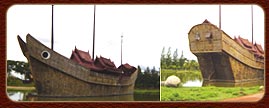
The significance of Ayutthaya and Bangkok lies in their status as major cities situated along riverbanks, where long-distance sea trading ships could dock. This made them prosperous port cities for trade and international transportation, in addition to serving as capitals, the administrative centers of the kingdom. Furthermore, Thailand built seagoing vessels to carry Thai goods to overseas markets. The image shown depicts Thai junks that once docked along the Chao Phraya River, from the river mouth up to Bangkok. This type of vessel gradually disappeared around fifty years ago. (Image courtesy of Muang Boran)
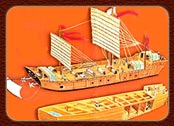
A cross-sectional view of a Thai junk, adapted from Chinese junks, shows distinctive differences in the construction of the keel and frames. The carvings and paint decorations on the bow and stern are also characteristic, often in bright, striking colors. This illustration of a Thai junk was drawn from a replica, based on line drawings found in Japanese trade records from around the mid-22nd Buddhist century. (Image from the book Boats: The Culture of the Chao Phraya River Basin People)
Note
Trade using Chinese-style junks in the Chao Phraya River basin has evidence dating back as far as the (Sri) Dvaravati period, when the region served as a central state for international trade in Southeast Asian waters, continuing through the Sukhothai, Ayutthaya, Thonburi, and Rattanakosin periods (Ship: The Culture of the People of the Chao Phraya River Basin, 2002: 15–16).
From foreign trade records of the early Rattanakosin period, junks—called samphao or royal junks—were used. In the reign of King Rama I, there were two royal junks, Husong and Royal Messenger. Privately owned junks belonged to both high-ranking nobles and merchants. It was said that Phraya Khlang (Khun), later Chao Phraya Rattanathibet of the Rattanakul lineage, had more junks than anyone else and was so wealthy that he became known as the samphao trading magnate.
Sethakoses explained the features of the junks as follows: the prow, which juts forward, was called the fish mouth, with centipede flags on both sides. Further inward from the prow were the painted “eyes” in black and white. The bow was covered with paper inscribed with Chinese characters: one side read Leng Thao Cha Kim Kak, meaning “dragon head sprouts golden horns,” and the other side read Hou-Keo Ngow Ngeng, meaning “elephant mouth sprouts silver tusks.” The cut at the front, just below the fish mouth, was painted red, with a central board shaped like a lion to bridge the fish mouth. In the middle was a white-painted circle, etc. The stern was also painted red with a white circle, under which were Chinese characters stating the name of the ship. The captain, called Junju, had full authority over all goods. Navigation was the responsibility of the Hojang or Tonhon, while the Taikong, who in modern fishing vessels is the chief, at that time was in charge of the stern.
Junks would sail into the bay three to four ships at a time around March or April, following the northeast monsoon blowing south, and depart around July–August to catch the southwest monsoon blowing north. The junks docked along the Chao Phraya River near the mouth of Khlong Ong Ang to the west, arranged in two rows with bows facing the river mouth. Ships arriving later would be greeted by those already docked with a timalo signal of three strokes. When unloading, officials such as Khun Thongwaree or Khun Phakdi (Sethakoses could not recall clearly) would “step on the prow.” Sir John Bowring recorded that every junk carried goods to present to the king and ministers.
The junks functioned like department stores: the crew displayed their goods for sale, and Thai buyers would flock to choose and purchase for two months, until May, June, and July, after which the junks would sail out of the bay, most heading to China.
During the reign of King Rama III, the number of junks declined, leading to the prediction that junks would soon disappear. A pagoda with a junk-shaped base was built at Wat Khok Krabue, renamed Wat Yannawa.
The prophecy came true: the last junk, Buan Heng, owned by Phraya Phisan Phonpanich (Jin Shu Phisanbutr) (or Jin Shu Phisanbutr), sank in the middle of the sea in 1874 (Ship: The Culture of the People of the Chao Phraya River Basin, 2002: 22). However, the samphao trade continued, shifting to Western-style steamships. To solve difficulties entering China, bamboo panels were used to create ship decks, and steamships were modified and decorated to resemble junks so that Chinese officials allowed them to trade more easily. Later, further adaptations were made: the bow was junk-style, and the stern was steamship-style, called a “hybrid steamship,” known locally as Ruea Kampan Buai, which further facilitated trade with China (Baray, 2004: 5).
9.2.2 Long-term measures to alleviate famine and shortages among the people are as follows:
1. King Taksin of Thonburi promoted and supported foreign trade, especially with China, due to shortages of consumer goods within the country. Trade also provided significant profits. Therefore, supporting international commerce became a key factor in restoring the country’s economic status. King Taksin encouraged samphao trade by sending royal junks to trade with multiple foreign nations, such as China and India; at times, as many as eleven royal junks were dispatched. The main goods included forest products, animal hides, tin, ivory, and logs (Suree Phumiphom, 1996: 78–79). In addition, foreign junks, including those from China and Java, came to trade with Thonburi. Profits from trade strengthened the economy and helped reduce the burden of revenue collection through taxes.
2. He created prosperity for the people and prevented potential shortages, such as:
– 2.1 During the winter, when there was no warfare, he ordered the construction of roads to facilitate travel and trade for merchants and the public, as well as communication between communities. Previously, roads had rarely been built, so King Taksin can be regarded as a very progressive monarch.
– 2.2 In years of drought, when food became scarce and expensive, such as in 1768 (B.E. 2311), when rice cost 2 chang per cartload (160 baht), he ordered officials to organize the cultivation of off-season rice across all villages and districts on a large scale, so that people would not have to compete to buy rice from the populace, which would further burden them (Sanun Silakorn, 1988: 36–37).
– 2.3 He encouraged the planting of mulberry trees for silk production, and the production of tobacco, wax, and lacquer as export commodities (Suree Phumiphom, 1996: 78–79).
Promotion of Rice Cultivation
When the country was peaceful and free from enemy disturbances, the people could return to their normal occupations. In particular, rice farming, which had long been the mainstay of Thai society, received careful support from the government at that time. This also helped alleviate the shortage of food for the populace considerably.
Later, in 1771 (B.E. 2314), he ordered a large-scale expansion of rice fields by converting garden lands into paddy fields near the capital, outside the city moats on both sides (east side – Phra Nakhon side, west side – Thonburi side), which were called “Thale Tom”. This also served a strategic purpose, providing space for encampments to defend the capital if enemies approached.
After the campaign against Awa Xuanqi in the northern cities in mid-1776 (B.E. 2319), he ordered the entire army to assemble at Thonburi, and had generals lead their troops in rice cultivation.
For example, Chao Phraya Chakri, Chao Phraya Surasih, and Phraya Thamma were assigned to oversee all troops farming on the east side of Thonburi. In addition, Phraya Yommarat and Phraya Yaratcha Suphawadi were assigned to cultivate fields in Krathum Baen, Nong Bang, and Nakhon Chai Si districts. The areas where officials supervised rice cultivation were in the Thale Tom fields outside the eastern city moat. During peacetime, soldiers were also encouraged to return to their home villages to farm.
“He ordered people to leave their duties at the fortifications and return to cultivate the fields in their local areas … and since the Burmese did not follow closely, it was the right season for farming, so he disbanded the army at Phichit and Nakhon Sawan.” Encouraging the populace to return to cultivation ensured there was enough food for the kingdom’s people. The labor force for farming during the Thonburi period
In addition to Thai commoners, labor was also obtained from Lao and Khmer people obtained through territorial wars. For example, in 2317 BE (1774 CE), about ten thousand Lao captives were taken; in 2321 BE (1778 CE), more than ten thousand Khmer; and in 2322 BE (1779 CE), a large number of Lao were relocated. These captives were settled to cultivate the land in Phetchaburi, Saraburi, Ratchaburi, Chanthaburi, and western towns. Additionally, some Chinese groups engaged in farming, such as areca nut and pepper cultivation, along the eastern coastal towns and in the south (Sukhothai Thammathirat Open University, 2003: 359).
On the eastern bank of the river, cultivation extended continuously to the fields of Bangkapi and Samsen, while on the western bank, it reached Krathum Baen, Nong Bua, and the Nakhon Chai Si district. Bangkok thus became a major new rice-producing area in central Thailand from that time onward.
Summary: Once the general situation improved, King Taksin of Thonburi further supported the kingdom in various ways, providing abundance and well-being for the people, including building roads to facilitate transportation.
At the beginning of his reign, the economic and social conditions were extremely poor. He sought to solve these problems both by alleviating shortages—through the distribution of food and essential goods—and by revitalizing the economy through trade. This also increased the migration of Teochew Chinese into Siam; these migrants had strong commercial knowledge, which reduced the influence of the Hokkien community that had been prominent since the Ayutthaya period (Suree Phumiphamorn, 1996: 80). Additionally, he promoted production, gradually bringing the economy to a stable and improved state that continued into the Rattanakosin period (Royal biography and achievements of King Taksin the Great, in the commemorative book for the cremation of Ms. Phan Na Nakhon, 20 September 1981: 6).