
His Majesty King Bhumibol Adulyadej The Great
Chapter 22: Royal Speeches and New Year’s Blessings
1. Royal Speeches Filled with Wisdom, Bringing Joy and Contentment to All Subjects
His Majesty King Rama IX possessed exceptional wisdom in delivering royal speeches, combining keen intellect with a sense of humor. His judgments were guided by reason and were always appropriate, harmonizing both worldly and moral principles. He consistently alleviated tension, ensuring that everyone who had the opportunity to be granted an audience felt at ease and comforted, as illustrated in the following excerpts.

Story 1
One day, His Majesty King Rama IX visited his subjects in a province. As usual, many villagers came to welcome him. At the front of the line, an elderly woman knelt to pay respects at his feet and held his hand, saying, “I’m so happy to see you, Your Majesty,” and went on chatting at length. His Majesty remained silent at first, not responding, which made his attendants exchange uncertain glances, wondering if he was pleased. But when they heard his reply, they could hardly contain their laughter. His Majesty said, “Call you ‘grandmother’? You’re much younger than my mother! You should be called ‘aunt’ instead.”
Story 2
His Majesty visited Sakon Nakhon Province to meet the villagers. He asked a man who had come to pay respects, as the man’s arm was in a cast, “How did your arm get hurt?” The man replied, “I fell from a bridge.” His Majesty then said with a smile, “Only this arm fell, not the other one,” causing everyone around to laugh.
Story 3
His Majesty visited the southern province of Narathiwat, where the soil has problems with acidity and salinity. He asked the villagers who came to pay their respects, “How is the soil behind your houses? Is it salty?” The villagers looked at each other in confusion and respectfully replied, “I’ve never tasted it.” His Majesty then remarked to the royal attendants, “The villagers here have a good sense of humor.”
Story 4
Many years ago, His Majesty had a minor skin problem, and a dermatology team came to offer treatment. One doctor, an expert in dermatology but unfamiliar with royal terminology, respectfully asked, “Uh—Sir, have you had this itching (on your abdomen) for a long time, Your Majesty?” His Majesty smiled and replied, “I’m not a woman, how could I be pregnant?” Understanding that the doctor might not know the correct royal terms, His Majesty graciously allowed, “Alright, let’s speak in English.”
Another time, while still enjoying his traditional herbal medicine, His Majesty was about to light it but had not yet done so. Someone present knelt, offered a lighter, and respectfully said, “May I offer the fire, Your Majesty?” His Majesty laughed heartily and humorously said, “Not yet… not yet… I’m not dead yet!”
[Stories 1–4 from Varada, 15 Nov 2001, 23:23:41]
http://pantip.inet.co.th/caf?/rajdumnern/topic/P1186435.html
Story 5
On one occasion, an honorary Doctor of Laws degree was conferred, and His Majesty told a close royal attendant, “Now I have become a doctor of law.” Later, when an honorary Doctor of Medicine degree was conferred, he said, “Now I have become a doctor of medicine.” A little later, when an honorary Doctor of Music degree was conferred, he said, “Now I have become a ‘Molam’ doctor.” (Wilas Maneewat, 2000: 10)
Story 6
Police Major General Suchart Phueaksakorn recounted His Majesty’s brilliance in communication as follows: One evening, it was discovered that the joint communication network of the Royal Police, well known within the service, was so overloaded that it was impossible to contact either fixed or mobile relay stations for an extended period. Communication across the network had to be completely halted, causing considerable confusion for those responsible. Upon His Majesty’s awareness of the situation, operations to inspect and locate the local relay transmitters began near dusk.
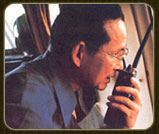
After a lengthy inspection of the two fixed relay stations, an approximate location was determined: the radio station jamming the “Pathumwan” police network was situated southeast of Bangkok. The measured signal was very strong, suggesting that the station was not far away. By comparing the lines on the map—one drawn from His Majesty’s Chitralada Royal Residence and the other from my residence at the Police Communications Division in Bang Khen—the estimated location fell around Bang Phli District, Samut Prakan.
His Majesty then instructed me to bring the necessary equipment, and my wife accompanied me on the trip. During the journey, I felt a mix of exhilaration and confidence, convinced that the mission would be easily accomplished. I periodically checked the coordinates with His Majesty to ensure that I was following the correct route. I arrived at Bang Phli Market around midnight, on a completely dark waning moon night. The area was famously infested with mosquitoes, which swarmed in clusters. Once I reached a suitable location, His Majesty instructed me to measure the signal strength and use the portable antenna to determine the direction of the source.
As it was impractical to remain inside a car with the windows fully closed and the air conditioning on, I therefore took the equipment outside to conduct the inspection, in accordance with His Majesty’s instructions, with great endurance despite the constant disturbance of swarms of mosquitoes that relentlessly took turns attacking me. While I was performing duties outside the vehicle, radio communication between His Majesty and myself had to be conducted using a portable transceiver, or Handie Talkie. The following is an example of our exchange:
“KS 1 from KS 9, W 2.”
“KS 1, W 2—oops!”
“KS 1 from KS 9, what happened?”
“KS 9 from KS 1, several mosquitoes flew into my mouth.”
(Sound of His Majesty’s laughter) “KS 1 from KS 9, permission granted to enter W 4 (the vehicle).”
As dawn was approaching, His Majesty then ordered the temporary suspension of the search, remarking, “… For W 4 (operations) to be effective, it is necessary to establish a fixed station at Bang Khen (my residence) to operate jointly with another station. The point of intersection between the cooperating stations will then become more precise …”
From the article “His Majesty King Bhumibol Adulyadej’s Genius in Communication Technology (Radio Direction Finding)” (http://www.dabos.or.th/ro5.html: November 28, 2001: 7–8)
Topic 7: The Royal Speech in the United States
H.S.H. Princess Vipavadee Rangsit (then holding that title) recorded in “The Royal Visit to the United States, 1960” as follows:
His Majesty King Bhumibol Adulyadej graciously responded in substance:
“… I acknowledge the host’s statement that Thailand is a country worth visiting, and as for the suggestion that I might be eligible to run for President of the United States because I was born in Cambridge, Massachusetts, I also accept that; however, that right is now nullified, as I am reigning as King of Thailand …”
“… I do not quite understand why it is said that the Gold Rush in San Francisco is over, when I have seen the Golden Gate Bridge, the gold in people’s hearts, the black gold in the ground (oil), and also the gold in the banks—since San Francisco is known as the city of banks …”
This royal speech lasted five minutes longer than usual, and the audience responded with laughter and applause. (Vipavadee Rangsit, 1960: 138)
Story 8: The Royal Speech on the Pelican
“… Five years ago (1992), it was reported that there was one pelican in the Chitralada Villa. Three more were then purchased, making four in total. These pelicans later had offspring and invited their friends to join them. One day, fifteen were counted, which meant they must have been happy. But today, in this pond, only one remains floating, as the others have probably gone to visit relatives or started new families and must now take care of them. The one that remains has been named Khun Smith, and in this meeting it was mentioned that the Meteorological Department had forecasted the weather, and Khun Smith himself once wondered why the forecasts were so accurate. We never told the real Khun Smith that there was a pelican named after him, because we did not dare, but now that the real Khun Smith has retired from his position as Director-General of the Meteorological Department, it can be said that the remaining pelican, Khun Smith, is the weather forecaster …” (The Benevolent King Who Cared for All Living Beings, 2001: 34)


Spot-billed Pelican
Scientific name: Pelecanus philippensis
Story 9
H.S.H. Prince Bhisadej Rajani recounted the following story about the use of spoken language with the hilltribe people:
“… It should be explained why the officer who was conveying His Majesty’s instructions used such simple words when speaking to the hilltribes. When the lecturer began, he said, ‘The pigs must receive sufficient food to meet the needs of their bodies’… But His Majesty, perhaps concerned that the hilltribes might think the word ‘pig’ referred to an ordinary small dog, thus said to the astonished hilltribe man, ‘Pigs must be well-fed.’ His Majesty served as an interpreter, translating Thai into simpler Thai several times, until Professor Sangvien began using more ordinary words in his explanation—for example, when speaking about a pig’s diarrhea, he would use even simpler terms.”
The author further related, “I humbly suggested that a male pig with 50% foreign blood should be presented to the hilltribes, so that it could mate with the sows whose bellies dragged on the ground even though they were not yet pregnant.” … “That idea about the pigs was, in truth, good, but far too small to be useful, because if the hybrid pigs were not properly fed to ‘meet the needs of their bodies,’ they would become thin, and worse still, when deprived of protein, they would help themselves by biting and eating the villagers’ chickens—so much so that the hilltribes became frightened and believed them to be ghost pigs.”
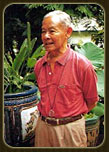
H.S.H. Prince Bhisadej Rajani
When His Majesty visited the hilltribe people, He always received their petitions. The most unusual was a petition from a hilltribe woman named Ee Hua (the prefix “Ee” was understood to be part of her name). It began with Ee Hua complaining to Her Majesty the Queen. Her Majesty then passed the case to the highest court, which was His Majesty King Bhumibol Adulyadej.
Ee Hua already had one child, but her husband had gone to live with another woman and no longer provided her with food or support. She wanted to separate from her husband, saying, “I can take a new husband,” but her husband refused to allow the divorce.
When the court summoned the husband to give testimony, it was revealed that he had purchased Ee Hua on an installment plan—having paid one pig, owed roughly two chickens, and a small amount of silver coins from Burma. If they divorced, he would lose the pig. There had been negotiations to return the pig, but Ee Hua’s father was unwilling, unwilling to exchange his daughter for the pig.
Ordinary courts might have had the power to impose fines, but His Majesty King Bhumibol Adulyadej instead graciously granted compensation to the defendant, Ee Hua’s husband, which was very unusual.
The peculiar story continued, though the author was unsure whether it was appropriate to tell. The magazine “Sawadee” of Thai Airways had already published it, albeit with inaccuracies, so the author took this opportunity to critique Thai Airways, especially since the true events were more interesting.
In truth, when the author later visited the hilltribe villages, people asked, “Did the King really take a hilltribe wife?” H.R.H. Princess Maha Chakri Sirindhorn confirmed recently that the story had spread as far as the hilltribes in Laos.
Therefore, the author had to report that regarding the purchase of Ee Hua, the royal command was, “I give her to you, Phisadej.”
Since then, whenever the author visited Ee Hua’s village, Khun Wang, he would lay out his sleeping bag at the village headman’s house, offer food to the hilltribes, and share meals together. Ee Hua, who lived in a separate house, would bring delicious food such as stewed muntjac, in her role as a dutiful wife. The story did not end sweetly like a tale for reading, because when the author did not go to Khun Wang for some time, Ee Hua went to “take a new husband” without returning the pig to the author, which was quite sad. Nevertheless, other events occurred that brought much warmth to the author’s heart.
One day at Doi Inthanon, the author carried a heavy backpack filled with food, pots, clothes, and a sleeping bag, walking from the Karen village at Tha Fang, across the mountains to Khun Mae’s middle house, and then climbing eastward to reach the destination—Mae Ya Noi hilltribe house at night. At the headman’s house, which the author had never known before, he offered food, laid out his sleeping bag, and, exhausted, fell asleep immediately using his clothes as a pillow, waking only when roused to eat.
That night, the village headman told the author, “Phaja, Phaja, we will provide you with a hilltribe girl. When you climb the mountain, she will carry your things. When you are hungry, she will prepare your meals. When you sleep, you will not feel cold.” This was an extreme display of generosity, which made the author feel very sorry to have to decline.
The author replied, “I must visit many mountains and meet the Lahu, Karen, Muser, Lisu, and Kachin. If I take a hilltribe girl to the Muser village, they will be upset. Wherever I go, I would have to bring six or seven wives, which would cost a lot of money. The King would be displeased.” This was a clever pretext, and the village headman did not feel offended.
Story 11
When His Majesty King Bhumibol Adulyadej visited AIT and observed the judging of an art competition on royal projects organized by AIT, Suwicha (1992: 107) recounted in the book Tawan Song La that…


At one point, I heard Dr. Suwit Yodmani respectfully tell H.R.H. the Princess Mother, Princess Srinagarindra, that he preferred the painting that had won second prize, and H.R.H. agreed. His Majesty King Bhumibol Adulyadej then turned and remarked, “Being at a high place, the mouth appears a little crooked.”
Arriving at the third painting, which depicted “His Majesty” holding a map of Thailand in His hand—likely meant to show that He bore the responsibility of the entire country—H.R.H. the Princess Mother asked, “Is it heavy?” He made a strained expression and replied, “Very heavy.” In another painting, many people were depicted, and in the corner was a small figure within a family; “His Majesty” nudged the Princess to look and said, “Here is the small person,” pointing to both the royal daughter and the small figure in the painting. In a painting some critics said showed excessive perspiration, He remarked, “It’s raining,” and in another depicting “His Majesty” on an elephant, He smiled and said, “I only rode once at Phu Kradueng.”
Another child’s drawing depicted a mountain with ghosts on it, and above the clouds and the ghosts was a portrait of “His Majesty.” “His Majesty” remarked, “The hilltribe people say the King must be above the ghosts.”
Story 12
When the Bangkok flood occurred in 1983, Suwicha (1996: 29) wrote as follows:
“We went to Bang Khun Thian. The car stopped at the pier, and we stepped onto a narrow pier—not very wide. Standing there, observing, we heard the sound of a train approaching. We then realized the car had been parked on the railway tracks, so it had to be moved to allow the train to dock. People were boarding and disembarking, many on their way home, taking the train. Some were simply staring, probably thinking they recognized the face, and then realized it was the King standing there. They stared so much that they forgot to board the train, and it left without them. When asked how they would get home, they said they would have to walk back, wading through the water—it was terrible …”
“At Bang Chak—but not really leaving, as mosquitoes were everywhere. While standing and looking at the map, both legs were swarmed and bitten. When returning, the legs were swollen and red; only after coming back from Sakon Nakhon did the swelling subside. I could see red bumps, about one hundred and fifty on each leg, exactly three hundred in total. The mosquitoes were really vicious. I used your map, waving it to shoo them, but still got bitten.”

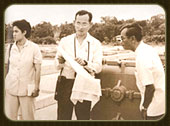
His Majesty the King recounted a story about visiting the flood-affected areas to observe the situation firsthand, in order to provide royal guidance on how to address the problem.
Story 13
When His Majesty presided over the opening ceremony of Suan Luang Rama IX, it was recounted that…

“… When His Majesty arrived at this garden (the Romanee Garden, designed as a water garden with aquatic plants allowed to grow naturally to attract water birds), He remarked to Privy Councillor Kamthorn, ‘This is well done, but do not make it so shallow that it becomes a breeding ground for mosquitoes; otherwise, it will just end up raising mosquitoes.’ He smiled, showing His sense of humor.” (Suwicha, 1996: 97)
Vilas Maneewat (1998: 31–35) wrote as follows:
Regarding the use of royal language, it is not only villagers in Roi Et or Thung Song who feel nervous; even university professors can be hesitant, unsure whether they are using it correctly, so they stammer.
Once, during a royal audience with a group of rural citizens, a middle-aged man spoke clearly and precisely, using elevated language. Queen Sirikit, the Queen Mother, asked him whether he had ever been inside the palace, since he spoke royal language so fluently.
The man replied, “Your Majesty… by the grace of the King, I used to be a lead actor in the likay theatre, Your Majesty.”
The secret was immediately revealed, causing the entourage following the royal procession to burst into laughter.
Regarding the King’s sense of humor, M.L. Pin Malakul recounted that at one year’s commencement ceremony at Prasarnmit University, after conferring degrees, His Majesty asked M.L. Pin, “Today, how many kilos of diplomas have I given?” M.L. Pin hesitated because the ministry officials and deans had not weighed the diplomas beforehand.
The following year, at a similar occasion, the university prepared by weighing all diplomas in advance, and M.L. Pin reported loudly, “Today, Your Majesty graciously conferred a total of 230 kilograms of diplomas.” Immediately, His Majesty asked, “How many calories must I consume to compensate for the energy expended?”
On another occasion, after climbing a large mountain ridge, someone asked the King which peak was higher—the one climbed the day before yesterday or the current one. The King replied, “The one the day before yesterday was higher, because I ate five Indian gooseberries before reaching the summit… but today, only three were needed.” These are some examples of His Majesty’s humor.

Malccea Tree
Scientific name: Phyllanthus emblica Linn.
Even during His Majesty’s illness in mid-July 1982, when He had a high fever and His heartbeat was irregular, He maintained His sense of humor throughout. As a musician, He told the doctors that the rhythm of His heartbeat resembled a 5/4 time signature in music, and after recovering, He composed a jazz piece in 5/4 time, giving it the title High Fever!
During the course of treatment, the medical team had to draw His blood almost daily, between 50 and 100 cc each time. Even while ill, His Majesty remained focused and cheerful, and after His condition improved, He humorously teased the doctors, remarking that this medical team treated Him in the old-fashioned way without administering any medicine… instead, they relied on bloodletting.
Long live His Majesty’s sense of humor!
2. Even though it is a tale passed down for a long time, we remain ever mindful with cheerful hearts.
Story 1
In the Royal Ploughing Ceremony of 1960, which was the first year that His Majesty graciously appointed Mom Chao Chakrapan Pensiri Chakrapan, then holding that rank (now elevated as Phra Chao Worawong Thoe Phra Ong Chao Chakrapan Pensiri), as Director-General of the Rice Department and Royal Ploughman, with the Rice Department serving as the main organizer, the Livestock Department provided a pair of white Lamphun cattle, a native white breed. At the start of the ceremony, photographers crowded in for close-up shots and used numerous flashes, which startled the two cattle, who had not been trained to pull the plough, causing them to bolt from the plough, and the officials had to drag the plough themselves to complete all nine rounds of the ceremony. The following year, the Livestock Department took special care of the cattle intended for the royal ceremony, training them thoroughly in ploughing, and also trained another pair as reserves for the ceremony.
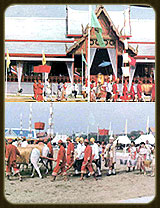
Royal Ploughing Ceremony and the First Ploughing of the Rice-Planting Season
From the book The King Who Cares for All Living Beings, Kasetsart University conferred an honorary Doctor of Veterinary Medicine degree upon His Majesty King Bhumibol Adulyadej (Rama IX) on 19 July 2001, as presented by Privy Councillor Mr. Amphol Sena Narong (2000 [2001]: 18).
Story 2: During the Visit to the United States
Mom Chao (Princess) Vibhavadi Rangsit (her title at the time) wrote about the visit to the state of Hawaii as follows: After the meal, Mr. Killingham rose to address His Majesty at the table, and before he could finish, he walked to the doorway to continue speaking, then somehow ended up speaking on the terrace, and after a while returned to continue indoors. His remarks were therefore interrupted in parts, but it could be understood that the businessman spoke about politics and the human world deteriorating. His Majesty responded to comfort him, saying not to think only of bad things, for there are plenty of good things and good people in the world, and then offered a royal toast to the businessman and his wife. The wife was deeply moved by His Majesty’s words, but the businessman, apparently hard of hearing, bent down to mutter to his large dog, which even looked up as if listening. The lady, being sensitive, almost burst into laughter upon seeing the scene (Vibhavadi Rangsit, M.C., 1960: 2).
Story 3
Mom Chao Vibhavadi Rangsit wrote about the moment His Majesty received bouquets of flowers that Her Majesty the Queen had accepted from well-wishers: “In this city, they presented very large bouquets. On that particular night, someone offered a bouquet of roses (to Her Majesty the Queen), the number of dozens unknown, a long and heavy bouquet. Upon receiving it, one could hardly see the way, and with three bouquets at once, it appeared as if a rose bush full of flowers was walking” (Vibhavadi Rangsit, M.C., 1960: 24).

Story 4
Mom Chao Piset Ruchanee wrote in the book His Majesty King Bhumibol Adulyadej (Rama IX) and the Royal Projects, presented on the occasion of the Royal Coronation Ceremony, regarding the giant catfish at Chitralada Palace.
“One day, His Majesty was observing a small green micro boat in the canal next to the cattle grazing fields of Chitralada Garden. As the boat moved toward the shore, several cows stood nearby, and His Majesty remarked that the cows seemed to think the green boat was grass and were going to eat it.”
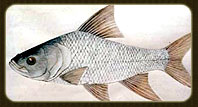
In another incident, a fish struck the royal micro boat, making it tremble. His Majesty thought that although the boat was small (less than eight feet), the fish must be very large. He instructed Khun Preeda Kransuth, then Director-General of the Department of Fisheries. A netting operation caught a giant catfish, nearly extinct, exciting the fishing community. Khun Preeda was privately nicknamed “Palat Kahoh” and later became Permanent Secretary of the Ministry of Agriculture and Cooperatives (1988: 23).
Story 5: His Majesty King Bhumibol Adulyadej (Rama IX) and the Four-Legged Friends, a story told in several parts, as recounted by a veterinarian.
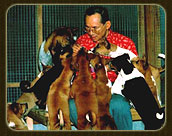
Within the grounds of Chitralada Palace, besides being the birthplace of numerous royal initiatives that greatly benefit the Thai people, the palace is also home to thirty-four “Khun” (four-legged companions), who contribute to the joy and happiness of His Majesty King Bhumibol Adulyadej (Rama IX).
The stories of each “Khun” reveal the compassionate heart, sense of humor, and linguistic ingenuity of His Majesty King Bhumibol Adulyadej (Rama IX), making the deep respect and affection of the Thai people for him even more evident.
Chapter 1: A Bright New Morning … of “Khun Mali”
Originally, within Chitralada Palace, there were only four “Khun”: “Khun Sudlo,” “Khun Muu,” a Dalmatian, and “Khun Suzie” and “Khun Cookie,” both Cocker Spaniels.
One day … a long-haired white street dog, previously called “E-Mali,” slipped into the enclosure of the “Khun” during her heat period, ready to mate. “Khun Sudlo” and “Khun Muu” then mated with her.
When palace staff saw “E-Mali,” they took her to the Bangkok authorities. Upon learning this, His Majesty commanded that the wives of “Khun Sudlo” and “Khun Muu” be brought back and cared for, elevating Mali from a street dog once called “E-Mali” to the esteemed “Khun Mali.”
During the period when “Khun Mali” was brought back to be cared for and treated for mange, she was left at Kasetsart University Veterinary Hospital. “Khun Mali” gradually regained her health, the mange disappeared, and it turned out that she was pregnant, eventually giving birth to nine puppies, offspring of “Khun Sudlo” and “Khun Muu” (since both were Dalmatians and took turns mating, it was impossible to tell which puppy belonged to whom).
Dr. Nopkrit Chantik, the veterinarian at Kasetsart University Veterinary Hospital who, along with the veterinary team, helped care for His Majesty King Bhumibol Adulyadej’s dogs, recounted that
after “Khun Mali” had delivered her puppies for one week, the veterinary hospital sent “Khun Mali” and her puppies back to the palace, where her family brought great joy to His Majesty.
Dr. Nopkrit related, “… Once the nine puppies arrived at the palace, His Majesty was greatly delighted. He personally came to take photographs of all nine puppies every day.
… During the birth period, His Majesty was very meticulous, instructing that the date and exact time be recorded to the minute, and that the birth weights be measured and reported to him.
… After that, the puppies’ weights had to be measured daily and reported to His Majesty.”
Even later, after His Majesty had bestowed the puppies of “Khun Mali” to palace staff carefully chosen for their genuine love of dogs, he continued to express concern, requesting that photos of the puppies be sent and that their weights be measured and reported at least once a month.
Chapter 2: “Khun Thongdaeng” … the Royal Dog
Shortly after “Khun Mali” had her newborn puppies, “Khun Thongdaeng,” a local mixed-breed puppy (the name derived from the word “municipal”), was brought to reside at Chitralada Palace.
Originally, “Khun Thongdaeng” was the offspring of “Nang Daeng,” a stray dog near Rama 9 Road. A veterinarian brought “Thongdaeng” to present to His Majesty King Bhumibol Adulyadej when he visited to inaugurate the Rama 9 Medical Center.
Upon seeing “Thongdaeng,” His Majesty instructed that the puppy be taken in and raised, as “Nang Daeng,” the mother, was in poor condition and unable to care for her young. His Majesty then made “Khun Thongdaeng” a foster child of “Khun Mali,” since the puppy was only a day younger than Mali’s own nine puppies. “Khun Mali” welcomed the newcomer warmly, showing no aversion, and cared for “Khun Thongdaeng” as if it were her own.
With the addition of “Khun Thongdaeng,” “Khun Mali” now nursed ten puppies. Because she was healthy and well-nourished, she had sufficient milk to feed all ten.
Dr. Nopkrit recounted, “His Majesty often praised ‘Khun Mali’ as an exemplary mother dog, noting her lack of discrimination or disdain toward ‘Khun Thongdaeng,’ a puppy that was not her own.”
On many occasions, His Majesty used the story of “Khun Mali” as a moral lesson for people, showing the virtues of care and generosity.
Once a stray whose siblings were killed by passing vehicles, “Khun Thongdaeng” came to live in the palace, while “Nang Daeng” was later taken in and lovingly cared for by others.
Within the palace, “Khun Thongdaeng” became a favorite of His Majesty, admired for her intelligence and endearing character.
Dr. Nopkrit continued, “Khun Thongdaeng’s intelligence was remarkable. Whenever His Majesty called her for weighing, she would immediately step onto the scale. If her body blocked the view, she would adjust her position so that His Majesty could clearly see the scale readings.”
… Or, when His Majesty moved to stay at Phiamsuk Residence, Klai Kangwon Palace, bringing the royal dogs along,
… during walks along the coconut-lined beach, a simple command to circle a coconut tree would have Khun Thongdaeng run around it immediately, without any prior training, while the other dogs played freely.
… Halfway around the tree, Khun Thongdaeng would pause and look back at His Majesty, as if asking, “Did I do it right, Your Majesty?” Upon receiving a nod, she would continue walking or running.
… Khun Thongdaeng never sought to cling to His Majesty. During walks, she would lead in front; when he sat, she would lie down in a prostrate position with her front legs crossed like a human bowing, keeping her gaze outward, alert to the surroundings.
For these reasons, Khun Thongdaeng was honored with the title “the Royal Dog.”
Chapter 3: Khun Thongthae, companion of Khun Thongdaeng
After acquiring Khun Thongdaeng, His Majesty developed an interest in Basenji dogs, a breed with a facial appearance resembling that of Khun Thongdaeng.
The Basenji breed originally comes from Central Africa, later brought across seas to Europe and America. It is believed to be a breed dating back to ancient Egypt (we can see depictions of Basenjis on pyramid walls, with human bodies and dog heads—the dog head represents the Basenji).
Dr. Nopkrit said, “One day, His Majesty opened a book and saw that the Basenji looked very much like Khun Thongdaeng. He noted the similarity in breed.”
… But Khun Thongdaeng was a slightly larger dog, so His Majesty officially gave the breed a name. Previously, he had jokingly called it “Thousand Ways,” sometimes “Middle Road” or “street middle,” but it became known as the Thai Super Basenji.
… Whenever His Majesty took an interest in something, he would research it thoroughly. In the case of Basenjis, he was so engaged that he almost compiled a CD-ROM on the subject.
… One day, I encountered a Basenji in Germany and brought it to present to His Majesty, who bestowed the name “Khun Thongthae.”
However, Khun Thongthae arrived in Thailand at eight months old, already grown. She was a timid dog and would hide under tables and chairs whenever called to an audience. His Majesty then remarked that her name would be changed from “Khun Thongthae” to “Khun Aimud” (the Hider).
From that time on, Khun Thongdaeng had a new companion. Originally paired with Khun Thongdam, a daughter of Khun Mali, Khun Thongdaeng became the mate of Khun Thongthae instead, replacing Khun Thongdam.
Chapter 4: The Story of … “Khun Luang Jam Phakdi”
On one occasion, when His Majesty King Rama IX relocated to stay at Phiamsuk Palace, Klai Kangwon Palace, Hua Hin District, the staff brought local villagers along with a Saint Bernard dog to pay respects.
The owner of the Saint Bernard requested royal permission to present the dog, named “Sir James,” to His Majesty, because the dog liked to sneak into the palace to sleep. Each time palace staff saw him, they would return him to his nearby owner, yet soon after, Sir James would slip back into the cool palace to rest again.
This happened three or four times until finally, the owner realized that Sir James seemed truly devoted to His Majesty and decided to formally present him to the King.
Kittipan Srisawat (2004: 322-323) shared with Ploy Kaem Phet magazine, issue 310, December 2004, the family’s delight over “Luang Jam Phakdi”: “…Before, our house had a Saint Bernard named James. My mother bought him without realizing how big a Saint Bernard grows. At first, he was a cute little puppy. … Once brought home, James was very mischievous—running in and out of alleys, and the Klai Kangwon Palace fence, a simple wire fence with an opening, was right in front of the house. James would sneak in and meet the palace guards, who found him adorable. … He gradually got to know the cooks in the kitchen and was given steak. Seeing all the food in the kitchen, he came every day.
… His Majesty kept about ten small dogs. James would run and play with them and became the leader because he was bigger than the others. The smaller dogs would jump and nibble at his ears and tail, but he did not get angry and acted as a good companion. … The King saw this, took a liking to him, and allowed him to play in the palace. … One day, a palace attendant told our family, ‘Auntie — please keep James at home today. His Majesty is not feeling well, and they are worried James running into the palace might disturb him while resting.’”
… So his mother kept him in a cage for a while, not letting him out. After some time, a palace attendant came running back and said, “Auntie, may I borrow Khun James for a moment?” She asked why, and he replied, “Today His Majesty asked where the big dog is.” So she agreed to send him, and the attendant returned to report, “At five o’clock, he will be received.” That day, James, then about a year old, was presented and later became known as Luang Jam Phakdi, with twelve offspring.
When His Majesty accepted him and bestowed a new name, he said, “As a dog of the King of Thailand, he should have a Thai name.”
From “Sir” (an English noble title), he changed it to “Khun Luang,” and from “James,” he became “Jam.” Thus, Sir James entered the palace with his new royal name, “Khun Luang Jam,” and was also granted the surname “Phakdi.”
In addition to “Khun Luang Jam” receiving a surname, “Khun Thong Daeng” was also granted one. His Majesty gave him the surname “Suwanchad” (Suwan meaning gold, and Chad meaning red).
The naming of these dogs demonstrates the linguistic creativity and insight of His Majesty the King.
For example, the nine puppies of “Khun Thong Kwao” and “Khun Thong Thae” were all given names incorporating the word “Thong” (gold). His Majesty also observed the unique characteristics of each puppy when assigning their names.
One puppy was named “Khun Thong Meed Khuak” because he was the firstborn of Khun Thong Kwao and had to be delivered via surgery, whereas the other two, “Khun Thong Pandun” and “Khun Thong Panchang,” were born naturally.
Similarly, “Khun Sroi Thong” and “Khun Thong Piak” received their royal names because they were the smallest in their litter.
The youngest puppy in that litter was named “Khun Thong Jim” because of a white stripe running from its nose up to its forehead in a wedge shape, with a black spot on its head, as if someone had marked it.
For the nine puppies of “Khun Thong Daeng” and “Khun Thong Thae,” the third litter, all were given names of desserts containing the word “Thong” (gold), including Khun Thong Chomphunuch, Khun Thong Ek, Khun Thong Muan, Khun Thong That, Khun Thong Phlu, Khun Thong Yip, Khun Thong Yod, Khun Thong At, and Khun Thong Nopkhun.
When bestowing a dog to someone, His Majesty did not do so lightly. He carefully selected recipients who could properly care for the dog.
The term “properly,” as used by His Majesty, meant adequately and sufficiently. Therefore, the “Khuns” in the palace, while comfortable and well-fed, with good health, were also trained by Air Force instructors to stand, sit, lie down, wait, and greet on two legs.
Yet, King Rama IX did not favor extravagant or luxurious items for the dogs. Their belongings were kept simple, much like those of ordinary dogs.
Veterinarian Dr. Nopkrit said, “His Majesty always emphasized sufficiency. Even in raising the dogs, he instructed that they must be cared for in a way that is sufficient and appropriate.”
3. New Year’s Blessings
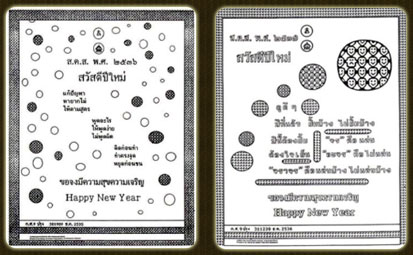
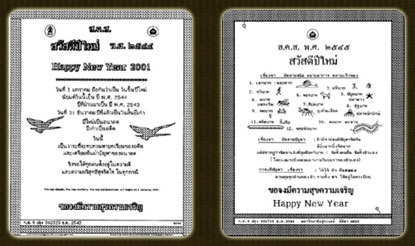
His Majesty King Rama IX would annually bestow New Year’s blessings upon the Thai people through radio and television broadcasts. The first royal New Year’s greeting card (S.C.S.) from His Majesty was issued in December 1986 for the year 1987, and subsequent royal greetings have been compiled from 1988 to the present as follows.
The first edition of the New Year’s card had no decorative patterns around it. The text was brief and concise. Initially, this Royal New Year’s card was granted only to the offices and personnel who served directly under the royal command. It was printed from a computer and then faxed to the relevant agencies.

Since then, His Majesty the King has granted Royal New Year’s cards every year. The messages contained in each year’s card have been drawn from the country’s events, reflecting, in part, the problems and challenges that the nation faced over the past year. Although these greetings were brief, they were rich in value, meaning, and moral lessons, aimed at encouraging the Thai people to remain resilient, courageous, and determined in overcoming future obstacles. The design of the Royal New Year’s cards evolved from the first edition, which had no decorative patterns, to the period between 1989 and 1994 (B.E. 2532–2537), when more elaborate shapes and decorations began to appear, including straight and diagonal lines, stars, and other stylish motifs. From 1995 onwards (B.E. 2538), the designs became increasingly intricate, featuring images of various musical instruments, hearts, and illustrations from the royal literary work Phra Mahachanok, all created by the hand of His Majesty King Rama IX himself.

It is well known that each year’s Royal New Year’s card carries profound meaning, whether through its message, its design, or even its colors. One can clearly observe that the cards His Majesty granted each year are primarily black and white, reflecting His desire to show the Thai people an example of frugality and moderation. Although many items may lack eye-catching colors, they are nonetheless rich in significance. His Majesty sought to ensure that everything served a purpose, valuing simplicity, meaning, and the inherent worth of all things above mere outward beauty or extravagance.